1
Relationship Between Regulation of Polysialic Acid Expression and Brain Diseases.
25.0
AI
E grade · PMID 41917389
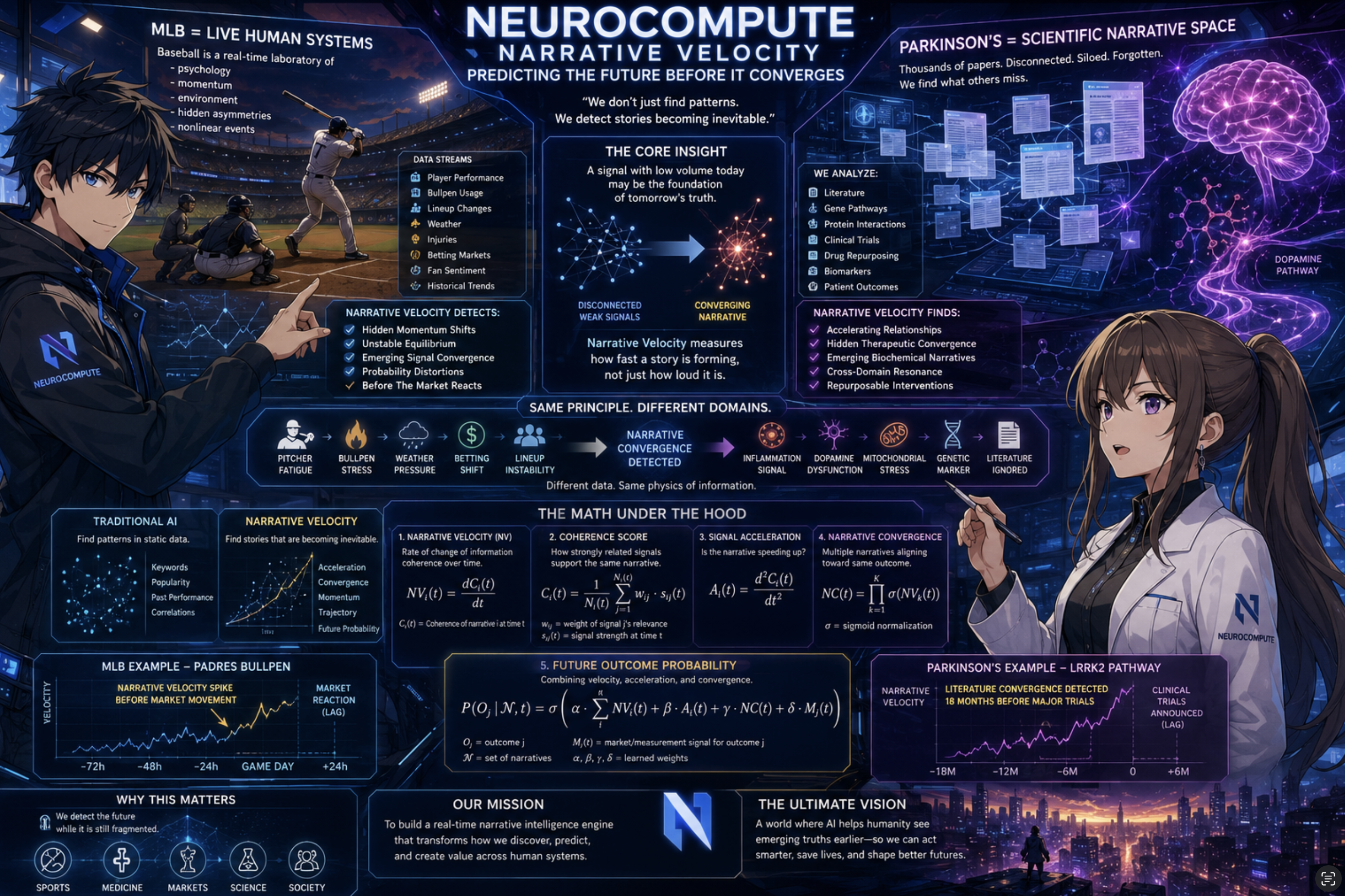
View analysis →Neurocompute scores biomedical literature, surfaces overlooked patterns, and turns Parkinson’s research into a living discovery terminal.
E grade · PMID 41917389
View analysis →E grade · PMID 42043759
View analysis →E grade · PMID 42037593
View analysis →E grade · PMID 41979429
View analysis →E grade · PMID 41949409
View analysis →E grade · PMID 41911604
View analysis →E grade · PMID 42016532
View analysis →E grade · PMID 42024677
View analysis →E grade · PMID 41929954
View analysis →E grade · PMID 41937501
View analysis →This review summarizes evidence linking polysialic acid (polySia), its synthase ST8SIA2, and the sialidase-mediated degradation pathway to psychiatric and neurodegenerative disorders including Alzheimer’s and Parkinson’s disease, with emphasis on connections to neuroinflammation.
Highlights a biologically plausible but underexplored pathway (polySia/ST8SIA2/sialidase) that could yield biomarkers or enzyme-targeted strategies to modulate neuroinflammation in Parkinson’s, though it is a broad review with limited direct, actionable therapeutic data.
This study shows that people with Parkinson's disease have significantly reduced contrast sensitivity compared with age-matched controls across photopic, mesopic and glare conditions—most markedly under mesopic with mild glare—and that apparent stage-related declines are largely explained by age.
Findings highlight a real-world functional visual deficit in PD that could serve as a noninvasive outcome measure or symptom-target for interventions, but the paper offers limited mechanistic or therapeutic-discovery insight.
A well-powered meta-analysis of nine studies (1613 PD cases, 2126 controls) found no significant association between the PINK1 rs3738136 (Ala340Thr) polymorphism and Parkinson's disease risk across multiple genetic models, with results robust to sensitivity analyses though heterogeneity remained.
Provides useful negative evidence that this specific PINK1 variant is unlikely to be a PD risk biomarker or direct therapeutic target, helping researchers avoid pursuing a low-yield locus and focus on other PINK1 sites, mitochondrial mechanisms, or multi-locus/gene–environment interactions.
This clinical review outlines the phenotypic spectrum, diagnostic approach, genetic considerations, and symptomatic management of frontotemporal lobar degeneration and related spectrum disorders.
Provides useful context for differentiating FTLD-related parkinsonian syndromes (eg, PSP, corticobasal syndrome) from Parkinson's disease and may inform patient selection and diagnostic stratification in neurodegeneration research, but offers limited direct mechanistic or therapeutic leads for…
This study shows people with Parkinson's disease exhibit increased nasal burst airflow during consonant release—indicative of velopharyngeal dysfunction—that correlates with disease duration, speech motor scores, and voice-related quality of life.
Nasal airflow metrics may provide a noninvasive biomarker for axial/speech motor deterioration and for monitoring interventions, but the work offers limited direct mechanistic or therapeutic targets for PD drug discovery.
Single-case report demonstrating technical feasibility and safety of intraoperative, symptom-guided dual-target (STN + VIM) MRgFUS ablation in Parkinson's disease, resulting in complete tremor resolution in one patient.
This is clinically informative for adaptive functional neurosurgery and symptom control strategies but provides minimal mechanistic or therapeutic-discovery insights for drug development, highlighting need for larger studies to assess efficacy and safety.
This study translated and validated a Japanese version of the Parkinson's Disease Pain Classification System, showing good-to-excellent intra- and inter-rater reliability and preliminary construct validity in 31 PD patients.
While not providing therapeutic mechanisms, the validated, mechanism-informed pain phenotyping tool supports standardized assessment in clinical studies and could help stratify patients for future mechanism-targeted pain interventions in PD.
People with Parkinson’s produce more pauses and longer pauses (notably between sentences and in long/complex sentences); pause frequency correlates negatively with MoCA cognitive scores and pause duration correlates positively with dysarthria severity.
Provides evidence that pause metrics are a non-invasive behavioral biomarker of cognitive-linguistic and motor-speech impairment in PD useful for monitoring progression or intervention effects, but offers limited direct insight for molecular therapeutic discovery.
Biophysical and computational work showing Cu(II) binds CCG repeat DNA and induces altered B‑DNA conformations that could promote genomic instability.
Highlights metal-induced DNA structural damage as a potential modifier of neurodegeneration (including PD), but provides limited direct therapeutic targets or translational strategies for Parkinson's drug discovery.
Qualitative interviews with people with Parkinson's, supporters, and physiotherapists identify preferences for engaging, challenge-balanced dual-task (cognitive+motor) training, support for home-based adjuncts and technology, and hybrid assessment approaches to improve accessibility and adherence.
Although it offers no molecular or biomarker insights, the study provides actionable guidance for designing and implementing rehabilitation interventions and trial protocols that could enhance adherence, functional outcomes, and real-world translational uptake in Parkinson's therapeutics.
In a small case-control study of medicated Parkinson patients, a fractal metronome improved stride-time fluctuation structure while listening to music increased gait velocity, stride length, and arm swing compared with no cue or a regular metronome.
This paper supports nonpharmacologic auditory cueing (music or fractal metronome) as clinically useful rehabilitation strategies and highlights stride-time DFA as a sensitive outcome measure for gait interventions, but it offers limited direct insights for molecular or drug-target discovery.
Small proof-of-concept study found that 45-minute group singing sessions improved mood, social bonding, pain thresholds, and reduced cortisol in older adults with and without Parkinson's, with benefits accumulating across sessions.
The work supports group singing as a low-risk psychosocial adjunct that can improve wellbeing and stress-related biomarkers in Parkinson's patients, but it provides little mechanistic or directly drug-discovery–actionable insight.
This paper develops deterministic and stochastic delayed models (including spatial connectome spread) for prion protein dynamics, proving existence/uniqueness, characterizing persistence versus extinction, identifying Hopf bifurcations, and illustrating behavior with simulations.
Provides a rigorous theoretical framework for how toxic proteins can propagate and fluctuate in the brain—insight that can inform conceptual models of proteinopathies relevant to Parkinson's—but it offers little direct, actionable guidance for therapeutic targets, biomarkers, or translational…
Feasibility study showing a student-led virtual intergenerational program reduced loneliness and demoralization in 25 people with Parkinson's over four months but did not change PD-specific psychosocial functioning or quality-of-life scores.
This study has limited direct value for therapeutic discovery but is useful for trial design and patient-centered care because psychosocial interventions that reduce loneliness/demoralization may improve adherence, retention, and subjective outcomes in PD research.
Neurophenomenological study in 42 PD patients that integrates interviews, postural/motor measures, heart rate and electrodermal activity to identify two embodied empathic response types—Resonance Bodyssence and Marginal Resonance Bodyssence—when viewing others' pain.
While it offers little molecular or mechanistic insight for drug discovery, the work identifies clinically relevant heterogeneity in embodied empathy that could inform patient stratification, outcome measures, and targeted non-pharmacological or behavioral interventions in PD research.
This study applies CNN + LSTM/GRU models to MRI-derived short videos to classify Alzheimer's, Parkinson's, and controls, reporting very high accuracy (~99.7%) and providing a GUI for deployment.
Has limited direct therapeutic discovery value—it's primarily a diagnostic/classification tool that could aid patient stratification or trial recruitment if rigorously validated, but it offers no mechanistic insights or intervention targets for Parkinson's disease.
Qualitative interviews with six Swedish couples reveal that Parkinson's disease alters marital roles, communication, intimacy, and future planning, with shared responsibility and open communication associated with better relationship outcomes.
While not providing mechanistic or therapeutic leads, the study identifies caregiver burden and communication factors that can influence patient adherence, quality-of-life endpoints, and clinical trial retention, informing supportive interventions that complement drug development.
Narrative review positing the gut-brain axis as a mechanistic link between type 2 diabetes and Parkinson's disease, highlighting microbial dysbiosis, metabolic inflammation, insulin/GLP-1 signaling, and potential alpha-synuclein propagation pathways.
Suggests actionable translational avenues—microbiome-targeted therapies and repurposing diabetes drugs (e.g., GLP-1 agonists)—that could influence PD progression, but the lack of an abstract and primary data limits immediate therapeutic impact and prioritization.
Bone marrow mesenchymal stem cell-derived exosomes carrying miR-1278 modulate LDHA-dependent microglial polarization and attenuate Parkinson's-like pathology in preclinical models.
Identifies a mechanistic, targetable axis connecting exosome-delivered miRNA, microglial metabolic/inflammatory state and neuroprotection, supporting development of exosome- or LDHA/miR-1278-focused therapeutic strategies for Parkinson's disease.
A 2022 global MDS survey found persistent gender- and region-based inequities in access to resources, compensation, leadership, and work-life supports among movement disorders professionals.
This work is valuable for informing equity, mentorship, and workforce policies that can indirectly influence research capacity, but it offers negligible direct insight or actionable targets for Parkinson's therapeutic discovery (no biological mechanisms, biomarkers, or interventions reported).