E grade · PMID 41955501
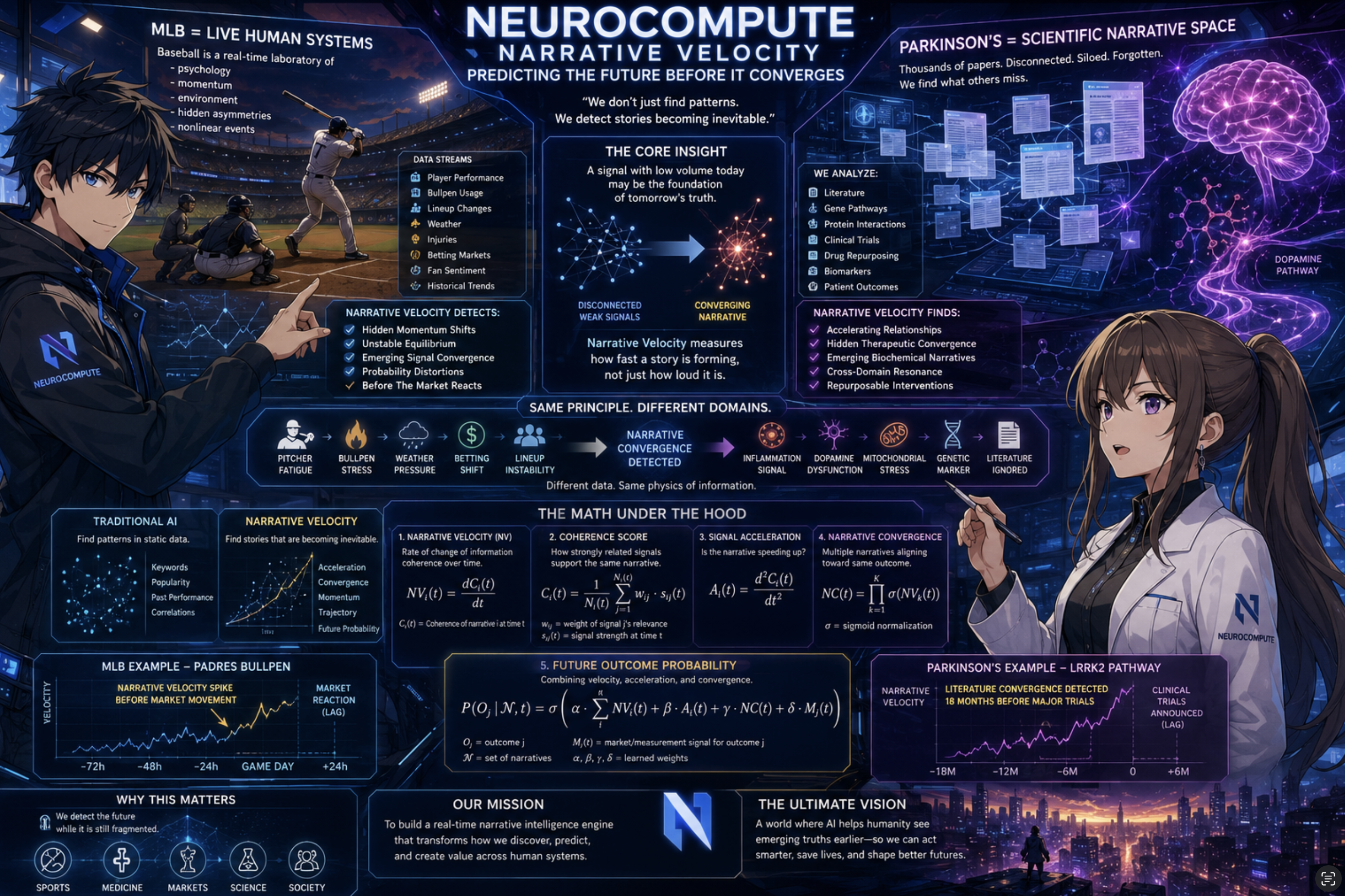
View analysis →Finding therapies hidden in 1,516 Parkinson’s papers.
Neurocompute scores biomedical literature, surfaces overlooked patterns, and turns Parkinson’s research into a living discovery terminal.
Ranked discovery teasers
E grade · PMID 41942434
View analysis →E grade · PMID 41953728
View analysis →E grade · PMID 41989436
View analysis →E grade · PMID 41913429
View analysis →E grade · PMID 41929081
View analysis →E grade · PMID 41954638
View analysis →E grade · PMID 41986191
View analysis →E grade · PMID 41908698
View analysis →E grade · PMID 42007924
View analysis →Database feed
All ranked Parkinson’s papers
Using cryo-fluorescence and synchrotron X-ray fluorescence imaging, the paper maps subcellular manganese in primary rat neurons and astrocytes, finding preferential accumulation in the Golgi and postsynaptic densities and ~3× higher uptake in astrocytes that can reduce neuronal manganese uptake…
By pinpointing the Golgi and postsynaptic sites and revealing astrocyte buffering of manganese, the work identifies cell-type and subcellular targets relevant to manganese-induced parkinsonism and suggests avenues for targeted neuroprotective strategies against environmental metal neurotoxicity.
Longitudinal network analysis of 19 cognitive tests in 355 people with Parkinson's over four yearly assessments identified five dynamic cognitive dimensions that reorganize over time and differ from baseline cross-sectional domains.
The finding that cognitive domains in PD are temporally dynamic highlights the need to rethink diagnostic criteria, endpoint selection, and patient stratification in trials—potentially improving biomarker and clinical outcome design—though it offers little direct mechanistic or therapeutic targets.
Survey of 119 movement disorder specialists showing reduced perceived barriers and increased clinician comfort with ordering and returning genetic testing for Parkinson disease since 2019, coinciding with rollout of PD GENEration and similar programs.
Improved uptake of genetic testing enhances patient identification for genotype-stratified trials and precision-medicine approaches, but the study offers limited direct mechanistic or therapeutic insights.
This study shows that negative global metacognitive bias—driven by depression and anxiety—underlies subjective cognitive complaints in prodromal PD and PD without objective impairment.
While not revealing molecular targets, this identifies modifiable affective contributors and measurement considerations that could inform symptomatic treatments, patient selection, and outcome measures in PD trials.
A self-powered galvanic Cu-foam electrochemiluminescence sensor was developed for sensitive, rapid on-site detection of reduced glutathione (GSH) in human urine (LOD 1.8×10⁻⁷ M) with high recovery and good selectivity/stability.
This low-cost, portable platform enables point-of-care monitoring of GSH as an oxidative-stress biomarker relevant to Parkinson’s disease patient monitoring and stratification, but it offers limited direct mechanistic or therapeutic-discovery insights.
This study identifies a regulatory methylation site (cg15069948) at the MOBP locus that colocalises with ALS and PSP risk variants and links genotype to altered MOBP methylation/expression in oligodendrocytes, but finds no genotype–methylation effects in Parkinson's or MSA.
The work highlights oligodendrocyte/MOBP dysregulation as a shared neurodegeneration signal and a possible biomarker/target, but provides limited direct, PD-specific mechanistic or therapeutic leads for Parkinson's drug discovery.
In a pre-registered UK Biobank cohort (n=158,686) with ~9 years follow-up, poorer speech-in-noise performance (digit triplet test) showed a directionally positive but statistically imprecise association with incident Parkinson's disease dementia (101 cases), with exploratory categorical analyses…
If confirmed in larger cohorts, hearing impairment could serve as an early, potentially modifiable risk marker for Parkinson's disease dementia, informing screening and prevention strategies, but current findings are exploratory and underpowered.
The authors collected a Malayalam speech corpus and used multidomain acoustic features with mRMR and grouped permutation importance to train 12 classifiers, achieving very high subject-dependent accuracy (~0.96) and moderate subject-independent generalization (accuracy up to ~0.75, macro-F1…
Offers a language-specific, speaker-robust speech biomarker and feature-selection pipeline useful for remote staging and monitoring in PD clinical assessments and trials, but it provides little mechanistic or therapeutic discovery insight.
This paper evaluates CycleGAN and Pix2Pix models to synthesize missing T1/T2 brain MRI across HCP, PPMI and an MS cohort, showing Pix2Pix often outperforms CycleGAN and that synthesized T1 images can be used for lesion detection, volumetry, and texture analysis in MS.
Direct therapeutic relevance to Parkinson's is limited, but the demonstrated ability to synthesize missing MRI contrasts (validated on PPMI data) can help recover incomplete imaging datasets and enable quantitative biomarker or longitudinal imaging studies in PD research.
They developed an AI/mathematical model (HD-Phase-Model) that predicts HTT CAG super-expansion in individual human spiny projection neurons from single-nucleus transcriptomes, validated across brain regions and showing absence of super-expansion signatures in Alzheimer's and Parkinson's donor SPNs.
Direct therapeutic relevance to Parkinson's is limited, but the approach—inferring cell-autonomous genetic/pathologic states from transcriptomic signatures—could be adapted to identify PD-relevant cellular states or biomarkers at single-cell resolution.
A global epidemiological analysis (1990–2021) with projections to 2050 quantifying incidence, prevalence, mortality, and DALYs for late-onset MS, Parkinson's disease, and dementias in adults 55+, reporting substantial PD burden with sex and regional SDI differences and population aging as the main…
Useful for public-health prioritization, trial site and recruitment planning, and identifying high-burden regions and demographic groups for PD interventions, but offers minimal mechanistic or translational insights for direct therapeutic discovery.
Using Global Burden of Disease 1990–2021 data the study quantifies rising prevalence and YLDs for 10 neurological disorders in China—particularly stroke, Alzheimer's, and a rapidly increasing Parkinson's disease burden—and forecasts continued growth to 2050 with major rehabilitation and geographic…
Valuable for health-policy and care-planning by documenting a growing Parkinson's rehabilitation burden in China, but it provides little mechanistic insight or direct therapeutic targets for drug discovery.
A case report describing a 28-year-old pregnant woman with paroxysmal supraventricular tachycardia from Wolff-Parkinson-White syndrome successfully terminated with intravenous adenosine and discussing acute and follow-up management during pregnancy.
This paper has minimal relevance for Parkinson's therapeutic discovery because it is a cardiology case report without mechanistic, biomarker, or neurodegeneration insights, though it may inform clinicians about pregnancy-specific drug and management considerations that could intersect with comorbid…
This review surveys DNA modifications and chromatin architecture changes as epigenetic biomarkers in neurodegenerative diseases and outlines translational steps toward biomarker-driven diagnostics and therapeutic development.
Highlights epigenetic alterations as candidate biomarkers and targetable pathways that could inform earlier Parkinson's diagnosis and epigenetic-based interventions, but is a broad, non-Parkinson-specific review with limited immediate actionable therapeutic leads.
A 4-year longitudinal analysis of PPMI cohorts found that peripheral inflammation markers predict motor, cognitive decline, and overall disease progression in Parkinson's disease.
Identifies peripheral inflammation as a prognostic biomarker and a translationally relevant pathway that could guide patient stratification and testing of anti-inflammatory or immunomodulatory therapies, though observational design limits causal inference.
Correction to a systematic review and meta-analysis assessing bright light therapy's effects on non-motor symptoms in Parkinson's disease.
Although this is a correction rather than new data, the underlying review concerns bright light therapy—a low-risk, repurposable intervention targeting sleep/circadian dysfunction relevant to PD non-motor symptoms and clinical trial design.
This population-genetics study screened 16,769 Middle Eastern exomes for eight NBIA genes and estimates a lifetime risk of 3.43 per 1,000,000 for autosomal recessive NBIA, with PLA2G6, PANK2, and C19orf12 contributing most to the burden.
While primarily epidemiological, the region-specific carrier frequencies—especially enrichment of PLA2G6 variants linked to parkinsonism and iron dysregulation—help prioritize genetic screening, patient identification, and follow-up studies of iron-related mechanisms that could inform…
Case report of a 17-year-old with EBV encephalitis showing bilateral substantia nigra MRI hyperintensity and transient secondary parkinsonism that resolved after antivirals, steroids, and supportive care.
Low direct value for Parkinson's drug discovery, but the case highlights infection-triggered nigral dysfunction and an imaging correlate that could inform studies of secondary parkinsonism and mechanisms of nigral vulnerability.
This is a retraction notice for a study that had reported structural connectivity predicts amelioration of postoperative REM sleep behavior disorder in Parkinson's disease patients after subthalamic nucleus deep brain stimulation.
The retraction means the reported connectivity-based predictor and its implications for DBS-guided treatment of sleep symptoms in PD are unreliable and should not inform therapeutic decisions, though the topic (sleep outcomes and biomarkers for DBS) remains clinically relevant for future valid…
In an MPTP mouse model of Parkinson's disease, intranasal balenine (a methylated, carnosine-resistant analog) improved object-location memory, preserved tyrosine hydroxylase-positive neurons, reduced GFAP-driven inflammation, and proteomics pointed to modulation of KEAP1–NFE2L2 (Nrf2), neddylation,…
The study presents a brain-targetable, degradation-resistant antioxidant/anti-inflammatory compound with translational potential (intranasal delivery and Nrf2-related mechanism) that could be advanced for neuroprotective PD strategies, though validation in alpha-synuclein models and…