AI-POWERED RESEARCH INTELLIGENCE

Finding therapies hidden in 1,516 Parkinson’s papers.

Neurocompute scores biomedical literature, surfaces overlooked patterns, and turns Parkinson’s research into a living discovery terminal.

1,516Papers indexed
984Papers AI scored
998Ranked papers
0.7%Coverage
LIVE RESEARCH INTELLIGENCE
↑ Narrative velocity rising ↑ New papers ingested ↑ Cross-paper convergence detected ↑ AI score dials updating ↑ Research blind spots surfacing
TOP SIGNALS TODAY

Ranked discovery teasers

View all discoveries →
RESEARCH TERMINAL

All ranked Parkinson’s papers

1516 results
E
Limbic free-water alterations as neuroimaging biomarkers for predicting phenoconversion in prodromal Parkinson's disease.
PMID 42013782 Published: 2026-03-27 Ingested: 2026-04-28 08:58 PM Parkinsonism & related disorders
AI48.0
Base30.8
Rank29.2
AI Summary

This study finds that elevated free-water in limbic regions (notably the left insula and mid-cingulate, plus hippocampus and right orbitofrontal cortex) combined with RBD and anxiety scores predicts conversion from prodromal to clinical Parkinson's disease with a combined-model AUC ~0.76.

Why It Matters

Provides a noninvasive, translatable biomarker signature that could be used to enrich and stratify prodromal PD cohorts for early intervention trials and longitudinal therapeutic evaluation, though it does not yet reveal targetable disease mechanisms.

E
Pallidal and subthalamic stimulations modulate inter-hemispheric interaction and asymmetry in Parkinson's disease.
PMID 41904270 Published: 2026-03-29 Ingested: 2026-04-28 08:58 PM Molecular psychiatry
AI46.0
Base30.8
Rank29.2
AI Summary

Resting-state fMRI and UPDRS-III data from 55 PD patients show that bilateral STN- and GPi-DBS both improve motor symptoms but differentially reduce motor asymmetry depending on baseline laterality, with motor gains linked to altered homotopic connectivity in the lateral occipital/extrastriate body…

Why It Matters

Provides clinically actionable insight for DBS target selection and a candidate imaging biomarker in visual networks that may help predict and optimize motor outcomes, offering moderate translational value though not addressing disease-modifying mechanisms.

E
Motoneuron Excitability in Parkinson's Disease: Effects of Dopaminergic Medication.
PMID 42003164 Published: 2026-04-19 Ingested: 2026-04-28 08:58 PM Journal of neurophysiology
AI45.0
Base30.8
Rank29.2
AI Summary

This human study found elevated motoneuron excitability and PIC-related amplification in people with Parkinson's disease compared with age-matched controls, and that dopaminergic medication did not fully normalize these measures.

Why It Matters

By implicating persistent intrinsic motoneuron changes and PICs that are insensitive to dopamine replacement, the work points to non-dopaminergic targets (ion channels, alternate monoaminergic systems) and electrophysiologic biomarkers that could be exploited for therapeutic discovery.

E
Geo-Mamba: Geometry-informed state-space learning of functional brain organization.
PMID 41997086 Published: 2026-04-12 Ingested: 2026-04-28 08:58 PM Medical image analysis
AI45.0
Base30.8
Rank29.2
AI Summary

Geo-Mamba is a geometry-informed dual-path state-space model that operates on Riemannian manifolds of fMRI/EEG functional connectivity to produce compact SPD representations and improves classification robustness across multiple neuroimaging datasets, including three Parkinson's cohorts.

Why It Matters

Although it does not address molecular mechanisms or interventions, the method has moderate translational value by potentially improving PD biomarker detection, patient stratification, and cross-modal neuroimaging analyses for clinical studies and trial endpoints.

E
Classification of functional brain patterns elicited by deep brain stimulation of the subthalamic nucleus in Parkinson's disease.
PMID 41955135 Published: 2026-04-09 Ingested: 2026-04-28 08:58 PM IEEE transactions on neural systems and rehabilitation engineering : a publication of the IEEE Engineering in Medicine and Biology Society
AI45.0
Base30.8
Rank29.2
AI Summary

Using resting-state fMRI from 104 PD patients (plus 34 external validation), the study applied nine machine-learning algorithms to classify subthalamic nucleus DBS ON vs OFF and found that global connectivity metrics with linear models or nonlinear SVMs achieved up to AUC 0.82, supporting…

Why It Matters

Identifies validated fMRI-derived features and analytic approaches that could become objective biomarkers to standardize and personalize DBS programming and to track network-level effects relevant for therapeutic optimization in Parkinson's disease.

E
Quantitative ultrasound radiofrequency analysis for monitoring Parkinson's disease.
PMID 41956318 Published: 2026-04-07 Ingested: 2026-04-28 08:58 PM Neuroscience
AI45.0
Base30.8
Rank29.2
AI Summary

Quantitative ultrasound radiofrequency Nakagami imaging detected increased muscle scattering (higher m parameter) across multiple muscles in Parkinson's patients versus controls, with the gastrocnemius medialis m strongly correlating with disease severity and good diagnostic performance in a small…

Why It Matters

This noninvasive, rapid, low-cost imaging biomarker could provide an objective tool for diagnosis and longitudinal monitoring to improve patient stratification and endpoint sensitivity in clinical studies, although findings are preliminary given the small sample and lack of mechanistic linkage to…

E
Longitudinal Modeling of Rank-based Global Outcome.
PMID 41959649 Published: 2026-04-01 Ingested: 2026-04-28 08:58 PM Statistica Sinica
AI45.0
Base30.8
Rank29.2
AI Summary

The paper presents a robust rank-based longitudinal global percentile outcome and associated regression/estimation methods (including dropout handling and variance estimation) to integrate multiple time-varying endpoints and applies it to a Parkinson’s disease clinical trial.

Why It Matters

This approach improves sensitivity and interpretability for PD trial analyses and risk-factor detection—helpful for trial design, endpoint selection, and translational prioritization—even though it does not identify biological mechanisms or direct therapeutic targets.

E
Task-specific machine learning system for automatic assessment of multi-limb bradykinesia in Parkinson's disease.
PMID 42040335 Published: 2026-01-01 Ingested: 2026-04-28 08:58 PM Frontiers in neuroscience
AI45.0
Base30.8
Rank29.2
AI Summary

Developed a task-specific machine learning system with wearable sensors to automatically score multi-limb bradykinesia (MDS‑UPDRS III tasks) showing promising accuracy (peak F1≈0.87) in a small cohort (21 PD, 8 controls).

Why It Matters

Delivers an objective, automated bradykinesia measurement that could standardize assessments and improve outcome measures and monitoring in clinical trials and care, but requires larger validation for therapeutic decision-making.

E
Insole-Derived Plantar Pressure Variability Reveals Dual-Task Gait Differences in Early-Stage Parkinson's Disease.
PMID 41970941 Published: 2026-01-01 Ingested: 2026-04-28 08:58 PM IEEE journal of translational engineering in health and medicine
AI45.0
Base30.8
Rank29.2
AI Summary

Sensor-equipped insoles measuring plantar pressure detect subtle and dual-task-specific gait abnormalities in early-stage Parkinson's disease that conventional spatiotemporal metrics largely miss.

Why It Matters

Validating an affordable, clinic-ready biomarker that is more sensitive to early and cognitively-challenged gait deficits could improve early detection, patient stratification, monitoring of progression, and outcome measurement in PD therapeutic trials.

E
Long-term outcomes after caudal zona incerta-forel field ablation: three-year clinical follow-up in advanced Parkinson's disease.
PMID 41972105 Published: 2026-01-01 Ingested: 2026-04-28 08:58 PM Frontiers in aging neuroscience
AI45.0
Base30.8
Rank29.2
AI Summary

Prospective study of 10 advanced unilateral tremor-rigid PD patients treated with stereotactic radiofrequency ablation of the caudal zona incerta and Fields of Forel showed very large, sustained UPDRS III improvements over 3 years with minimal transient adverse effects.

Why It Matters

Provides clinically relevant evidence that infrathalamic ablation can be a durable, relatively safe alternative to DBS in selected patients or low-resource settings, but offers little mechanistic or biomarker insight for pharmacologic therapeutic discovery.

E
Muscle Network of Parkinson's Gait: A 12-Month Longitudinal Analysis Before and After Deep Brain Stimulation Surgery.
PMID 41955137 Published: 2026-01-01 Ingested: 2026-04-28 08:58 PM IEEE transactions on neural systems and rehabilitation engineering : a publication of the IEEE Engineering in Medicine and Biology Society
AI45.0
Base30.8
Rank29.2
AI Summary

Graph-theory analysis of inter-muscular coherence from instrumented gait EMG shows PD patients have increased muscle network density and reduced modularity versus controls, which move toward normal levels 12 months after bilateral subthalamic DBS and correlate with UPDRS-III improvement.

Why It Matters

Offers a noninvasive, quantitative network-level biomarker for gait motor control and DBS response that could be used to monitor treatment efficacy or as an objective endpoint in clinical studies, though it provides limited new mechanistic or target-discovery insight.

E
Molecular chaperones mediated proteostasis depletion: A cause of neurodegeneration?
PMID 41904003 Published: 2026-01-01 Ingested: 2026-04-28 08:58 PM Advances in protein chemistry and structural biology
AI45.0
Base30.8
Rank29.2
AI Summary

A focused review examining how chaperones (Hsp90, Hsp110, Hsp27, and DJ-1) regulate proteostasis and how their dysfunction may contribute to neurodegenerative diseases including Parkinson's, with discussion of mechanisms for folding, aggregation prevention, and degradation pathways.

Why It Matters

Highlights chaperone-based mechanisms (including the PD-linked DJ-1 and mitoprotection) that suggest actionable targets for modulating proteostasis, but remains a conceptual review with limited new experimental or translational data.

AI Summary

Using in vivo negligible-depletion SPME in a 6‑OHDA rat model, the study quantified free and total anandamide (AEA) and 2‑AG, finding significantly elevated striatal free AEA in lesioned animals while 2‑AG was undetectable in vivo.

Why It Matters

Provides a minimally perturbing in vivo method to measure biologically active endocannabinoids and highlights AEA as a candidate early PD biomarker, supporting translational biomarker development though it offers limited immediate therapeutic mechanistic insight.

E
Dual Oscillatory Signatures in Pallidal Circuits Underlie Symptom Complexity in Huntington's Disease Patients.
PMID 41937711 Published: 2026-04-06 Ingested: 2026-04-28 08:58 PM Movement disorders : official journal of the Movement Disorder Society
AI42.0
Base30.8
Rank29.2
AI Summary

This study reports that Huntington's disease patients exhibit dual pallidal oscillatory signatures—posterior GP theta (2–8 Hz) linked to hyperkinesia and high beta (20–30 Hz) linked to hypokinesia—mapped to distinct pallidal subregions and indirect/direct pathway connectivity and proposed as…

Why It Matters

Although HD-focused, the paper provides circuit-level biomarkers, pallidal subregion mapping, and DBS-targeting insights that are translatable to Parkinson's therapeutics for improving stimulation strategies and monitoring motor-state biomarkers.

E
Associations of epigenetic age acceleration with motor impairment: Evidence from the Parkinson's Progression Markers Initiative cohort.
PMID 41905169 Published: 2026-03-25 Ingested: 2026-04-28 08:58 PM Neurobiology of aging
AI42.0
Base30.8
Rank29.2
AI Summary

Longitudinal analysis in PPMI shows accelerated epigenetic aging in blood associates with worsening tremor phenotypes in Parkinson's disease—particularly in men—while associations with gait, rigidity, and bradykinesia are weaker or absent.

Why It Matters

This supports blood-based epigenetic clocks as candidate biomarkers for monitoring tremor progression and for patient stratification in trials, providing translational value despite limited direct mechanistic or therapeutic targets.

E
Dynamical analysis of a mean firing rate model in Parkinson's disease.
PMID 42028460 Published: 2026-12-01 Ingested: 2026-04-28 08:58 PM Cognitive neurodynamics
AI40.0
Base30.8
Rank29.2
AI Summary

A computational mean firing-rate model incorporating cortex, thalamus and PPN identifies how dopaminergic parameter interactions, synaptic weights, delays and time constants can produce pathological beta-band oscillations in basal ganglia circuits.

Why It Matters

The work highlights circuit-level drivers (cortex–thalamus coupling, STN–GPe loop strength, connection delays, and PPN dynamics) that are actionable targets for neuromodulation or DBS parameter optimization and generates testable quantitative hypotheses, but it lacks molecular mechanisms and in…

E
Altered EEG microstate transition patterns and visual hallucinations in Parkinson's Disease.
PMID 41895342 Published: 2026-06-01 Ingested: 2026-04-28 08:58 PM International journal of psychophysiology : official journal of the International Organization of Psychophysiology
AI40.0
Base30.8
Rank29.2
AI Summary

Resting-state EEG microstate transition patterns (reduced D→B and increased E→F and F→C) differentiate PD patients with visual hallucinations with ~89.5% accuracy.

Why It Matters

Identifies a noninvasive, high-temporal-resolution biomarker of large-scale network imbalance that can help stratify patients, monitor hallucinatory risk, and inform network-targeted interventions (e.g., neuromodulation) though it lacks direct molecular or therapeutic mechanisms.

E
Machine learning classification of early-stage Parkinson's disease using sit-to-walk biomechanical features.
PMID 41912640 Published: 2026-03-30 Ingested: 2026-04-28 08:58 PM Scientific reports
AI40.0
Base30.8
Rank29.2
AI Summary

Using 3D motion capture, force plates, and EMG from 106 participants performing a sit-to-walk task, the authors identified three biomechanical features (mean COM speed, anteroposterior CoP–COM displacement during gait-initiation, and forward thoracic range of motion) and trained a random forest…

Why It Matters

The work offers objective, noninvasive biomechanical biomarkers and a proof-of-concept ML screening tool that could aid earlier detection and functional monitoring of PD, though it does not provide molecular targets or direct therapeutic interventions.

E
Opicapone in Parkinson's patients with motor fluctuations: clinical assessments and patient-reported outcomes from the OPTI-ON study.
PMID 42016531 Published: 2026-01-01 Ingested: 2026-04-28 08:58 PM Clinical parkinsonism & related disorders
AI40.0
Base30.8
Rank29.2
AI Summary

A 6-month prospective, open-label US observational study found add-on opicapone improved motor and non-motor fluctuations and was generally well tolerated in Parkinson's patients with OFF episodes.

Why It Matters

Supports real-world symptomatic efficacy and tolerability of opicapone as a levodopa adjunct—useful for clinical practice and therapeutic positioning but offering limited mechanistic or novel discovery insights for Parkinson's drug development.

E
Association of neurogenic orthostatic hypotension with cognitive decline in Parkinson's disease: a longitudinal cohort study.
PMID 41908284 Published: 2026-01-01 Ingested: 2026-04-28 08:58 PM Frontiers in neurology
AI40.0
Base30.8
Rank29.2
AI Summary

In a retrospective longitudinal cohort, Parkinson's patients with baseline neurogenic orthostatic hypotension experienced significantly faster decline in global and multiple domain-specific cognitive scores (MoCA) over time, without accelerated motor or nonmotor symptom progression.

Why It Matters

This identifies nOH as a clinically assessable prognostic biomarker that could help stratify PD patients for cognitive-risk, monitoring, and trials and suggests autonomic/cerebral-perfusion pathways as potential but currently underexplored therapeutic targets.

Previous
Page 32 of 76
Next
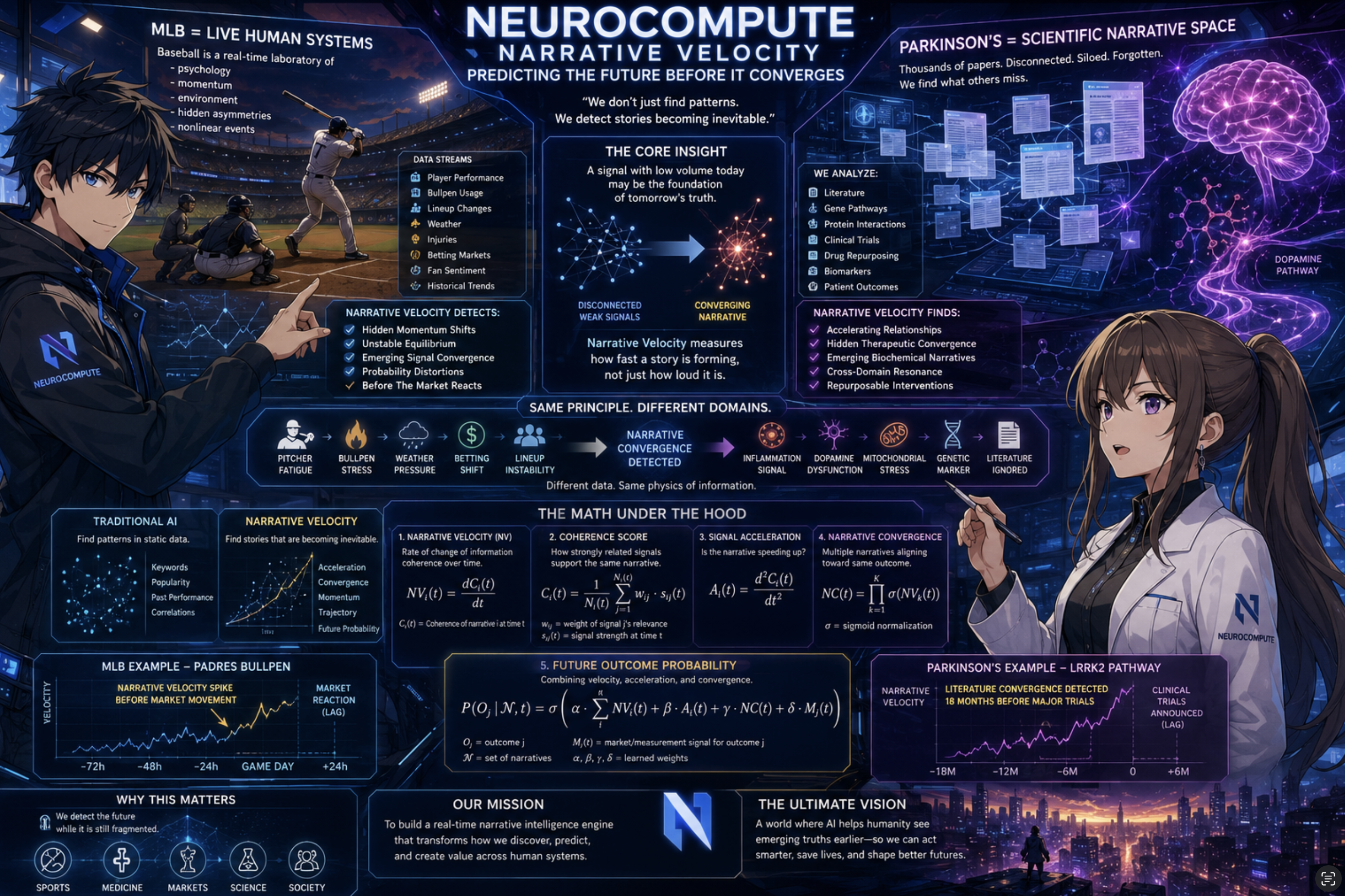
Neurocompute Parkinson’s Narrative Velocity Infographic
NEUROCOMPUTE VISUAL SYSTEM

Open the Narrative Velocity Map

Explore the full Parkinson’s research intelligence diagram.

Expand Intelligence View →
Full Neurocompute Infographic