← Back to all signals
RESEARCH PAPER ANALYSIS

Limbic free-water alterations as neuroimaging biomarkers for predicting phenoconversion in prodromal Parkinson's disease.

This study finds that elevated free-water in limbic regions (notably the left insula and mid-cingulate, plus hippocampus and right orbitofrontal cortex) combined with RBD and anxiety scores predicts conversion from prodromal to clinical Parkinson's disease with a combined-model AUC ~0.76.

PMID42013782
JournalParkinsonism & related disorders
Publication Date2026-03-27
Ingested2026-04-28 08:58 PM
EXECUTIVE SUMMARY

What the AI sees

This study finds that elevated free-water in limbic regions (notably the left insula and mid-cingulate, plus hippocampus and right orbitofrontal cortex) combined with RBD and anxiety scores predicts conversion from prodromal to clinical Parkinson's disease with a combined-model AUC ~0.76.

WHY IT MATTERS

Research significance

Provides a noninvasive, translatable biomarker signature that could be used to enrich and stratify prodromal PD cohorts for early intervention trials and longitudinal therapeutic evaluation, though it does not yet reveal targetable disease mechanisms.

ABSTRACT

Source abstract

BACKGROUND: Parkinson's disease (PD) diagnosis typically occurs after motor symptom onset, highlighting the need for biomarkers predicting phenoconversion from the prodromal parkinson's disease (pPD). Free-water (FW) imaging, reflecting extracellular microstructural changes, may capture early extrastriatal pathology. OBJECTIVE: To evaluate regional free-water alterations from whole-brain mapping as biomarkers predicting imminent pPD-to-PD phenoconversion. METHODS: Whole-brain FW mapping derived from diffusion tensor imaging was obtained for 51 healthy controls (HCs), 83 pPD, and 202 de novo PD (dnPD) subjects from the Parkinson's Progression Markers Initiative. The pPD cohort underwent ≥4-year longitudinal follow-up. Whole-brain FW values were compared across groups using false discovery rate correction. Predictors of phenoconversion to PD were identified via LASSO regression from baseline FW metrics and clinical covariates. A multivariable Cox proportional hazards model was subsequently constructed using the selected predictors, with model performance evaluated through Kaplan-Meier survival analysis and receiver operating characteristic (ROC) curves. RESULTS: Cross-sectionally, elevation in FW values in the left insula and left middle cingulate gyrus were observed in pPD compared to HCs, alongside lower values than in dnPD. Longitudinally, LASSO-Cox analysis identified six predictors: FW in left insula, left mid-cingulate cortex, left hippocampus, right orbitofrontal cortex, RBDSQ, and STAI scores. Left insula FW (HR = 1.403,P = 0.004) and left mid-cingulate FW (HR = 1.325,P = 0.029) independently predicted conversion. The combined model integrating FW and clinical metrics demonstrated superior AUCs (0.755). CONCLUSION: Free-water changes particularly in limbic regions predict phenoconversion from prodromal to clinical Parkinson's disease.

SUPPORTING PAPER SET

32 more papers to review

Ranked by current scoring engine
1 The cGAS-STING-Glymphatic-gut Axis in Parkinson's disease: A proposed self-amplifying triad of Neuroinflammation and therapeutic opportunity. International immunopharmacology 91.0 2 Immunosenescence and Inflammaging as Drivers of Neurodegeneration: Cellular Mechanisms, Neuroimmune Crosstalk, and Therapeutic Implications. Cells 91.0 3 Flavonoids improve neurotransmitters for Parkinson's treatment: mechanism and therapeutic potential. Frontiers in pharmacology 88.0 4 Alpha-Lipoic Acid and Biotin in Neurodegenerative Diseases: Convergent Mechanistic Insights from Preclinical Models to Clinical Perspectives. Neurology international 78.0 5 The Gut Microbiota in Parkinson's Disease: Mechanistic Insights into Microbial-Host Interactions. Microorganisms 85.0 6 Linking inflammation, metabolic dysfunction, and neurodegeneration: a comprehensive review of TLR2 pathways in type 2 diabetes. Frontiers in clinical diabetes and healthcare 80.0 7 Neuroprotective effects of GLP-2 and a GLP-2/GIP dual receptor agonist in an MPTP-induced mouse model of Parkinson's disease. Peptides 86.0 8 TNF alpha unmasks enteric malate aspartate shuttle dysfunction bridging Parkinson disease and intestinal inflammation. Nature communications 91.5 9 Lipid Metabolism and Neurodegeneration: Mechanistic Insights and Therapeutic Targets. Ageing research reviews 82.0 10 Shared functional microbiome signatures in Parkinson's disease and constipation predominate irritable bowel syndrome despite taxonomic divergence. Brain, behavior, & immunity - health 80.0 11 Benzimidazole as a Versatile Scaffold for Developing Neurotherapeutics Against Neurodegenerative Diseases. ChemMedChem 74.0 12 Biomimicking neuromelanin reverses the gait deficits and dopaminergic neuronal loss in the Parkinson's disease. Colloids and surfaces. B, Biointerfaces 86.0 13 Neuroprotective roles of klotho: Molecular pathways and therapeutic implications for cognitive health in neurological and psychiatric diseases. Experimental physiology 84.0 14 Flavonoid Rutin Reduces Intestinal Inflammation in an Experimental Model of Parkinson's Disease. Neurotoxicity research 70.0 15 Nanostructured Lipid Carriers Enhance Brain Delivery and Antioxidant Efficacy of a Small-Molecule MAO B Inhibitor for Neurodegenerative Disease Therapy. Molecular pharmaceutics 78.0 16 Pathophysiological Role of the Gut Brain Axis in Parkinson's Disease: From Microbial Metabolites and Intestinal Permeability to Central Neuroinflammation. Current neurovascular research 86.0 17 Parkinson's Disease: From Metabolism to Genetics-A Comprehensive Review. Current issues in molecular biology 86.0 18 Navigating the cholesterol maze: Key insights on use of statins in neurodegenerative disorders. Neuroprotection (Chichester, England) 76.0 19 Integrative network pharmacology delineates dual GPCR and non-GPCR mechanisms of blended and individual Taikong Blue lavender and Pingyin rose essential oils in neurodegenerative and psychiatric disorders. Computers in biology and medicine 65.0 20 Models of neuroprotection in Parkinson's disease: Exploring cellular, molecular, and microenvironmental targets. Experimental neurology 78.0 21 Hyaluronic acid: emerging roles and biomaterial innovations in Alzheimer's and Parkinson's disease therapy. Frontiers in pharmacology 75.2 22 Molecular mechanisms underlying Parkinson's disease and role of phytochemicals, α-synuclein, sirtuins, and incretin mimetics in potential therapy. Frontiers in pharmacology 75.0 23 Lipid droplets in neurodegenerative diseases: pathological drivers and therapeutic vulnerabilities. Cell death discovery 82.0 24 Brain-gut-microbiota axis: a review on the bidirectional regulatory mechanisms between gut microbiota and brain and their disease interactions. Frontiers in microbiology 74.0 25 Long non-coding RNAs in neurodegenerative diseases - Molecular mechanisms, liquid biopsy biomarkers, and therapeutic targets: A review. Biomolecules & biomedicine 84.0 26 Neurosyphilis and Parkinsonism: Overlapping Pathophysiology and Emerging Therapeutic Insights. Current neurovascular research 76.0 27 Molecular biochemistry of soluble epoxide hydrolase in lipid mediator pathways and neuroinflammatory responses. The Journal of steroid biochemistry and molecular biology 82.0 28 Multifaceted role of CNPY2 beyond ER stress: Disease implications and therapeutic potential. Cell stress 83.3 29 Neuroprotective Role of Exercise-based Physiotherapy Combined with Pharmacological Agents in Parkinson's Disease. Central nervous system agents in medicinal chemistry 64.0 30 Distinct metabolomic and proteomic signatures in Parkinson's disease patients with REM sleep behavior disorder. Signal transduction and targeted therapy 84.0 31 HMGB1-mediated neuroinflammation: molecular mechanisms and emerging therapeutic approaches. Inflammopharmacology 78.0 32 Beyond acid-base dyshomeostasis: Dynamic instability of neuronal lysosomal pH as a pathogenic mechanism and therapeutic target in neurological diseases. Biochemical pharmacology 88.0
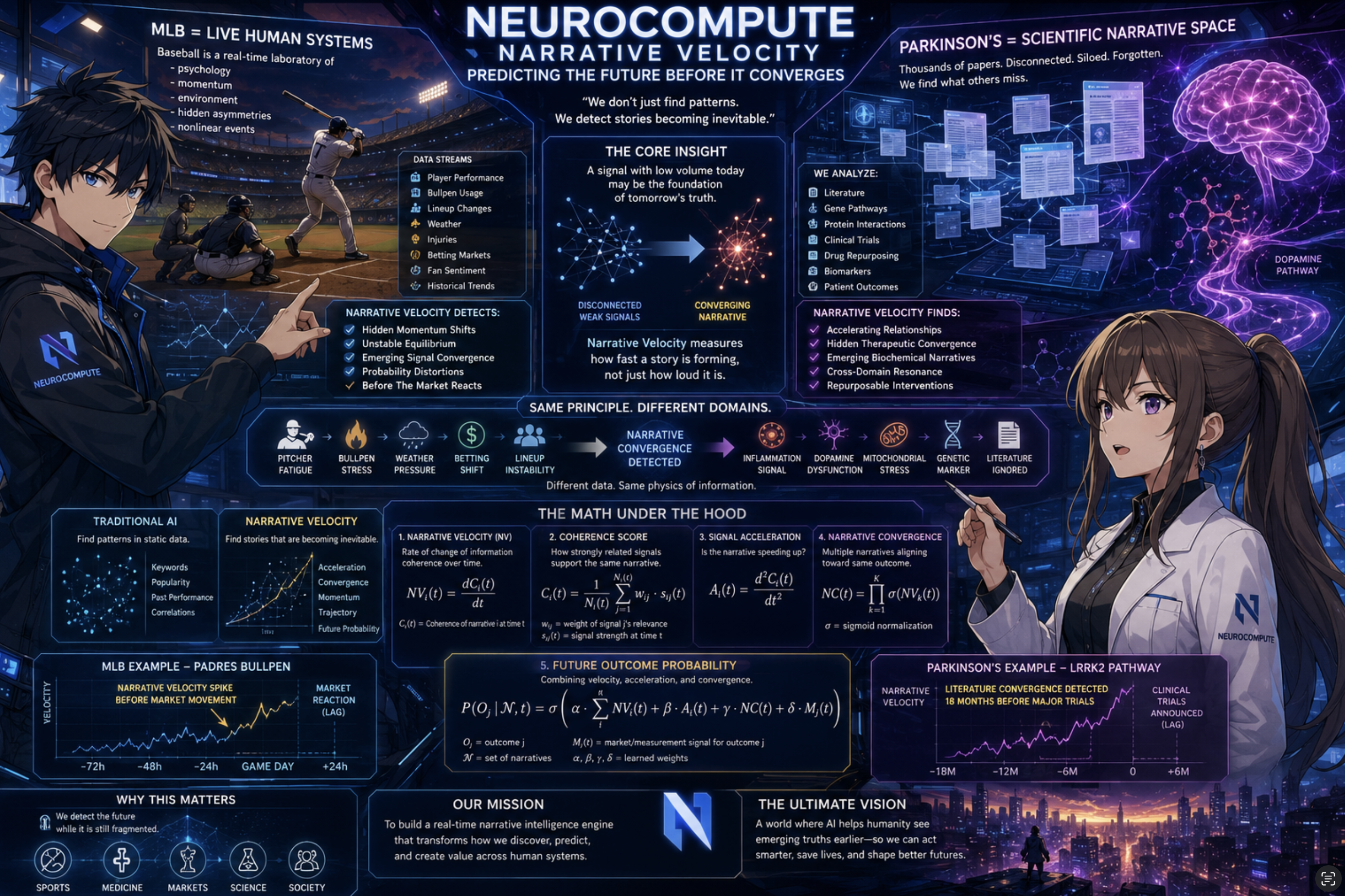
Neurocompute Parkinson’s Narrative Velocity Infographic
NEUROCOMPUTE VISUAL SYSTEM

Open the Narrative Velocity Map

Explore the full Parkinson’s research intelligence diagram.

Expand Intelligence View →
Full Neurocompute Infographic