1
Treadmill exercise rebalances M1 response repertoires during motor state transitions in Parkinsonian mice.
50.0
AI
E grade · PMID 41967788
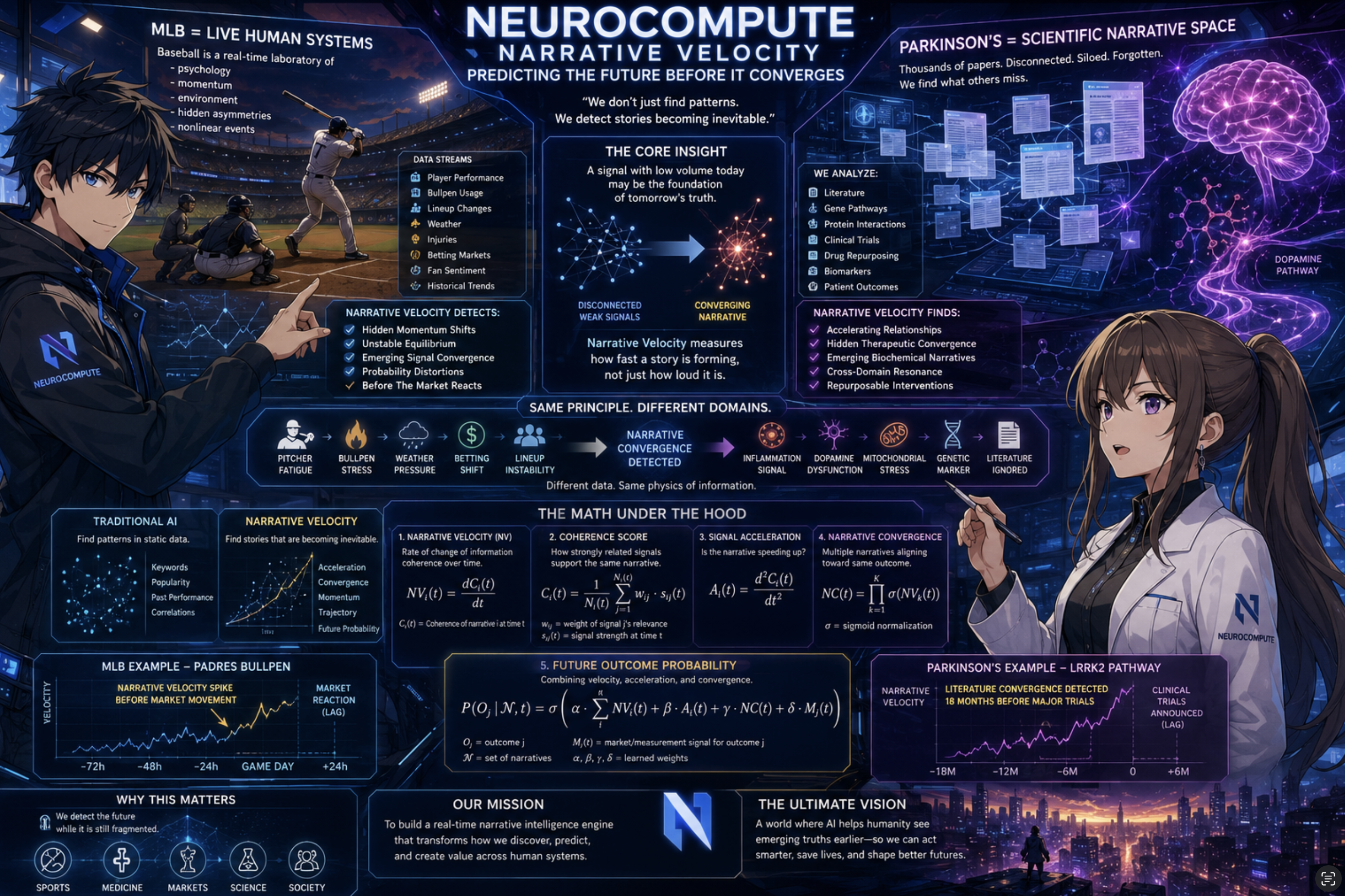
View analysis →Neurocompute scores biomedical literature, surfaces overlooked patterns, and turns Parkinson’s research into a living discovery terminal.
E grade · PMID 41967788
View analysis →E grade · PMID 41904014
View analysis →E grade · PMID 41895098
View analysis →E grade · PMID 41925436
View analysis →E grade · PMID 42025146
View analysis →E grade · PMID 41922909
View analysis →E grade · PMID 41995965
View analysis →E grade · PMID 41959929
View analysis →E grade · PMID 41972104
View analysis →E grade · PMID 41997149
View analysis →Treadmill exercise in 6-OHDA Parkinsonian mice partially restores the diversity of primary motor cortex transition-related firing patterns and shifts local field potential modulation from absent beta to emergent gamma-band activity during movement initiation/termination, accompanying improved motor…
This paper highlights a circuit-level, exercise-responsive mechanism (cortical transition coding) that could serve as a biomarker or target for non-pharmacological interventions and neuromodulation strategies in PD, providing moderate translational value though it lacks direct molecular therapeutic…
A broad review of Tauopathies covering tau isoforms, molecular mechanisms of tau aggregation, neuronal and peripheral organ effects, and cross-talk between tau and other neurodegenerative proteins including alpha-synuclein.
Provides useful synthesis on tau–alpha-synuclein interactions and shared pathogenic pathways that could inform Parkinson's therapeutic target selection or combination strategies, but is primarily conceptual and lacks direct actionable interventions or biomarkers.
This hypothesis/review proposes the endothelial surface layer–glycocalyx (ESL-GC) as a mechanistic interface linking gut microbiome dysbiosis, ion (especially K+) dysregulation and reactive gas nanobubbles to Parkinson's disease, reframing PD as an interface-based systems disorder rather than…
The paper presents a novel, testable conceptual framework that could point to new biomarkers and interventions (glycocalyx-targeting therapies, ion modulation, microbiome approaches) but is currently speculative and lacks direct experimental or clinical validation.
Mendelian randomization and national survey analyses indicate knee osteoarthritis—but not hip OA—is associated with increased Parkinson's disease risk, suggesting a potential causal, joint-specific link.
Highlights knee OA as a potentially modifiable risk factor that could steer mechanistic work on peripheral inflammation/systemic mediators and motivate prevention or repurposing strategies to lower PD risk.
Large UK Biobank analysis links multiple liver health measures to risk of several neurodegenerative diseases, with strong associations for vascular and all-cause dementias but only modest, limited associations (3 factors) for Parkinson's disease.
The study supplies population-level evidence that liver dysfunction modestly correlates with PD risk and highlights liver-related biomarkers that merit mechanistic and translational follow-up, but it is observational and does not provide causal pathways or immediate therapeutic targets for…
GBD 2021 data show neurological diseases—particularly intracerebral hemorrhage, ischemic stroke, dementia, and a rapidly increasing Parkinson's disease burden—are major and regionally variable contributors to DALYs in mainland China.
The paper provides limited mechanistic or therapeutic leads but is valuable for prioritizing public-health resources and highlighting the urgent need to scale translational and clinical Parkinson's research and care in China due to a large recent rise in PD-related burden.
This systematic review and network meta-analysis of five RCTs (n=708) found dose-specific ON-state motor improvements with some GLP-1 receptor agonists (notably exenatide 20 μg/day and lixisenatide 20 μg/day) but overall heterogeneous results and limited evidence for broader clinical benefit.
Moderately high translational value because GLP-1RAs are an already available, mechanism-plausible repurposing class that showed clinically meaningful motor effects in some trials, supporting larger, longer, biomarker-informed trials despite current heterogeneity and tolerability issues.
This review summarizes hDPSCs' ability to differentiate into neuronal cell types, provide paracrine neuroprotection, and be combined with biomaterial scaffolds, with preclinical evidence across CNS/PNS injuries including Parkinson's disease.
It highlights a promising cell-based regenerative approach that could inform PD neuroprotection/transplant strategies, but as a broad preclinical review lacking PD-specific mechanistic targets or actionable translational data its immediate value for Parkinson's drug discovery is modest.
Longitudinal analysis of 726 PD patients found that carriers of GBA1 PD-risk variants (and nominally severe variants) showed faster cognitive decline and, for PD-risk carriers, greater worsening of apathy, sleep, tremor, and non-motor symptom scores, though associations did not survive…
Links between GBA1 risk variants and accelerated non-motor progression reinforce lysosomal dysfunction as a therapeutically actionable axis and justify using GBA1 status for trial stratification or targeting, but the results are exploratory and need independent replication before clinical…
The paper demonstrates that SARM1 is essential for PARP1-driven parthanatos—mediating mitochondrial depolarization, AIF nuclear translocation, and neuronal death—and that SARM1 inhibition robustly protects against MPP+ dopaminergic toxicity and NMDA excitotoxicity.
By placing SARM1 at the intersection of NAD+ metabolism, PARP1-mediated DNA damage responses, and excitotoxic/MPP+-induced dopaminergic death, the study identifies a druggable, translationally relevant target with strong potential for Parkinson's neuroprotection strategies.
This review surveys methods to separate oscillatory and aperiodic components of neural signals, arguing that aperiodic parameters are meaningful biomarkers linked to excitation–inhibition balance and neurodegeneration and that standardized metrics could inform closed-loop neuromodulation.
By proposing standardized estimation of aperiodic neural features and linking them to Parkinsonism and DBS modulation, the paper offers moderate translational value for developing reliable biomarkers and adaptive neuromodulation strategies, though it lacks direct molecular or therapeutic targets.
Case-based commentary describing a Parkinson's patient who reported pronounced happiness and sustained perceived symptom benefit from swimming despite no objective motor improvement on video analysis.
Low direct therapeutic-discovery value, but underscores the importance of patient-reported outcomes and subjective wellbeing when designing exercise interventions, safety guidance, and clinical endpoints in PD research.
This commentary proposes evaluating rationally designed combination therapies that target multiple Parkinson's disease etiological factors as an alternative strategy to discover disease-modifying treatments.
While it presents no new experimental data, the paper shifts emphasis toward combination approaches that could enhance translational and repurposing potential by addressing complementary mechanisms and informing future trial design.
Review synthesizing preclinical evidence that nanoplastics can cross the blood–brain barrier, promote protein aggregation, impair microglial clearance, disrupt the gut–liver–brain axis, and drive neuroinflammation while noting a lack of standardized human exposure data and causal proof.
Although primarily a mechanistic review rather than a translational study, it highlights inflammation, microglial dysfunction, and gut–brain interactions—pathways highly relevant to Parkinson's disease—that could guide biomarker development and targeted preclinical experiments to assess therapeutic…
This review describes midnolin (MIDN) as a newly identified ubiquitin-independent proteasome adapter (via a CUHC domain) that selectively targets nuclear transcription factors, implicating MIDN in neurodevelopment, synaptic plasticity, cancer, metabolic homeostasis, and Parkinson's disease while…
MIDN reveals a novel intranuclear proteasomal pathway that could be exploited to modulate disease-relevant transcriptional regulators in Parkinson's disease, offering a potentially actionable therapeutic or biomarker axis although current evidence is review-based and requires experimental…
A bibliometric and micro‑interpretation review that maps research on the comorbidity of depression and type 2 diabetes, emphasizing HPA axis and BDNF mechanisms and noting links to Parkinson's disease and obesity.
While primarily a high‑level review with limited direct translational data, it flags BDNF and stress‑axis pathways that overlap with PD‑relevant neuroprotection and metabolic/inflammatory mechanisms, pointing to potential biomarker and repurposing hypotheses for Parkinson's therapeutic research.
Systematic review/meta-analysis of five RCTs (n=270) found exercise interventions reduced fatigue in Parkinson’s disease (SMD −1.34) but with substantial heterogeneity and low certainty, while acupuncture showed no benefit.
The paper highlights exercise as a potentially useful symptomatic, non‑pharmacological strategy and pinpoints methodological gaps (small, heterogeneous trials, lack of PD‑specific fatigue measures) that should guide future mechanistic and sufficiently powered clinical studies, but it offers limited…
This study compares three patient-derived ATP13A2 mutations, demonstrates mutation-dependent intracellular iron accumulation in fibroblasts and overexpressing MCF7 cells, and shows that wild-type ATP13A2 expression mitigates iron-induced cell death.
By linking ATP13A2 loss-of-function to varying levels of cellular iron overload and rescuability by wild-type protein, the work supports iron-targeted or ATP13A2-restoration therapeutic strategies and offers a more sensitive cellular biomarker approach when MRI is inconclusive for…
This paper reports CVN-424, a GPR6 inverse agonist that has progressed to Phase III clinical trials for Parkinson's disease.
A Phase III-ready, non-dopaminergic small molecule targeting a novel GPCR (GPR6) has strong translational relevance and potential to provide new symptomatic or disease-modifying strategies, though the lack of an abstract limits assessment of mechanistic and biomarker data.
This review synthesizes neural, motor, and technological evidence that handwriting kinematics reflect age- and disease-related changes and advocates digital assessment and rehabilitation approaches across healthy aging and neurodegenerative disorders.
Moderately useful for Parkinson's therapeutic discovery because it highlights scalable, non-invasive digital biomarkers and rehabilitative interventions that can aid early detection, patient stratification, and trial endpoints, but it lacks actionable molecular mechanisms or direct therapeutic…