← Back to all signals
RESEARCH PAPER ANALYSIS

Knee Osteoarthritis as a Causal Risk Factor for Parkinson's Disease: Converging Evidence From a National Survey and Genetic Analysis.

Mendelian randomization and national survey analyses indicate knee osteoarthritis—but not hip OA—is associated with increased Parkinson's disease risk, suggesting a potential causal, joint-specific link.

PMID41925436
JournalThe American journal of geriatric psychiatry : official journal of the American Association for Geriatric Psychiatry
Publication Date2026-03-07
Ingested2026-04-28 08:58 PM
EXECUTIVE SUMMARY

What the AI sees

Mendelian randomization and national survey analyses indicate knee osteoarthritis—but not hip OA—is associated with increased Parkinson's disease risk, suggesting a potential causal, joint-specific link.

WHY IT MATTERS

Research significance

Highlights knee OA as a potentially modifiable risk factor that could steer mechanistic work on peripheral inflammation/systemic mediators and motivate prevention or repurposing strategies to lower PD risk.

ABSTRACT

Source abstract

OBJECTIVE: Osteoarthritis (OA) and Parkinson's disease (PD) are age-related degenerative conditions with potentially shared pathophysiological pathways. This study aimed to investigate the association and potential causal links between site-specific OA phenotypes and PD risk using a dual-method approach. DESIGN: We employed a dual-method approach combining cross-sectional analysis of National Health and Nutrition Examination Survey (NHANES) data with bidirectional two-sample Mendelian randomization (MR) analysis using large-scale genome-wide association study data. SETTING: The cross-sectional analysis used a nationally representative U.S. population sample. The MR analysis used summary statistics from large international genetic consortia. PARTICIPANTS: The NHANES analysis included 21,414 adults aged ≥40 years (1999-2016). The MR analysis utilized genetic data from hundreds of thousands of European individuals. INTERVENTION: None. MEASUREMENTS: In NHANES, OA and PD were based on self-reported physician diagnoses. In MR, genetic variants served as instrumental variables for OA phenotypes and PD. Multiple MR methods (inverse-variance weighted, weighted median, weighted mode, and MR-Egger) were used to assess potential causal links, with comprehensive sensitivity analyses performed. RESULTS: In the fully adjusted NHANES analysis, OA was significantly associated with higher odds of PD (OR=2.99, 95% CI: 1.92-4.65). MR analyses revealed that genetic predisposition to knee OA was associated with an increased PD risk (OR=1.49, 95% CI: 1.11-2.02), with a similar effect for combined hip/knee OA (OR=1.23, 95% CI: 1.03-1.47). In contrast, hip OA showed no significant association with PD. Reverse MR analyses found no evidence supporting causal effects of PD on any OA phenotype. CONCLUSIONS: Both observational and genetic evidence consistently suggest that knee OA, but not hip OA, may be a causal risk factor for PD, with no evidence of reverse causality. The phenotype-specific findings suggest joint-specific mechanisms linking OA to neurodegeneration.

SUPPORTING PAPER SET

32 more papers to review

Ranked by current scoring engine
1 The cGAS-STING-Glymphatic-gut Axis in Parkinson's disease: A proposed self-amplifying triad of Neuroinflammation and therapeutic opportunity. International immunopharmacology 91.0 2 Immunosenescence and Inflammaging as Drivers of Neurodegeneration: Cellular Mechanisms, Neuroimmune Crosstalk, and Therapeutic Implications. Cells 91.0 3 Flavonoids improve neurotransmitters for Parkinson's treatment: mechanism and therapeutic potential. Frontiers in pharmacology 88.0 4 Alpha-Lipoic Acid and Biotin in Neurodegenerative Diseases: Convergent Mechanistic Insights from Preclinical Models to Clinical Perspectives. Neurology international 78.0 5 The Gut Microbiota in Parkinson's Disease: Mechanistic Insights into Microbial-Host Interactions. Microorganisms 85.0 6 Linking inflammation, metabolic dysfunction, and neurodegeneration: a comprehensive review of TLR2 pathways in type 2 diabetes. Frontiers in clinical diabetes and healthcare 80.0 7 Neuroprotective effects of GLP-2 and a GLP-2/GIP dual receptor agonist in an MPTP-induced mouse model of Parkinson's disease. Peptides 86.0 8 TNF alpha unmasks enteric malate aspartate shuttle dysfunction bridging Parkinson disease and intestinal inflammation. Nature communications 91.5 9 Lipid Metabolism and Neurodegeneration: Mechanistic Insights and Therapeutic Targets. Ageing research reviews 82.0 10 Shared functional microbiome signatures in Parkinson's disease and constipation predominate irritable bowel syndrome despite taxonomic divergence. Brain, behavior, & immunity - health 80.0 11 Benzimidazole as a Versatile Scaffold for Developing Neurotherapeutics Against Neurodegenerative Diseases. ChemMedChem 74.0 12 Biomimicking neuromelanin reverses the gait deficits and dopaminergic neuronal loss in the Parkinson's disease. Colloids and surfaces. B, Biointerfaces 86.0 13 Neuroprotective roles of klotho: Molecular pathways and therapeutic implications for cognitive health in neurological and psychiatric diseases. Experimental physiology 84.0 14 Flavonoid Rutin Reduces Intestinal Inflammation in an Experimental Model of Parkinson's Disease. Neurotoxicity research 70.0 15 Nanostructured Lipid Carriers Enhance Brain Delivery and Antioxidant Efficacy of a Small-Molecule MAO B Inhibitor for Neurodegenerative Disease Therapy. Molecular pharmaceutics 78.0 16 Pathophysiological Role of the Gut Brain Axis in Parkinson's Disease: From Microbial Metabolites and Intestinal Permeability to Central Neuroinflammation. Current neurovascular research 86.0 17 Parkinson's Disease: From Metabolism to Genetics-A Comprehensive Review. Current issues in molecular biology 86.0 18 Navigating the cholesterol maze: Key insights on use of statins in neurodegenerative disorders. Neuroprotection (Chichester, England) 76.0 19 Integrative network pharmacology delineates dual GPCR and non-GPCR mechanisms of blended and individual Taikong Blue lavender and Pingyin rose essential oils in neurodegenerative and psychiatric disorders. Computers in biology and medicine 65.0 20 Models of neuroprotection in Parkinson's disease: Exploring cellular, molecular, and microenvironmental targets. Experimental neurology 78.0 21 Hyaluronic acid: emerging roles and biomaterial innovations in Alzheimer's and Parkinson's disease therapy. Frontiers in pharmacology 75.2 22 Molecular mechanisms underlying Parkinson's disease and role of phytochemicals, α-synuclein, sirtuins, and incretin mimetics in potential therapy. Frontiers in pharmacology 75.0 23 Lipid droplets in neurodegenerative diseases: pathological drivers and therapeutic vulnerabilities. Cell death discovery 82.0 24 Brain-gut-microbiota axis: a review on the bidirectional regulatory mechanisms between gut microbiota and brain and their disease interactions. Frontiers in microbiology 74.0 25 Long non-coding RNAs in neurodegenerative diseases - Molecular mechanisms, liquid biopsy biomarkers, and therapeutic targets: A review. Biomolecules & biomedicine 84.0 26 Neurosyphilis and Parkinsonism: Overlapping Pathophysiology and Emerging Therapeutic Insights. Current neurovascular research 76.0 27 Molecular biochemistry of soluble epoxide hydrolase in lipid mediator pathways and neuroinflammatory responses. The Journal of steroid biochemistry and molecular biology 82.0 28 Multifaceted role of CNPY2 beyond ER stress: Disease implications and therapeutic potential. Cell stress 83.3 29 Neuroprotective Role of Exercise-based Physiotherapy Combined with Pharmacological Agents in Parkinson's Disease. Central nervous system agents in medicinal chemistry 64.0 30 Distinct metabolomic and proteomic signatures in Parkinson's disease patients with REM sleep behavior disorder. Signal transduction and targeted therapy 84.0 31 HMGB1-mediated neuroinflammation: molecular mechanisms and emerging therapeutic approaches. Inflammopharmacology 78.0 32 Beyond acid-base dyshomeostasis: Dynamic instability of neuronal lysosomal pH as a pathogenic mechanism and therapeutic target in neurological diseases. Biochemical pharmacology 88.0
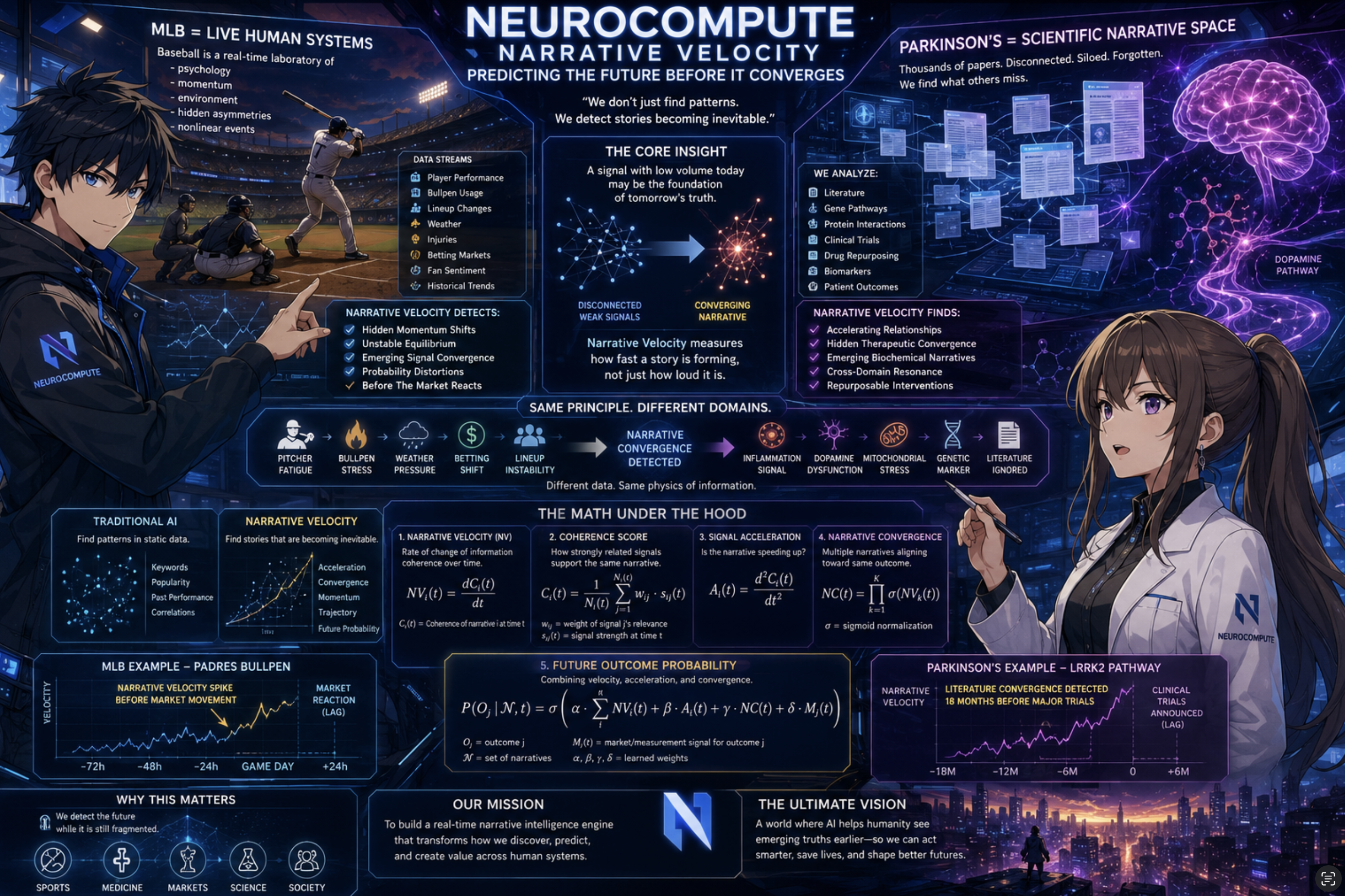
Neurocompute Parkinson’s Narrative Velocity Infographic
NEUROCOMPUTE VISUAL SYSTEM

Open the Narrative Velocity Map

Explore the full Parkinson’s research intelligence diagram.

Expand Intelligence View →
Full Neurocompute Infographic