← Back to all signals
RESEARCH PAPER ANALYSIS

Extreme heat and hospitalization with Parkinson's disease among older adults.

A national Medicare case-crossover study found that extreme heat modestly increases the odds of hospitalization with Parkinson’s disease (small but significant cumulative OR ~1.02 for 99th vs 50th percentile over 3 days), with stronger effects in temperate regions.

PMID41974975
JournalJournal of exposure science & environmental epidemiology
Publication Date2026-04-13
Ingested2026-04-28 08:58 PM
EXECUTIVE SUMMARY

What the AI sees

A national Medicare case-crossover study found that extreme heat modestly increases the odds of hospitalization with Parkinson’s disease (small but significant cumulative OR ~1.02 for 99th vs 50th percentile over 3 days), with stronger effects in temperate regions.

WHY IT MATTERS

Research significance

This epidemiologic evidence highlights a climate- and region-specific risk factor relevant for clinical guidance and public-health planning for PD patients, but it offers limited mechanistic or therapeutic discovery insight.

ABSTRACT

Source abstract

BACKGROUND: The projected rise in U.S. Parkinson's Disease (PD) cases makes understanding risk factors crucial to plan for changing healthcare utilization patterns. Factors such as extreme heat exacerbated by shifts in regional climate conditions may present additional risks among the PD population. OBJECTIVE: We aim to determine whether nationwide and climate region-specific acute heat index exposure is associated with increased rates of hospitalizations with PD among the Medicare population. METHODS: We follow a time-stratified case-crossover study design for a population of Medicare fee-for-service beneficiaries within the contiguous U.S. hospitalized between 1 January 2000 and 31 December 2016. The exposure of interest is the daily maximum heat index during the warm season (May-September), converted to percentiles using climate region-specific warm season heat index distributions. We used distributed lag models to estimate the immediate and lagged associations of heat index on hospitalization with PD. RESULTS: Our sample included 427,813 individuals (89.3% White, 47.7% female, mean age 79.8). In nationwide analyses, the odds ratio (OR) of hospitalization with PD comparing days in the 99th versus 50th percentile of the heat index distribution was 1.010 (95% CI 1.002, 1.017). Results suggest extreme heat effects persist 2 days beyond the initial day. The cumulative OR of hospitalization with PD after 3 days of continuous exposure (i.e., cumulative over lags 0-2) to heat indexes at the 99th versus 50th percentile was 1.022 (95% CI: 1.005, 1.039). Estimates were larger in temperate climates, while tropical, arid, and continental regions showed varying impacts with non-significant associations. SIGNIFICANCE: High heat index exposure is associated with increased odds of hospitalization with PD amongst older adults, particularly those living in temperate climates in the US South. These results may inform both medical practice and policy through crafting PD-patient-centered hotweather advice and via the issuance of local and state extreme heat advisories. IMPACT: For an aging society, the threat of increased frequency of extreme heat from climate change poses significant risks to older adults, especially those living with Parkinson's Disease (PD). Our work addresses gaps in several preceding studies by exploring more fully how effects of extreme heat on the risk of PD-related hospitalization differ across climate types and by sex. The additional insight presented in our analysis can equip practitioners and policymakers with the data required to help mitigate the threats of extreme heat on patients with PD.

SUPPORTING PAPER SET

32 more papers to review

Ranked by current scoring engine
1 The cGAS-STING-Glymphatic-gut Axis in Parkinson's disease: A proposed self-amplifying triad of Neuroinflammation and therapeutic opportunity. International immunopharmacology 91.0 2 Immunosenescence and Inflammaging as Drivers of Neurodegeneration: Cellular Mechanisms, Neuroimmune Crosstalk, and Therapeutic Implications. Cells 91.0 3 Flavonoids improve neurotransmitters for Parkinson's treatment: mechanism and therapeutic potential. Frontiers in pharmacology 88.0 4 Alpha-Lipoic Acid and Biotin in Neurodegenerative Diseases: Convergent Mechanistic Insights from Preclinical Models to Clinical Perspectives. Neurology international 78.0 5 The Gut Microbiota in Parkinson's Disease: Mechanistic Insights into Microbial-Host Interactions. Microorganisms 85.0 6 Linking inflammation, metabolic dysfunction, and neurodegeneration: a comprehensive review of TLR2 pathways in type 2 diabetes. Frontiers in clinical diabetes and healthcare 80.0 7 Neuroprotective effects of GLP-2 and a GLP-2/GIP dual receptor agonist in an MPTP-induced mouse model of Parkinson's disease. Peptides 86.0 8 TNF alpha unmasks enteric malate aspartate shuttle dysfunction bridging Parkinson disease and intestinal inflammation. Nature communications 91.5 9 Lipid Metabolism and Neurodegeneration: Mechanistic Insights and Therapeutic Targets. Ageing research reviews 82.0 10 Shared functional microbiome signatures in Parkinson's disease and constipation predominate irritable bowel syndrome despite taxonomic divergence. Brain, behavior, & immunity - health 80.0 11 Benzimidazole as a Versatile Scaffold for Developing Neurotherapeutics Against Neurodegenerative Diseases. ChemMedChem 74.0 12 Biomimicking neuromelanin reverses the gait deficits and dopaminergic neuronal loss in the Parkinson's disease. Colloids and surfaces. B, Biointerfaces 86.0 13 Neuroprotective roles of klotho: Molecular pathways and therapeutic implications for cognitive health in neurological and psychiatric diseases. Experimental physiology 84.0 14 Flavonoid Rutin Reduces Intestinal Inflammation in an Experimental Model of Parkinson's Disease. Neurotoxicity research 70.0 15 Nanostructured Lipid Carriers Enhance Brain Delivery and Antioxidant Efficacy of a Small-Molecule MAO B Inhibitor for Neurodegenerative Disease Therapy. Molecular pharmaceutics 78.0 16 Pathophysiological Role of the Gut Brain Axis in Parkinson's Disease: From Microbial Metabolites and Intestinal Permeability to Central Neuroinflammation. Current neurovascular research 86.0 17 Parkinson's Disease: From Metabolism to Genetics-A Comprehensive Review. Current issues in molecular biology 86.0 18 Navigating the cholesterol maze: Key insights on use of statins in neurodegenerative disorders. Neuroprotection (Chichester, England) 76.0 19 Integrative network pharmacology delineates dual GPCR and non-GPCR mechanisms of blended and individual Taikong Blue lavender and Pingyin rose essential oils in neurodegenerative and psychiatric disorders. Computers in biology and medicine 65.0 20 Models of neuroprotection in Parkinson's disease: Exploring cellular, molecular, and microenvironmental targets. Experimental neurology 78.0 21 Hyaluronic acid: emerging roles and biomaterial innovations in Alzheimer's and Parkinson's disease therapy. Frontiers in pharmacology 75.2 22 Molecular mechanisms underlying Parkinson's disease and role of phytochemicals, α-synuclein, sirtuins, and incretin mimetics in potential therapy. Frontiers in pharmacology 75.0 23 Lipid droplets in neurodegenerative diseases: pathological drivers and therapeutic vulnerabilities. Cell death discovery 82.0 24 Brain-gut-microbiota axis: a review on the bidirectional regulatory mechanisms between gut microbiota and brain and their disease interactions. Frontiers in microbiology 74.0 25 Long non-coding RNAs in neurodegenerative diseases - Molecular mechanisms, liquid biopsy biomarkers, and therapeutic targets: A review. Biomolecules & biomedicine 84.0 26 Neurosyphilis and Parkinsonism: Overlapping Pathophysiology and Emerging Therapeutic Insights. Current neurovascular research 76.0 27 Molecular biochemistry of soluble epoxide hydrolase in lipid mediator pathways and neuroinflammatory responses. The Journal of steroid biochemistry and molecular biology 82.0 28 Multifaceted role of CNPY2 beyond ER stress: Disease implications and therapeutic potential. Cell stress 83.3 29 Neuroprotective Role of Exercise-based Physiotherapy Combined with Pharmacological Agents in Parkinson's Disease. Central nervous system agents in medicinal chemistry 64.0 30 Distinct metabolomic and proteomic signatures in Parkinson's disease patients with REM sleep behavior disorder. Signal transduction and targeted therapy 84.0 31 HMGB1-mediated neuroinflammation: molecular mechanisms and emerging therapeutic approaches. Inflammopharmacology 78.0 32 Beyond acid-base dyshomeostasis: Dynamic instability of neuronal lysosomal pH as a pathogenic mechanism and therapeutic target in neurological diseases. Biochemical pharmacology 88.0
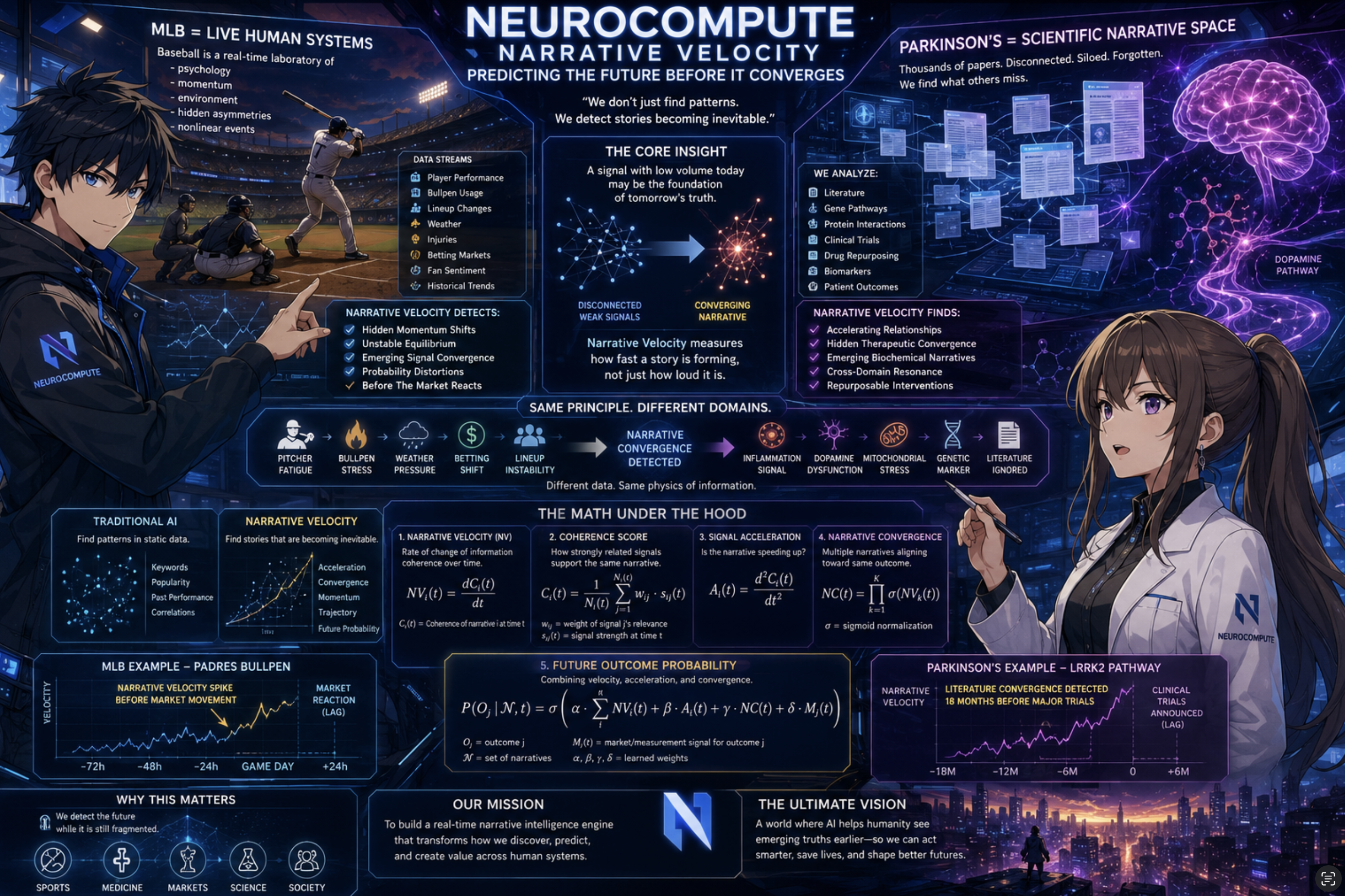
Neurocompute Parkinson’s Narrative Velocity Infographic
NEUROCOMPUTE VISUAL SYSTEM

Open the Narrative Velocity Map

Explore the full Parkinson’s research intelligence diagram.

Expand Intelligence View →
Full Neurocompute Infographic