E grade · PMID 41987070
View analysis →Finding therapies hidden in 1,516 Parkinson’s papers.
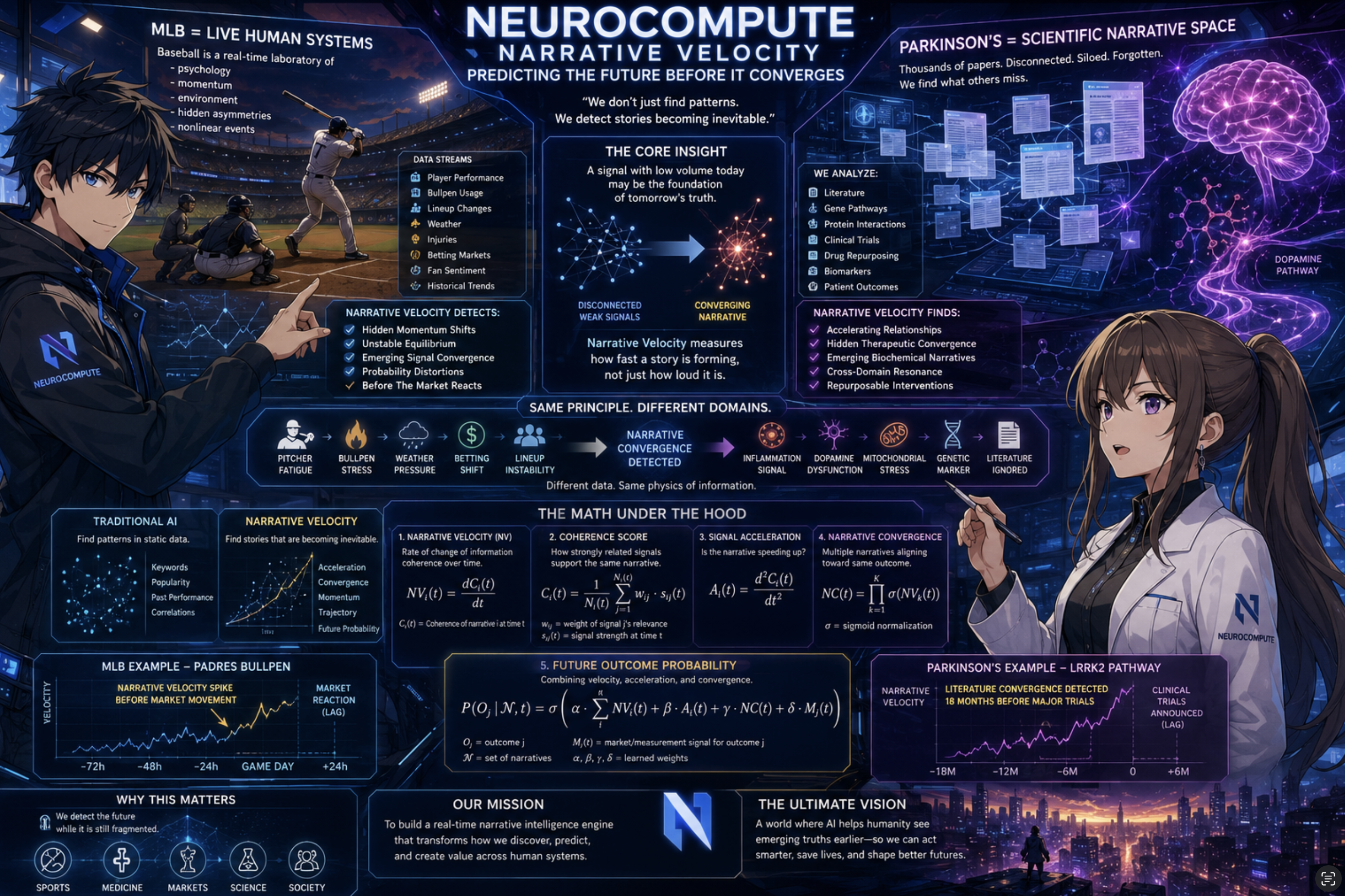
Neurocompute scores biomedical literature, surfaces overlooked patterns, and turns Parkinson’s research into a living discovery terminal.
Ranked discovery teasers
E grade · PMID 41955275
View analysis →E grade · PMID 41987457
View analysis →E grade · PMID 41992817
View analysis →E grade · PMID 42002559
View analysis →E grade · PMID 41896776
View analysis →E grade · PMID 41940961
View analysis →E grade · PMID 41912246
View analysis →E grade · PMID 42048627
View analysis →E grade · PMID 42029653
View analysis →Database feed
All ranked Parkinson’s papers
Randomized controlled trial testing intravenous esketamine for perioperative depressive symptoms in Parkinson's disease patients, assessing efficacy and safety.
Provides clinically actionable repurposing evidence for managing perioperative depression in PD—relevant for symptom control and perioperative outcomes—but offers limited insight into disease‑modifying mechanisms or core PD biology.
This paper addresses fecal microbiota transplantation (FMT) as a potential therapeutic approach for Parkinson's disease, focusing on the gut–brain axis but provides no abstract or concrete data in the submission.
Microbiome modulation is a plausible, translationally relevant avenue for PD (gut–brain interactions, inflammation, metabolism), but the lack of accessible data or mechanistic/clinical detail limits immediate utility for therapeutic discovery.
Perspective/review on using virtual reality to understand and manage freezing of gait in Parkinson's disease, emphasizing assessment and rehabilitation approaches rather than molecular mechanisms, though the abstract is missing.
Highlights a potentially useful non‑pharmacological, translational avenue for symptom management and improved phenotyping of gait disturbances, but offers limited actionable insights for drug discovery or molecular target development.
The paper analyzes pre-beta burst dynamics in Parkinson's disease to separate genuine neural beta-burst activity from recording artifacts.
Improving discrimination of true beta-burst signals could refine electrophysiological biomarkers and DBS tuning with translational relevance, but absence of an abstract and limited mechanistic or therapeutic content reduce its direct value for drug discovery.
Describes a multimodal explainable AI framework to predict Parkinson's disease from heterogeneous data sources, emphasizing interpretability rather than biological mechanisms.
Improved interpretable prediction could help identify candidate biomarkers and stratify patients for trials, but with no abstract and little mechanistic or therapeutic content the paper has limited direct value for drug discovery.
Cross-sectional comparison of olfactory dysfunction in essential tremor with rest tremor versus Parkinson's disease and essential tremor to evaluate smell impairment as a differential diagnostic marker.
May inform biomarker-based differentiation between PD and tremor disorders and improve early diagnosis, but offers limited direct mechanistic or therapeutic insights for Parkinson's drug discovery.
This study uses per-patient ('N-of-1') tissue activation modeling of subthalamic nucleus deep brain stimulation to identify regional stimulation patterns that predict declines in verbal fluency in Parkinson's disease.
Although it does not address molecular mechanisms or drug targets, the paper has translational clinical value by informing personalized DBS targeting and predictive modeling to reduce cognitive side effects, which can improve patient outcomes and trial design for neuromodulation interventions.
Title indicates a clinical-focused work on orthostatic hypotension in Parkinson disease; the abstract is missing so specific findings, mechanisms, or interventions are unclear.
Relevant to symptomatic management and to understanding autonomic involvement in PD (which could inform biomarkers or peripheral alpha‑synuclein pathology), but with limited immediate value for novel therapeutic discovery given the likely clinical/symptom focus and lack of available abstract.
An editor's note highlighting potential links between cerebral perfusion abnormalities and motor dysfunction in Parkinson's disease, but providing no primary data or detailed mechanistic insight.
Cerebral perfusion could reveal vascular contributions, imaging biomarkers, or repurposable vascular interventions for PD, but the editorial format and missing abstract limit immediate actionable or translational value.
A brief commentary on a case-control analysis linking diet to Parkinson's disease risk that provides critique/interpretation but no new data or clear therapeutic targets.
It flags epidemiological links between diet and PD that could motivate mechanistic work on gut-brain and metabolic pathways, but as a comment it offers limited actionable insights for therapy development.
This study compares the screening performance of the MDS‑UPDRS single anxiety item against the Hamilton Anxiety Rating Scale in people with Parkinson's disease.
Improves identification of anxiety for clinical care and trial assessments in PD but provides limited direct mechanistic or therapeutic discovery insights.
A methodological investigation asking whether the reported pre-beta burst dip in Parkinson's disease electrophysiology reflects true biology or an analytical artifact.
Resolving artifact versus biological signal improves confidence in beta-burst–based biomarkers and electrophysiology-driven trial endpoints, but the paper is low on direct therapeutic mechanisms or translational interventions.
Clinical report describing early cervical and orofacial dystonia in levodopa-naïve patients with PRKN (parkin) mutations, indicating variable dystonic manifestations in parkin-related Parkinson's disease.
Refines genotype–phenotype characterization that can improve early diagnosis and patient stratification for studies, but presents limited immediate therapeutic or mechanistic insights (abstract missing), so its direct value for drug discovery is low.
This paper describes an automatic, explainable video-based human motion analysis approach for assessing Parkinson's disease motor signs, aimed at objective diagnosis and monitoring.
Provides a scalable, noninvasive method to quantify motor symptoms and generate clinical biomarkers useful for patient stratification and trial endpoints, but offers little insight into disease mechanisms or therapeutic targets.
Likely a deep-learning approach for early Parkinson's diagnosis that combines spatial-temporal dual pathways with multi-scale attention fusion, but the abstract is missing so methodological and validation details are unclear.
Could improve early detection and patient stratification for trials, but offers little direct actionable mechanistic or therapeutic insight for Parkinson's disease drug discovery.
Title suggests a systems-level 'network signature' linked to Parkinson's disease, but no abstract or methodological details are provided so the specific mechanisms, targets, or biomarkers are unclear.
Network signatures can point to biomarkers or convergent pathways for therapeutic targeting and repurposing, but without accessible data or methods this manuscript currently has low actionable value for Parkinson's drug discovery.
This is a correction notice for a study proposing an end-to-end transformer (E2E-TM) that integrates MRI and EEG for Parkinson's diagnosis; no abstract or new experimental/therapeutic details are provided.
The work pertains to diagnostic/biomarker development—which can aid patient stratification and trials—but as a correction with no new data it offers minimal direct value for therapeutic discovery or mechanistic insights.
Develops and validates the Parkinson's Voice and Speech Handicap Index (PaVSHI), a patient-reported questionnaire to quantify voice and speech disability in Parkinson's disease.
Offers a validated clinical outcome measure useful for assessing symptom burden and tracking intervention effects in trials, but provides minimal mechanistic or therapeutic-discovery insight.
This is a correction notice to a review that revisits Parkinson’s disease definition and classification using two emerging biological frameworks and does not present new experimental data or direct therapeutic findings.
Although the correction itself offers little actionable therapeutic information, refined conceptual frameworks can still help align biomarker-based patient stratification and research priorities that indirectly support future drug discovery efforts.
This cross-sectional inter-rater agreement study examines how well the 5-2-1 pragmatic criteria align with neurologists' clinical judgment for identifying advanced Parkinson's disease in a Moroccan cohort.
Improves clinical staging and may aid patient selection for advanced therapies or trials, but provides little mechanistic or translational insight relevant to therapeutic discovery.