AI-POWERED RESEARCH INTELLIGENCE

Finding therapies hidden in 1,516 Parkinson’s papers.

Neurocompute scores biomedical literature, surfaces overlooked patterns, and turns Parkinson’s research into a living discovery terminal.

1,516Papers indexed
984Papers AI scored
998Ranked papers
0.7%Coverage
LIVE RESEARCH INTELLIGENCE
↑ Narrative velocity rising ↑ New papers ingested ↑ Cross-paper convergence detected ↑ AI score dials updating ↑ Research blind spots surfacing
TOP SIGNALS TODAY

Ranked discovery teasers

View all discoveries →
RESEARCH TERMINAL

All ranked Parkinson’s papers

1516 results
AI Summary

An editorial comparing diagnostic performance of standard susceptibility map-weighted imaging versus susceptibility maps reconstructed from clinical SWI and neuromelanin MRI for early Parkinson’s disease.

Why It Matters

Better imaging biomarkers can improve early diagnosis and trial stratification—useful for translational studies—but as an editorial without new mechanistic or therapeutic data its direct value for drug discovery is limited.

E
AI-based mouse behavior analysis in pathology: A focus on movement disorders.
PMID 42031087 Published: 2026-04-22 Ingested: 2026-04-28 08:58 PM Neuroscience and biobehavioral reviews
AI50.0
Base6.8
Rank7.3
AI Summary

A methods-focused review surveying AI-driven video and inertial-sensor approaches for high-resolution, multimodal rodent behavioral phenotyping with emphasis on Parkinsonian motor deficits and L-DOPA-induced dyskinesia.

Why It Matters

This paper outlines scalable, objective behavioral endpoints and multimodal strategies that can improve preclinical screening, biomarker development, and linkage of motor phenotypes to neural activity—accelerating therapeutic evaluation—though it does not provide direct mechanistic targets or…

E
A pilot study of assessing visual hallucinations using virtual reality in lewy body disorders.
PMID 41933015 Published: 2026-04-03 Ingested: 2026-04-28 08:58 PM Scientific reports
AI30.0
Base6.8
Rank7.3
AI Summary

Pilot study using structured VR exposure in 11 people with Parkinson's disease or dementia with Lewy bodies to elicit and characterize abnormal visual perceptual events, finding more misperceptions and hallucination-like events in visually degraded VR conditions but no clear separation between…

Why It Matters

Demonstrates a feasible, tolerable, and potentially objective VR-based phenotyping approach that could be developed as a biomarker or outcome measure for trials targeting visual hallucinations, though the small sample size and technical limitations limit immediate therapeutic translation.

E
A Methodological Review of Voice Acoustic Parameters, with Emphasis on Vocal Tremor: Definitions, Computation, and Software Tools.
PMID 41951462 Published: 2026-04-07 Ingested: 2026-04-28 08:58 PM Journal of voice : official journal of the Voice Foundation
AI25.0
Base6.8
Rank7.3
AI Summary

This paper is a structured methodological review of acoustic parameters for characterizing vocal tremor, comparing definitions, computations, and implementations across common voice-analysis software and advocating a multidimensional parameter framework.

Why It Matters

Standardizing and clarifying voice-acoustic features can improve development and reliability of speech-based biomarkers for Parkinson's disease diagnosis and monitoring, aiding patient stratification and outcome measurement in trials, though it offers little direct insight into therapeutic…

E
AI10.0
Base6.8
Rank7.3
AI Summary

Two systematic reviews of private drinking water in Pennsylvania identify chemical and biological contamination, links to shale gas drilling, and a small number of studies reporting health effects including one reporting an association with Parkinson's disease, recommending increased testing and…

Why It Matters

This paper has low direct value for Parkinson's therapeutic discovery but is relevant epidemiologically by flagging environmental water contaminants as possible PD risk factors that could justify targeted exposure studies to inform prevention and mechanistic research.

E
N-acetyl-L-leucine in Neurological Disorders: Mechanisms, Evidence, and Therapeutic Perspectives.
PMID 42047969 Published: 2026-04-28 Ingested: 2026-04-28 08:58 PM Cerebellum (London, England)
AI35.0
Base5.7
Rank6.3
AI Summary

A review of N‑acetyl‑L‑leucine describing proposed mechanisms, preclinical and clinical evidence, and therapeutic perspectives across neurological disorders.

Why It Matters

Offers moderate repurposing potential for Parkinson's by highlighting neuroprotective and symptomatic mechanisms, but the lack of PD‑specific data, absent abstract, and limited coverage of key PD pathways (alpha‑synuclein, mitochondria, lysosomes) reduce its immediate translational value.

E
AI28.0
Base5.7
Rank6.3
AI Summary

A review proposing deoxyelephantopin as a multifunctional sesquiterpene with anticancer and neuroprotective potential, but the paper (no abstract provided) lacks PD-specific mechanistic or translational data.

Why It Matters

The compound's reported anti-inflammatory and antioxidant profiles could be relevant to PD-related pathways (mitochondria, neuroinflammation, proteostasis), making it a candidate for follow-up assays, yet the current article offers low immediate actionability for Parkinson’s therapeutic discovery.

E
AI25.0
Base5.7
Rank6.3
AI Summary

This study evaluates CT-guided spatial normalization approaches to improve semi-quantitative analysis of dopamine transporter SPECT for detecting nigrostriatal degeneration.

Why It Matters

Better CT-guided normalization can improve accuracy and reproducibility of DAT SPECT biomarkers for diagnosis, patient stratification, and monitoring in Parkinson's therapeutic trials, though it does not provide direct mechanistic or interventional insights.

E
Analysis of head movements during gait in healthy populations and people with neurological disorders: a systematic review.
PMID 41966582 Published: 2026-04-02 Ingested: 2026-04-28 08:58 PM Journal of biomechanics
AI15.0
Base5.3
Rank6.0
AI Summary

Systematic review of methods and outcomes for measuring head movements during unperturbed gait in healthy people and those with neurological disorders, finding heterogeneous metrics, limited patient data, and reported differences such as altered acceleration and shock absorption but few studies…

Why It Matters

While not offering molecular or therapeutic targets, the paper identifies candidate biomechanical biomarkers and measurement gaps that could inform clinical phenotyping, outcome measures, and rehabilitation strategies relevant to Parkinson's gait dysfunction and trial design.

E
[Research progress on intelligent brain age prediction methods in diagnosis of Parkinson's disease].
PMID 42037347 Published: 2026-04-25 Ingested: 2026-04-28 08:58 PM Sheng wu yi xue gong cheng xue za zhi = Journal of biomedical engineering = Shengwu yixue gongchengxue zazhi
AI30.0
Base4.8
Rank5.6
AI Summary

Systematic review of statistical, traditional machine learning, and deep learning approaches for predicting brain age in Parkinson's disease, covering workflows and current clinical applications.

Why It Matters

Brain-age prediction methods can provide noninvasive biomarkers for early diagnosis, disease monitoring, and trial stratification in PD, improving translational research and clinical evaluation despite not directly revealing therapeutic mechanisms.

E
Narrative Review "Dual Frontiers in Neurodegeneration: Pharmacological Synergies and Divergences in Parkinson's Disease and Type 2 Diabetes Mellitus".
PMID 41931123 Published: 2026-04-03 Ingested: 2026-04-28 08:58 PM Cellular and molecular neurobiology
AI40.0
Base3.0
Rank5.5
AI Summary

Narrative review comparing pharmacological synergies and divergences between Parkinson's disease and type 2 diabetes mellitus, emphasizing shared metabolic and inflammatory pathways and their therapeutic implications.

Why It Matters

By linking metabolic/inflammatory mechanisms (and potential repurposing of diabetes drugs) to neurodegeneration, the paper could guide translational strategies for PD, but its narrative format and missing abstract reduce immediate actionability.

E
Peripheral immunochemical considerations in Parkinson disease: sources, targets and crosstalk mechanisms.
PMID 41981587 Published: 2026-04-14 Ingested: 2026-04-28 08:58 PM Journal of translational medicine
AI52.0
Base1.2
Rank2.5
AI Summary

A review-focused paper examining peripheral immune sources, targets, and crosstalk mechanisms implicated in Parkinson’s disease.

Why It Matters

By concentrating on peripheral immune pathways and their communication with the CNS (including inflammation and potential gut–brain interactions), it may point to biomarkers and immune-modulating therapeutic strategies, though the missing abstract limits assessment of novelty and actionability.

E
Author Correction: TMEM175, SCARB2 and CTSB associations with Parkinson's disease risk across populations.
PMID 41974742 Published: 2026-04-13 Ingested: 2026-04-28 08:58 PM NPJ Parkinson's disease
AI45.0
Base1.2
Rank2.5
AI Summary

This author correction pertains to a genetic association study linking lysosome-related genes TMEM175, SCARB2 (LIMP-2), and CTSB (cathepsin B) with Parkinson's disease risk across populations.

Why It Matters

These genes point to lysosomal dysfunction, a therapeutically actionable pathway and biomarker axis relevant to GBA-related and broader PD biology, but being a correction with no abstract or new experimental data limits immediate translational impact until the original findings are reviewed.

E
Foslevodopa+foscarbidopa for advanced Parkinson disease.
PMID 42022260 Published: 2026-04-01 Ingested: 2026-04-28 08:58 PM Australian prescriber
AI45.0
Base1.2
Rank2.5
AI Summary

Reports on foslevodopa+foscarbidopa as a therapeutic approach for advanced Parkinson disease aimed at improving symptomatic dopaminergic replacement.

Why It Matters

Clinically relevant for optimizing levodopa delivery and reducing motor fluctuations (high translational value), but offers limited mechanistic or disease‑modifying insight and evaluation is constrained by the missing abstract.

E
Impact of catechol-O-methyltransferase inhibition on plasma homocysteine levels in levodopa-treated Parkinson's disease.
PMID 42014471 Published: 2026-04-21 Ingested: 2026-04-28 08:58 PM Journal of neural transmission (Vienna, Austria : 1996)
AI40.0
Base1.2
Rank2.5
AI Summary

Paper evaluates whether inhibiting catechol-O-methyltransferase (COMT) affects plasma homocysteine concentrations in levodopa-treated Parkinson’s disease patients.

Why It Matters

Findings are clinically actionable because reduced levodopa-induced homocysteine via COMT inhibition could lower vascular and potential neurotoxic risk and guide adjunct strategies (COMT inhibitor choice or B‑vitamin management) to improve long-term outcomes, though lack of an abstract limits…

E
Parkinson's Disease: Is It Hidden in the Gut Ecology the Ariadne's Thread Leading to Help?
PMID 41918128 Published: 2026-03-31 Ingested: 2026-04-28 08:58 PM Journal of digestive diseases
AI40.0
Base1.2
Rank2.5
AI Summary

A review-style paper proposing that dysregulated gut ecology and gut–brain interactions may play a role in Parkinson’s disease and could inform therapeutic or biomarker strategies.

Why It Matters

Highlights the gut–brain axis and microbiome as promising, translational targets for PD diagnostics and interventions, but absence of an abstract and likely review nature limit immediate actionable insights.

E
AI35.0
Base1.2
Rank2.5
AI Summary

A clinical and neurophysiological investigation of whether levodopa treatment is associated with peripheral polyneuropathy in people with Parkinson’s disease.

Why It Matters

If levodopa contributes to neuropathy via metabolic changes (e.g., B12/homocysteine pathways), the finding could guide monitoring, simple supplementation or management strategies to improve safety and tolerability of a cornerstone therapy, though it is less directly informative about core…

E
Intestinal smooth muscle macrophages: linking the ENS and CNS in Parkinson's disease.
PMID 41951183 Published: 2026-04-06 Ingested: 2026-04-28 08:58 PM Gastroenterology
AI32.0
Base1.2
Rank2.5
AI Summary

This paper posits that intestinal smooth muscle macrophages form a link between the enteric nervous system and the CNS in Parkinson’s disease, implicating gut-resident immune cells in neuroinflammatory and potential alpha-synuclein propagation pathways.

Why It Matters

If supported by experimental data, this gut-immune—ENS connection could yield biomarkers or therapeutic entry points to modulate inflammation or block pathology spread, but the missing abstract limits assessment of actionable evidence and translational readiness.

E
The Unusual Suspects: Macrophages in Parkinson's Disease?
PMID 42046394 Published: 2026-04-27 Ingested: 2026-04-28 08:58 PM Movement disorders : official journal of the Movement Disorder Society
AI30.0
Base1.2
Rank2.5
AI Summary

Based on the title, this appears to be a review/discussion of peripheral and brain macrophages' roles in Parkinson's disease but the abstract is missing, so specific data, mechanisms, or interventions are unclear.

Why It Matters

Macrophage-focused research intersects with inflammation, alpha-synuclein clearance, and peripheral biomarkers—areas with translational and therapeutic potential—yet the missing abstract and likely speculative review format limit immediate actionability for drug discovery.

E
Role of Folate Metabolism in Neurodegenerative Diseases: Insight from Experimental and Clinical Studies.
PMID 42043709 Published: 2026-04-27 Ingested: 2026-04-28 08:58 PM Current nutrition reports
AI30.0
Base1.2
Rank2.5
AI Summary

A broad review summarizing experimental and clinical evidence that disturbances in folate and one‑carbon metabolism are associated with neurodegenerative diseases.

Why It Matters

Connects metabolism, homocysteine and methylation to neurodegeneration and highlights biomarker and repurposing opportunities (e.g., folate supplementation), but is non‑specific to Parkinson's and lacks clear, actionable therapeutic targets or novel PD‑focused data.

Previous
Page 47 of 76
Next
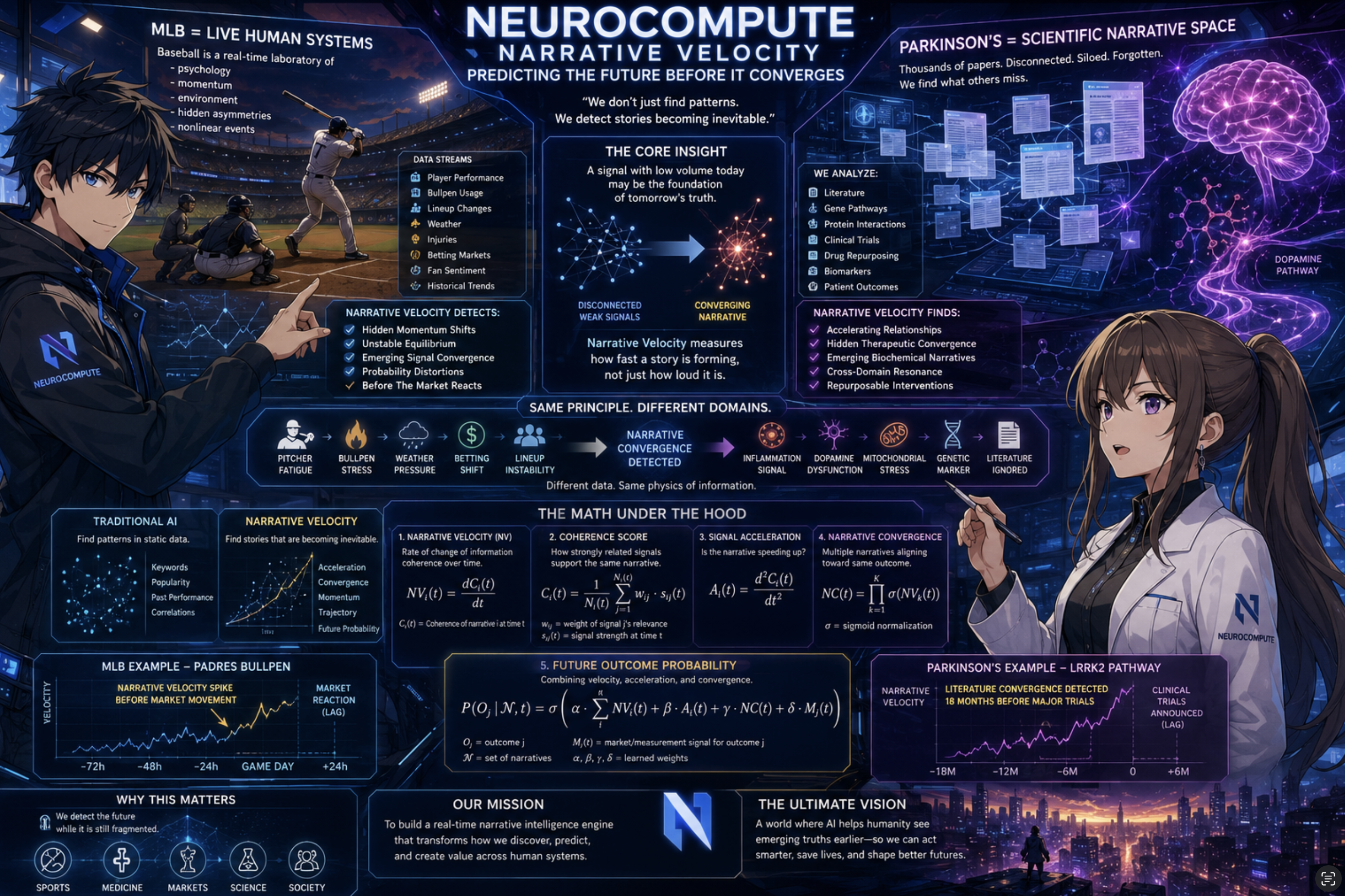
Neurocompute Parkinson’s Narrative Velocity Infographic
NEUROCOMPUTE VISUAL SYSTEM

Open the Narrative Velocity Map

Explore the full Parkinson’s research intelligence diagram.

Expand Intelligence View →
Full Neurocompute Infographic