E grade · PMID 41975387
View analysis →Finding therapies hidden in 1,516 Parkinson’s papers.
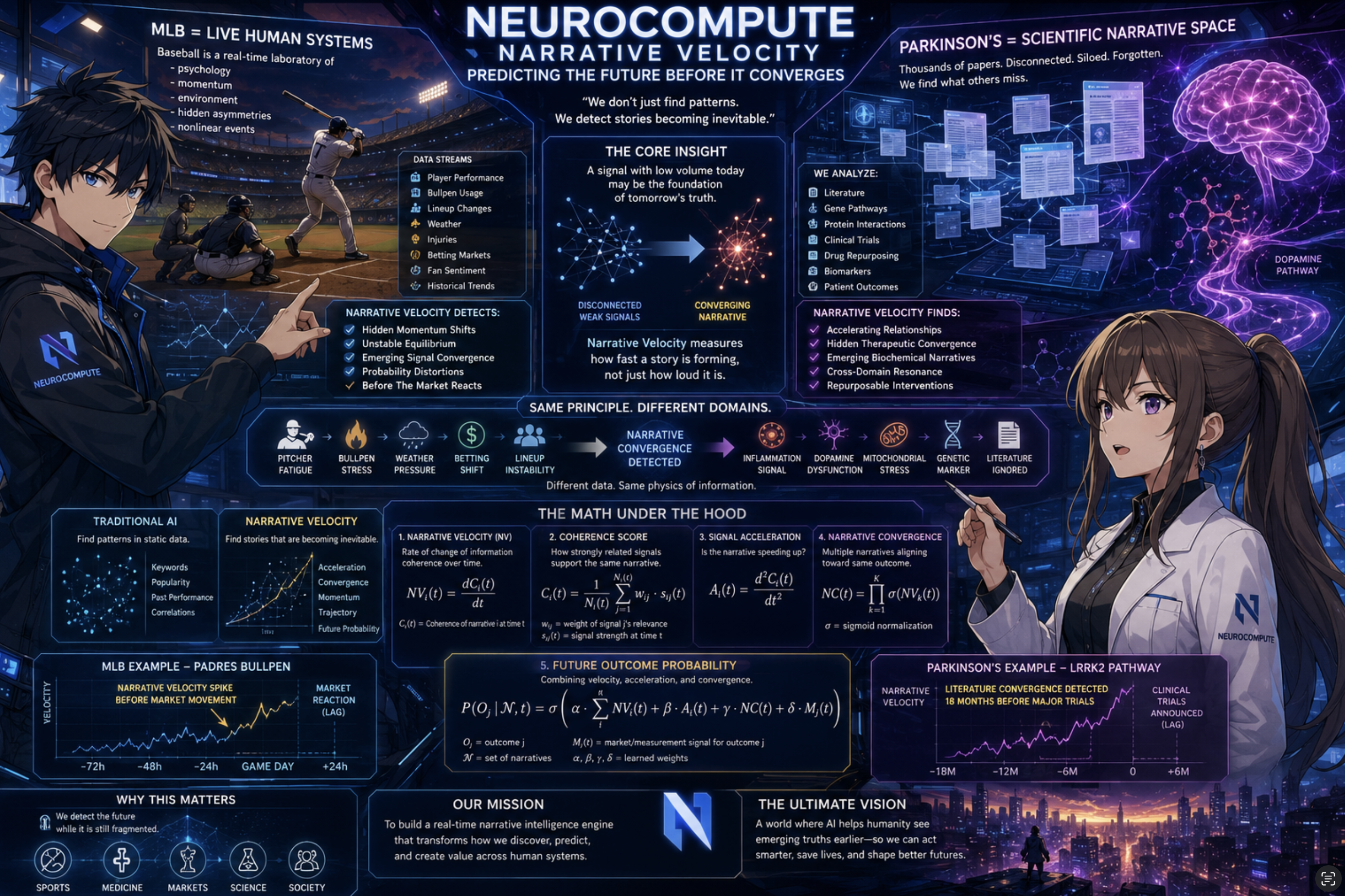
Neurocompute scores biomedical literature, surfaces overlooked patterns, and turns Parkinson’s research into a living discovery terminal.
Ranked discovery teasers
E grade · PMID 42000835
View analysis →E grade · PMID 42045279
View analysis →E grade · PMID 42012017
View analysis →E grade · PMID 41990985
View analysis →E grade · PMID 41968129
View analysis →E grade · PMID 41988218
View analysis →E grade · PMID 41896012
View analysis →E grade · PMID 41955966
View analysis →E grade · PMID 41951129
View analysis →Database feed
All ranked Parkinson’s papers
Short commentary proposing that integrating olfactory training (including essential oils) with visual rehabilitation could exploit olfactory–visual neuroplasticity to improve sensory function after COVID-19 and in conditions mentioned such as Parkinson's.
Low direct Parkinson's therapeutic discovery value because it lacks mechanistic, biomarker, or intervention detail, but it flags a non-pharmacological neurorehabilitation concept that could inform quality-of-life and symptomatic care studies.
Longitudinal wearable-sensor data identified multiple walking, non-walking, and composite digital measures that sensitively track progression in early- to mid-stage Parkinson's disease—some outperforming conventional clinical scales and detecting change within ~10 months.
These objective, remote digital biomarkers could increase sensitivity and temporal resolution in PD trials and monitoring, enabling smaller/shorter studies and earlier detection of treatment effects to accelerate therapeutic development.
Authors trained a convolutional neural network on frequency features from a single lumbar accelerometer during quiet standing and achieved ~98–99% accuracy distinguishing 40 early untreated PD patients from 79 controls.
Provides a simple, noninvasive, high-accuracy candidate biomarker for detecting subtle early postural impairment that could aid earlier diagnosis, trial enrollment, and objective outcome measurement, though it does not advance mechanistic or therapeutic targets.
Describes PPMI's use of participant advisors, advisory boards, and communication channels to adapt platforms, return-of-results policies, lumbar puncture education, recruitment strategies, and travel procedures to make the study more accessible and participant-centered.
Enhancing participant engagement and study procedures improves enrollment, diversity, and quality/quantity of biospecimens and clinical data, which indirectly accelerates biomarker discovery and translational Parkinson's therapeutic research despite lacking direct mechanistic or intervention…
This study maps PP2Ac–LRRK2 interaction sites using PEP-scan and identifies two peptides (P3, M1) that compete with the PP2A/LRRK2 interaction in vitro.
LRRK2 is a major Parkinson's disease-linked protein, so peptides that disrupt its interaction with PP2A are useful mechanistic tools with potential therapeutic relevance, but the work lacks cellular, functional, or in vivo validation needed for strong translational impact.
Externally validated machine-learning model using clinical and GAITRite gait data classifies PD fallers vs non-fallers with ~88–89% accuracy and highlights fear of falling, stride/velocity/rotation measures, and autonomic dysfunction as key features.
Although it does not identify molecular therapeutic targets, the work provides a robust, multidomain biomarker for fall-risk stratification and patient selection/outcome measurement in trials aimed at reducing falls or treating balance and autonomic symptoms in PD.
This cross-ancestry analysis validates the NeuroBooster array for genotyping known Parkinson's pathogenic variants, reports their frequencies across diverse ancestries, and assesses per-variant genotyping quality.
Although not mechanistic or therapeutic itself, the study provides a validated, ancestrally diverse genetic resource that improves variant ascertainment for target validation, cohort selection, and equitable discovery efforts that can enable future therapy development.
This chapter reviews transcranial B‑mode sonography (TCBS) methodology and the evidence supporting its use to image the brainstem and aid diagnosis of Parkinson disease and other parkinsonisms.
As a low-cost, noninvasive imaging biomarker with reported high accuracy and interrater reliability, TCBS can support diagnosis, differential diagnosis, and patient stratification in clinical research and trials, though it provides little direct mechanistic or therapeutic insight.
This paper reports generation and characterization of three donor-matched iPSC lines derived from postmortem dura fibroblasts from individuals with neuropathologically confirmed AD, PD, and PART, retaining donor genomic identity for use in disease modeling.
These well-characterized, autopsy-matched iPSC lines provide a valuable resource to create neural derivatives that can be directly compared to corresponding brain tissue, enabling more physiologically relevant PD modeling and downstream therapeutic or biomarker studies even though the paper does…
Multiscale computational co-simulation of cortex–basal ganglia–thalamus networks assesses effects of deep brain stimulation and stochastic noise, showing thalamic spiking variability largely reflects noise-driven fluctuations rather than changes in overall activity.
Offers a mechanistic, translatable framework that can inform DBS parameter optimization and generate hypotheses about network-level dysfunction in PD, but has limited direct applicability to molecular targets or conventional drug discovery.
In a community-based sample of 183 Framingham Heart Study participants with Parkinson's disease, annual dementia incidence was 5.0% and mortality 10.5%, with older age at PD diagnosis predicting higher risk while sex and education showed no association.
Although not mechanistic or therapeutic, the study informs prognosis and patient stratification for clinical trials by identifying older age at PD onset as a key predictor of dementia risk in community settings.
The paper implicates Fusobacteriaceae in driving Parkinson's disease through suppression of CA9 that induces ferroptosis along the gut–brain axis.
This identifies an actionable microbiome→CA9→ferroptosis pathway that could be targeted via microbiome modulation, CA9 modulation, or ferroptosis inhibitors and provides biomarker/repurposing opportunities, though the missing abstract reduces confidence in details.
Systematic review and meta-analysis assessing whether brain iron deposition correlates with emotional disorders (e.g., depression/anxiety) in Parkinson's disease patients.
A demonstrated link would point to iron accumulation as a potential imaging biomarker and mechanistic target (e.g., chelation, antioxidant strategies) for non-motor psychiatric symptoms in PD, but the missing abstract and review-only format limit immediate therapeutic actionability.
This is a correction notice for a study reporting that chronic cerebral hypoperfusion worsens Parkinson's disease dementia-like symptoms and pathology in 6-OHDA-lesioned rats by disrupting sphingolipid metabolism.
Highlights sphingolipid metabolism as a potential link between vascular insufficiency and PD-related cognitive decline—an actionable metabolic pathway—but the correction notice and missing abstract limit immediate translational or therapeutic insights.
The paper links blood–brain barrier disruption with gut microbiota dysbiosis in Parkinson’s disease, proposing a gut–brain axis association between peripheral microbial changes and central barrier integrity.
It points to potentially targetable mechanisms (microbiome modulation and BBB-protective strategies) and biomarker opportunities relevant to PD therapeutics, though lack of abstract/details limits immediate actionability.
Vignette-based EQ-5D-5L study quantifying the quality-of-life burden from sleep disturbance and early-morning OFF symptoms in people with advancing Parkinson's disease.
Highlights clinically important, measurable symptomatic burdens that can guide outcome selection and symptomatic intervention priorities in trials, but offers little mechanistic or drug-discovery information.
This paper assesses the quality and reliability of YouTube exercise videos targeting people with Parkinson's disease but does not present new mechanistic, biomarker, or therapeutic discovery data.
It helps clinicians and patients identify trustworthy exercise resources for symptom management, but offers minimal direct value for Parkinson's drug discovery or translational research.
Qualitative study showing 82% of Parkinson's patients with overactive bladder report situational triggers (mean 1.6), notably running water, that provoke urinary urgency.
Limited direct value for molecular therapeutic discovery but informs development of tailored behavioral interventions and symptom-management strategies to improve quality of life in PD.
Systematic review finds that manifest ventricular pre-excitation can cause left ventricular dysfunction via intra-LV dyssynchrony—especially with right-sided/septal accessory pathways—and that 2D strain imaging identifies dysfunction and catheter ablation largely restores function though…
This paper has minimal direct relevance to Parkinson's therapeutic discovery because it addresses cardiac electrophysiology and structural cardiomyopathy rather than neurodegenerative mechanisms (e.g., alpha-synuclein, mitochondria, inflammation) or actionable PD targets.
This review summarizes developmental origins, differentiation protocols, and applications of human iPSC/ESC-derived microglia to model microglial biology and disease-relevant phenotypes in neurodegeneration.
Offers a human-relevant platform to study microglia-driven inflammation and genetics relevant to Parkinson's disease and to prioritize targets and screens for therapeutic development, though as a review it provides synthesis rather than new actionable experimental findings.