E grade · PMID 42012648
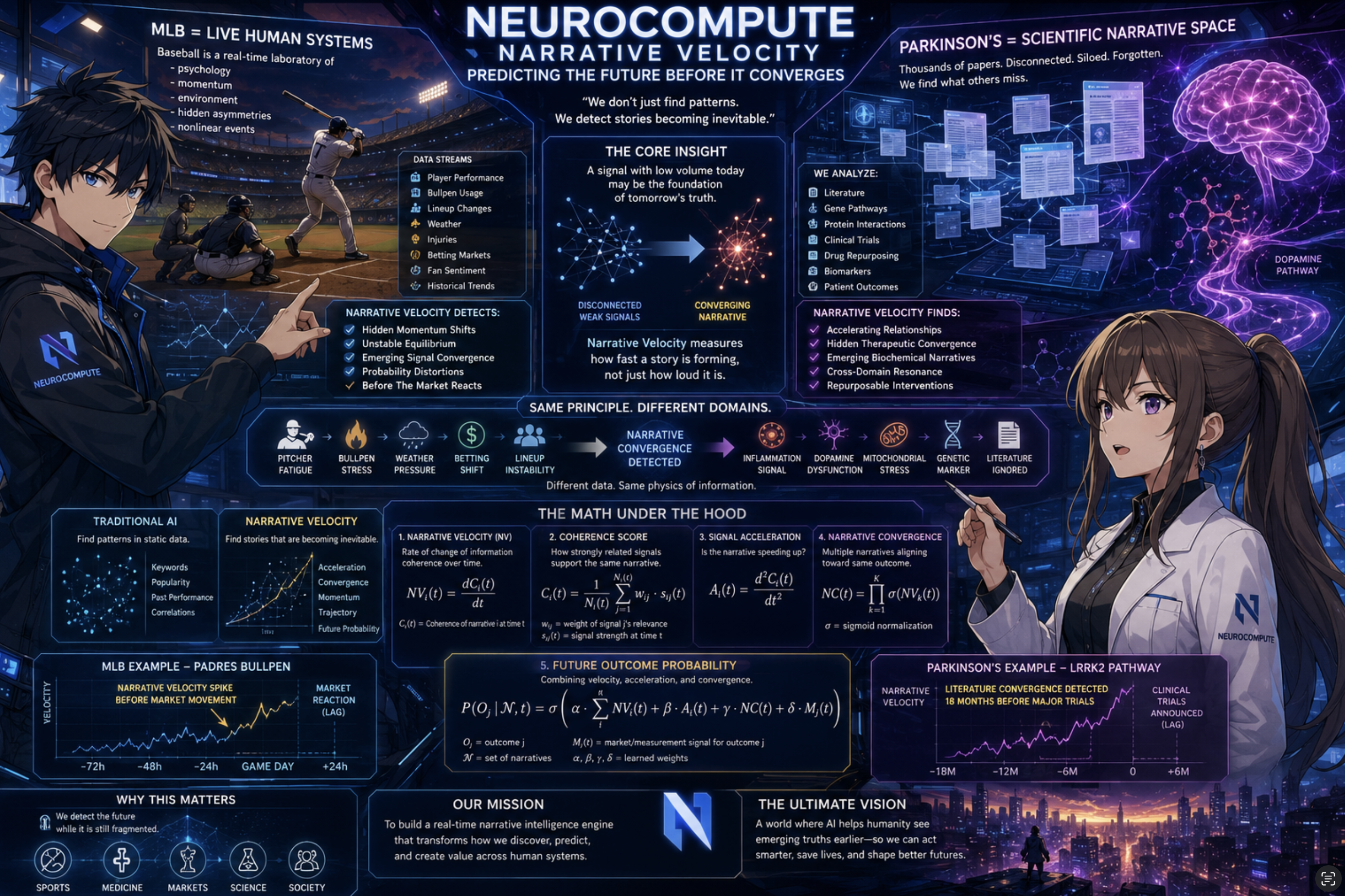
View analysis →Finding therapies hidden in 1,516 Parkinson’s papers.
Neurocompute scores biomedical literature, surfaces overlooked patterns, and turns Parkinson’s research into a living discovery terminal.
Ranked discovery teasers
E grade · PMID 41949413
View analysis →E grade · PMID 41997841
View analysis →E grade · PMID 41898412
View analysis →E grade · PMID 41959990
View analysis →E grade · PMID 41964742
View analysis →E grade · PMID 41963524
View analysis →E grade · PMID 41998450
View analysis →E grade · PMID 41896120
View analysis →E grade · PMID 42032107
View analysis →Database feed
All ranked Parkinson’s papers
A systematic review and meta-analysis of rodent Parkinson's disease models assessing how exercise affects α-synuclein levels and related pathology.
Synthesizes preclinical evidence that exercise may modulate the central PD protein α-synuclein and support neuroprotection, offering mechanistic and translational hints for non‑pharmacological or adjunctive therapeutic strategies despite limited direct drug-discovery actionability.
Case report where delayed [18F]FP-CIT PET/CT showed cortical tracer uptake corresponding to renal cell carcinoma brain metastases (and a striatal photopenic area from chronic infarct), indicating that hypervascular metastases can cause nonspecific cortical retention likely from altered…
Minimal direct value for Parkinson's therapeutic discovery, but important for clinical and research neuroimaging: it cautions that atypical cortical DAT-ligand uptake can reflect metastases or perfusion/BBB effects rather than synucleinopathy, which can prevent misdiagnosis and confounding in…
Case report of an adolescent who developed aberrant supraventricular tachycardia after minor blunt chest trauma during soccer that was terminated with vagal maneuvers and subsequently revealed previously unrecognized Wolff-Parkinson-White syndrome.
This paper has minimal direct relevance to Parkinson's therapeutic discovery—at best it offers a tangential observation about acute vagal modulation safety that could be of peripheral interest to neuromodulation approaches in PD but provides no mechanistic, biomarker, or therapeutic insights for…
This review synthesizes evidence that dysregulated neuronal Ca2+-cytoskeleton interactions — including STIM/Orai-mediated store-operated calcium entry, end-binding proteins, and the spine apparatus — drive synaptic and structural pathology across neurodegenerative diseases and surveys emerging…
For Parkinson's therapeutic discovery, the paper highlights a mechanistically plausible and druggable axis (calcium–cytoskeleton) with specific molecular components to prioritize for translational studies and biomarker work, though it is a conceptual review with limited PD-specific experimental or…
Case report of an 82-year-old woman with advanced Parkinson's disease and autonomic blood-pressure instability who developed posterior reversible encephalopathy syndrome (PRES) that resolved with blood pressure control, plus a brief literature review on PRES and autonomic dysfunction in PD.
While offering limited mechanistic or therapeutic insight for drug discovery, the report is clinically relevant for PD research and development because it underscores the importance of monitoring autonomic/blood-pressure effects of disease and medications—information that informs safety…
A paper reviewing how disrupted mitochondrial fission/fusion dynamics and abnormal autophagy/mitophagy contribute to Parkinson's disease pathogenesis.
Mitochondrial dynamics and autophagy are actionable, mechanistic pathways with direct therapeutic and biomarker potential for PD (e.g., Drp1/Mfn modulation, PINK1–Parkin pathway, autophagy enhancers), but the lack of an abstract and unknown study type/quality limit confidence in immediate…
The paper explores tear fluid as a noninvasive specimen for detecting alpha-synuclein seeding activity in Parkinson's disease.
A validated tear-based alpha-synuclein seeding assay could provide a minimally invasive, clinically scalable biomarker for early diagnosis, patient stratification, and monitoring in PD trials—boosting translational and therapeutic development despite not directly proposing a treatment.
The paper reports that the SGLT2 inhibitor dapagliflozin reduces motor deficits in a 6‑OHDA Parkinson’s model and, through combined in vivo and in silico work, implicates modulation of α‑synuclein, A2A receptor, TH, TNF‑α and intrinsic apoptosis (APAF‑1/caspase‑3) pathways.
This suggests a repurposing opportunity for an approved diabetes drug with anti‑inflammatory and anti‑apoptotic effects relevant to PD biology, improving translational potential despite limitations of the acute 6‑OHDA model and the missing abstract for full assessment.
This corrigendum refers to a study reporting that activation of α7 nicotinic acetylcholine receptors reduced α‑synuclein pathology in both brain and gut in a subacute MPTP mouse model of Parkinson’s disease.
If robust, the finding supports a druggable α7 nAChR pathway that modulates α‑synuclein and the gut–brain axis—offering translational and repurposing potential—but interpretation is limited by the preclinical MPTP model, lack of the original abstract here, and the fact this document is a…
This study reports that curcumin and ferulic acid activate PPARγ–PGC1α signaling and rescue mitochondrial function in a 6‑OHDA cellular model of Parkinson's disease.
Targeting the PPARγ–PGC1α mitochondrial biogenesis pathway is directly relevant to PD neurodegeneration and these natural compounds represent easily testable leads for neuroprotective repurposing, though findings are limited to an in vitro model and need in vivo/PK and efficacy validation.
The paper identifies Rab27b as a regulator of lysosomal function that promotes clearance of alpha-synuclein in Parkinson's disease models.
By linking Rab27b to lysosomal degradation of alpha-synuclein, the study points to a potentially actionable target for therapies aimed at enhancing proteostasis in PD, though the absence of an abstract limits assessment of experimental rigor and translational readiness.
The study reports an absence of cerebrospinal fluid α-synuclein seeding activity in Parkinson's disease patients harboring VPS35 D620N or LRRK2 Y1699C mutations.
Indicates pathological and biomarker heterogeneity in genetic PD—α-synuclein seeding assays may not detect disease in these subgroups, impacting patient stratification and the design of α-synuclein-targeted therapies and trials.
Clinical study evaluating the feasibility and clinical use of continuous subcutaneous levodopa infusion as an adjunct therapy in advanced Parkinson's disease patients who have subthalamic nucleus deep brain stimulation (abstract not provided).
Offers clinically relevant information on combining advanced drug-delivery approaches with DBS for symptomatic management, which can inform translational care strategies but provides limited novel mechanistic or disease-modifying insights for therapeutic discovery.
This corrigendum updates a prior study on whether transanal irrigation for chronic constipation in Parkinson's patients can rebalance the gut microbiota.
Gut–brain axis and a practical symptomatic intervention are relevant to Parkinson's, but as a corrigendum with no abstract and limited disease‑modifying or mechanistic data, its direct therapeutic discovery value is low to modest.
Survey/clinical study comparing patient-centered care and use patterns of medical cannabis in Parkinson's disease patients versus other chronic conditions, reporting that PD patients differ in needs or behaviors.
Relevant for symptomatic management and designing patient-centered clinical trials for cannabis or other symptom-directed therapies in PD, but offers minimal mechanistic or therapeutic-discovery insight for disease-modifying drug development.
Validation study assessing the reliability and validity of the supine-to-stand test in people with Parkinson's disease (no abstract provided).
Establishes a potentially useful, reliable clinical outcome measure for functional mobility and fall-risk assessment in PD (helpful for trials and rehabilitation), but offers little mechanistic or therapeutic discovery insight.
This paper appears to describe a 'time critical medicine' sticker intervention to prompt correct timing of Parkinson's medications for inpatients, but includes no abstract and no therapeutic mechanism or biomarker data.
Improving inpatient medication timing can reduce clinical complications and is important for patient care, but the work offers little actionable insight for Parkinson's drug discovery or translational research.
Case report describing use of continuous Levodopa/Carbidopa Intestinal Gel (LCIG) in a Parkinson's disease patient with Hemophilia A, focusing on feasibility and safety.
Low discovery value for new PD therapeutics but offers practical clinical guidance on LCIG use and safety considerations in patients with bleeding disorders, informing patient selection and risk management rather than mechanistic or biomarker insights.
Paper appears to address improving the reliability of AI chatbots for supporting Parkinson's disease patients and future care models, but provides no abstract or mechanistic/therapeutic details.
Improving chatbot dependability could help patient monitoring, education, and adherence, but it offers minimal direct insight or actionable leads for disease-modifying therapies or biomarkers.
This study examines associations between caregiver burden and mood and insomnia severity among caregivers of people with Parkinson's disease.
Highlights the need to address caregiver mental health and sleep to improve patient care and trial retention, but provides minimal direct actionable insight for Parkinson's therapeutic target discovery.