E grade · PMID 42038336
View analysis →Finding therapies hidden in 1,516 Parkinson’s papers.
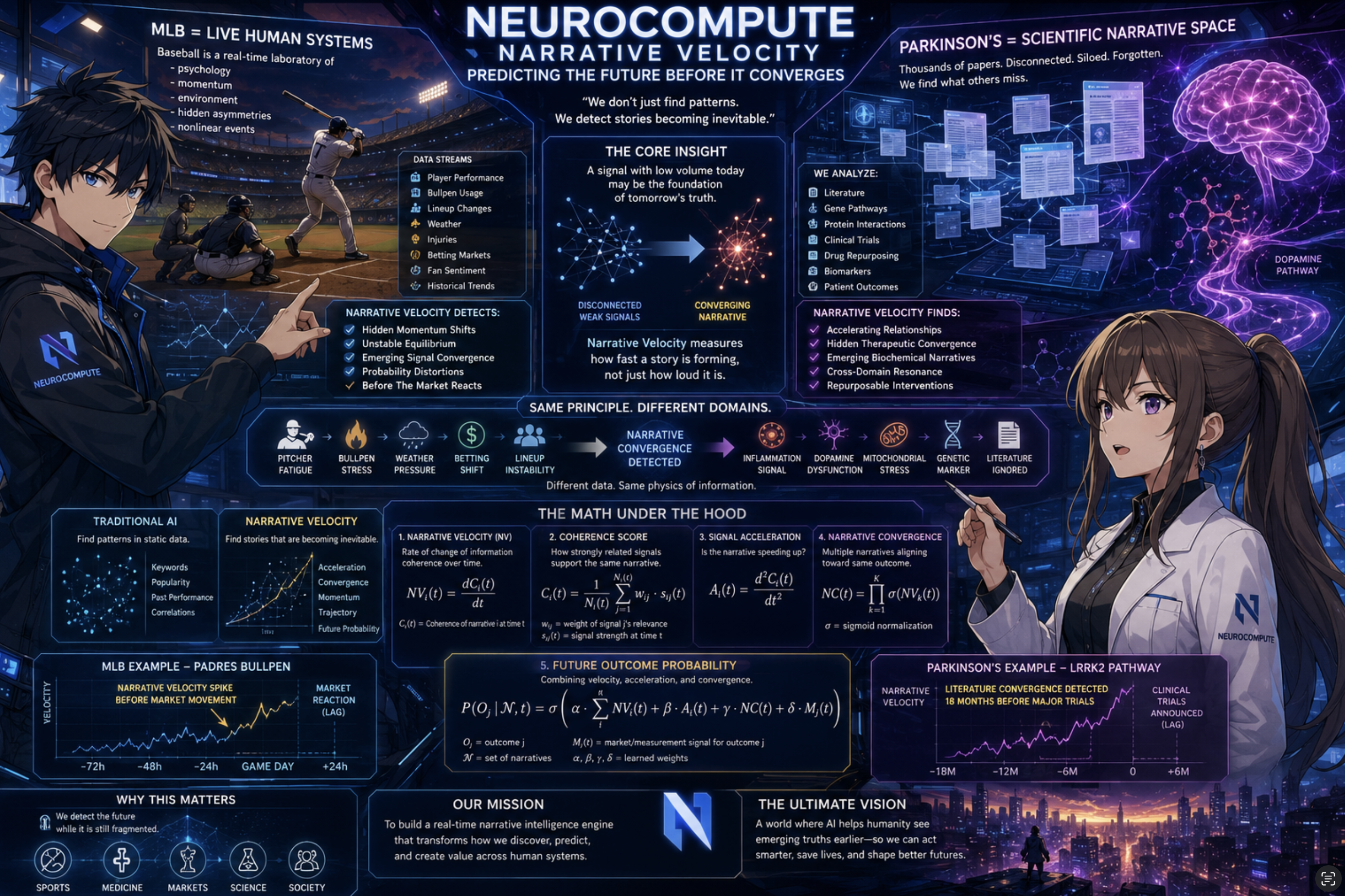
Neurocompute scores biomedical literature, surfaces overlooked patterns, and turns Parkinson’s research into a living discovery terminal.
Ranked discovery teasers
E grade · PMID 42012257
View analysis →E grade · PMID 41929179
View analysis →E grade · PMID 41921847
View analysis →E grade · PMID 41965748
View analysis →E grade · PMID 42015362
View analysis →E grade · PMID 42036356
View analysis →E grade · PMID 42011350
View analysis →E grade · PMID 41967035
View analysis →E grade · PMID 41921715
View analysis →Database feed
All ranked Parkinson’s papers
In a mouse DSS-colitis model, intestinal inflammation drives neuroinflammation and nigrostriatal pathology across genotypes, and these effects occur independently of Lrrk2 G2019S kinase activation.
Reinforces the gut–brain axis as a contributor to PD-relevant pathology and implies that targeting peripheral intestinal inflammation (or patient stratification by inflammatory status) may be a more promising therapeutic or preventative approach than relying solely on LRRK2 kinase inhibition for…
LC-MS/MS N-glycomics of prefrontal cortex synaptosomes and synaptic vesicles from PD vs control brains reveals fraction-specific remodeling—reduced sialofucosylation and increased fucosylated/neutral glycans (including altered sLeX) in synaptosomes and elevated high-mannose/neutral glycans with…
Provides synapse- and compartment-specific glycosylation signatures linked to neuroinflammation and defective glycan maturation that could serve as biomarkers and nominate glycosylation enzymes or lectin-mediated pathways as novel therapeutic or targetable mechanisms in PD-related synaptic…
Using long-read whole-genome sequencing on 100 post-mortem PD brains integrated with single-nucleus RNA-seq from matched regions, the study catalogs 74,552 structural variants and links specific SVs at PD GWAS loci to cell-type–specific gene expression changes via eQTL and allele-specific analyses.
By providing a high-confidence SV atlas and cell-type-resolved functional links at PD-associated loci, this work enables nomination of causal genes and regulatory variants for follow-up target validation and biomarker development, increasing translational opportunities despite not yet delivering…
Comprehensive review of the UFMylation post‑translational modification system that synthesizes current evidence linking impaired UFMylation to neurodegenerative pathologies, including modulation of tau and α‑synuclein, and proposes UFMylation as a potential therapeutic and biomarker axis.
Highlights a novel, targetable PTM pathway (UFM1 enzymatic cascade) connected to α‑synuclein and tau biology, providing mechanistic hypotheses and biomarker leads that could be translated into Parkinson’s therapeutics after focused experimental validation.
This paper develops and benchmarks experimental and computational approaches for allele-specific expression (ASE) analysis from single-nucleus RNA-seq—leveraging intronic reads, read length, and hybrid selection—and demonstrates that ASE has greater power than eQTL analysis in a Parkinson's disease…
By improving cell-type–resolved detection of regulatory effects of genetic variants in PD, these methods help prioritize causal genes/variants and refine target and biomarker discovery pipelines, increasing translational value even though the work is primarily methodological.
This paper describes myPPMI, a cloud-native, participant-centered virtual research environment that integrates e-consent, longitudinal motor and non-motor assessments, biospecimen referral, and precision recruitment/real-time eligibility matching across countries.
Although it does not report new therapeutic mechanisms, the platform meaningfully enhances decentralized, biomarker-driven Parkinson's research by enabling low-burden standardized data and specimen collection and precise cohort targeting, which can accelerate translational studies and clinical…
This MRI and 31P‑MRSI study of GCH1 mutation carriers (20 symptomatic, 5 asymptomatic) reports enlarged globus pallidus/putamen in symptomatic carriers, reduced basal ganglia NAD ratios, and elevated cerebellar high‑energy phosphate ratios in asymptomatic carriers, with metabolic and volumetric…
The work links region‑specific NAD/energy metabolism deficits and cerebellar bioenergetic adaptation to motor severity, suggesting measurable metabolic biomarkers and potential NAD‑targeted therapeutic or biomarker avenues relevant to Parkinson's‑related basal ganglia vulnerability, though its…
Systematic review of 28 preclinical studies reporting that crocin, a saffron constituent, exerts antioxidant (↓ROS, ↓MDA, ↑SOD), anti-inflammatory (↓TNF-α, ↓ILs) and cytoprotective effects (↓p‑ERK1/2, ↑PI3K/Akt/mTOR) in Alzheimer's and Parkinson's disease models.
Offers preclinical support that crocin targets neuroprotective pathways relevant to Parkinson's (oxidative stress, inflammation, survival signaling), making it a modestly promising lead for further translational work, though direct disease‑specific mechanisms, pharmacokinetics, safety, and clinical…
In a prospective cohort of ~20,000 adults followed for a median of 15 years, a 29-item frailty index predicted higher risk of multiple outcomes including Parkinson's disease (HR 1.25 per SD), non-Alzheimer dementia, cardiometabolic events, hospitalisations, and mortality.
This establishes frailty as a useful population-level risk stratification marker that could help identify individuals for surveillance or preventive interventions relevant to Parkinson's disease, but it offers little mechanistic insight or direct therapeutic targets for drug discovery.
Systematic review finds limited and mixed evidence that antiparkinsonian medications—particularly L‑Dopa via elevated homocysteine—may influence bone mineral density, but causal links are not established.
Low immediate value for PD therapeutic discovery, but clinically relevant for fracture risk management and suggests a testable biomarker (homocysteine) and adjunctive intervention opportunity rather than a direct disease‑modifying target.
Single-patient case report showing functional neuroimaging clarified a diagnosis of idiopathic Parkinson's disease versus atypical parkinsonism and guided multidisciplinary treatment including levodopa.
Limited value for discovery of new therapeutics, but modest translational utility for diagnostic stratification and ensuring appropriate treatment and trial enrollment through imaging-based differentiation.
Case report of a 74-year-old woman (with a history of Parkinson's disease) who experienced an acute hemolytic transfusion reaction caused by anti‑CD99 alloantibody, with laboratory evidence linking donor CD99 expression to red cell phagocytosis.
This has minimal direct value for Parkinson's therapeutic discovery but is clinically relevant for transfusion safety in PD patients and highlights a rare immune complication rather than informing PD mechanisms or drug targets.
This study shows that RAB12, a validated LRRK2 substrate, acts as a negative regulator of presynaptic vesicle exocytosis such that Rab12 knockout enhances presynaptic release, excitatory drive onto striatal neurons, and locomotor activity in mice.
By linking a PD‑relevant kinase substrate to synaptic hyperactivity, the work identifies the RAB12–LRRK2 axis as a mechanistic entry point for modulating synaptic dysfunction in Parkinson's research, though direct relevance to dopaminergic degeneration, alpha‑synuclein pathology, or clinical…
Comprehensive review of bioanalytical methods and data-processing (including AI) for identifying and characterizing cytoskeletal proteins (e.g., tau and neuronal intermediate filaments) implicated in neurodegenerative disease pathology.
Useful as a methodological resource for detecting cytoskeletal biomarkers and profiling protein alterations that can support biomarker discovery or target validation related to Parkinson’s-associated cytoskeletal dysfunction, but it is a general methods review with limited PD-specific mechanistic…
Case report of a 16-year-old with PRKAG2-associated hypertrophic cardiomyopathy whose condition progressed to arrhythmias and ventricular scarring, with sports participation and potential ICD placement managed via shared decision-making.
Negligible relevance to Parkinson's therapeutic discovery because it is a cardiology case focused on adolescent HCM and shared decision-making with no mechanistic, biomarker, or therapeutic links to Parkinson's disease.
This systematic review and meta-analysis of 51 studies reports that heterozygous GBA1 L444P carriers have a markedly increased risk of Parkinson's disease (pooled OR ~9.2) across ancestral groups.
By providing robust, mutation-specific evidence that L444P is a high-penetrance PD risk variant, the study strengthens justification for GBA1/GCase- and lysosomal-targeted therapies, informs patient stratification and trial enrichment, and highlights gaps in diverse genetic data.
This review synthesizes murine α‑synuclein pathology models showing selective degeneration of SNpc dopaminergic neurons (notably ALDH1A1‑ neurons) and implicates mitochondrial and lysosomal dysfunction, calcium dysregulation, presynaptic failure, and neuroinflammation as key mechanistic drivers.
By integrating transcriptomic/proteomic data across models and highlighting model‑ and stage‑dependent vulnerability, the paper helps prioritize cellular mechanisms and vulnerable cell populations for target selection and guides more translationally aligned, stage‑resolved in vivo studies for…
This chapter reviews advances in deep brain stimulation (including MRI-based connectomics and closed-loop neurophysiology) and low-intensity focused ultrasound neuromodulation, covering mechanisms, transducer and skull-correction hardware, and early clinical studies toward biomarker-guided…
Relevant to Parkinson's therapeutics because it outlines actionable technological and translational pathways to refine DBS and develop a non-invasive TUS analogue that could expand treatment options, improve targeting, and enable biomarker-driven clinical trials.
Systematic review of 64 studies (6,303 PD patients) finds monogenic PD in Africa is allelicly and locus-heterogeneous but dominated in North Africa by the LRRK2 p.Gly2019Ser founder variant, while over 98% of Sub-Saharan African patients lacked an identified molecular cause.
This matters for therapeutics because the strong, region-specific enrichment of an actionable target (LRRK2 G2019S) supports population-tailored deployment of LRRK2-directed therapies and the clear gap in genetic discovery in Sub-Saharan cohorts indicates that expanded sequencing could reveal…
This systematic review and meta-analysis finds QSM MRI detects disorder-specific iron accumulation—elevated substantia nigra susceptibility in PD, putaminal in MSA, and red nucleus in PSP—with moderate-to-high diagnostic accuracy but notable technical heterogeneity across studies.
QSM offers a promising non-invasive biomarker to improve diagnostic differentiation and patient stratification for clinical trials in parkinsonian syndromes, but standardization of acquisition and processing is needed to enable reliable therapeutic use.