1
Long-term follow up of opicapone as add-on to levodopa in Parkinson's patients without motor fluctuations.
45.0
AI
E grade · PMID 41995421
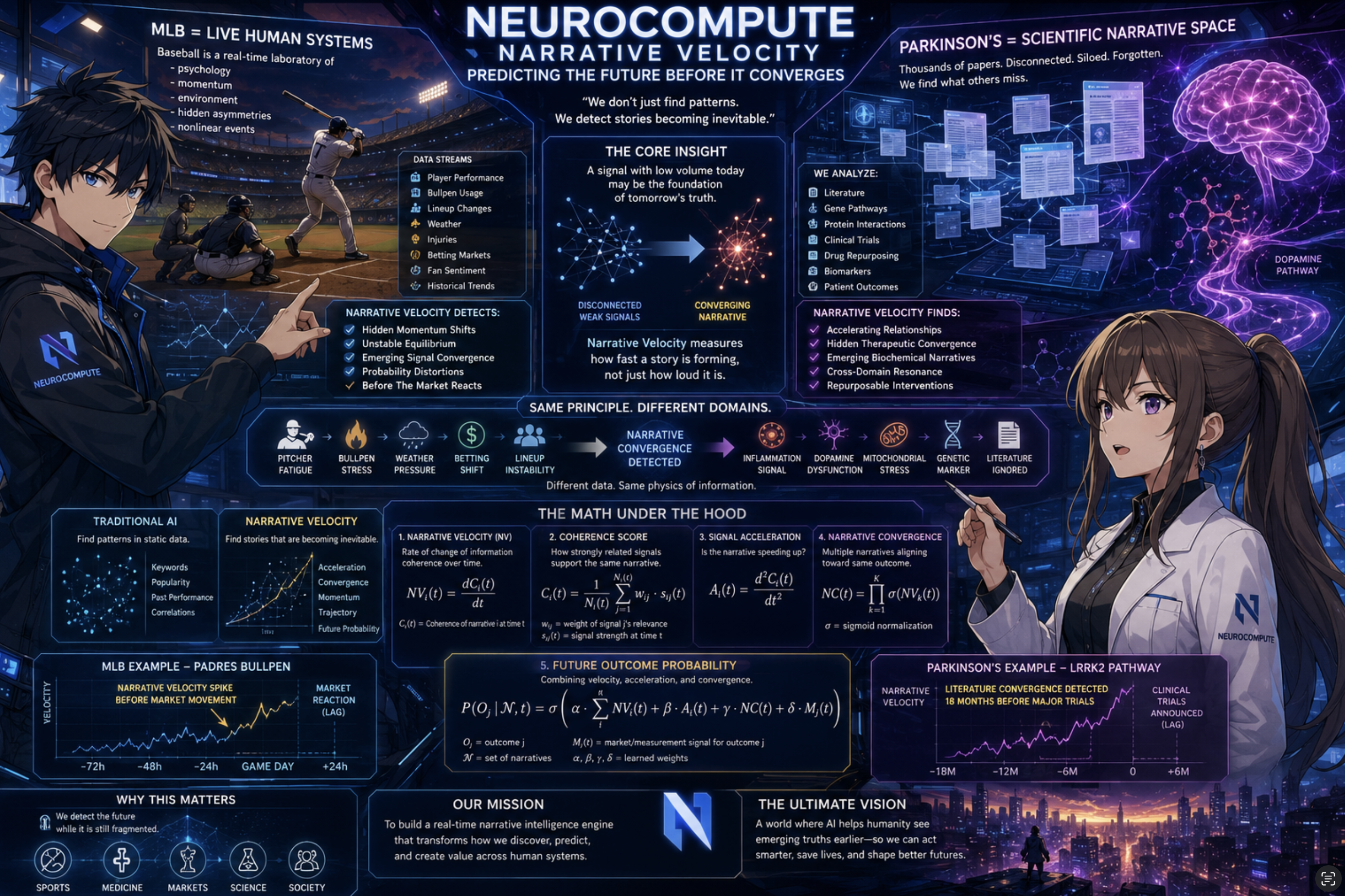
View analysis →Neurocompute scores biomedical literature, surfaces overlooked patterns, and turns Parkinson’s research into a living discovery terminal.
E grade · PMID 41995421
View analysis →E grade · PMID 41932028
View analysis →E grade · PMID 42030949
View analysis →E grade · PMID 41951686
View analysis →E grade · PMID 41942436
View analysis →E grade · PMID 41970652
View analysis →E grade · PMID 42036930
View analysis →E grade · PMID 41940289
View analysis →E grade · PMID 42022008
View analysis →E grade · PMID 42039466
View analysis →In the 1-year open-label extension of the EPSILON trial, adding opicapone to levodopa in non-fluctuating Parkinson's patients produced sustained improvement in motor scores and a non-significant trend toward fewer motor complications (80.2% vs 69.7%, p=0.1).
Findings support early adjunctive COMT inhibition as a safe, translatable symptomatic strategy that may delay motor complications, making it relevant for clinical management and pragmatic therapeutic optimization even though it does not demonstrate disease modification.
The authors generated and characterized transgene-free iPSC lines from a Parkinson's patient carrying the GBA1 p.Thr369Met variant and two variant-free controls, confirming pluripotency, normal karyotype, and tri-lineage differentiation capability.
These validated patient-specific iPSC lines provide a relevant human cellular platform to study GBA1-linked lysosomal dysfunction and alpha-synuclein mechanisms and to support target validation and screening of GBA1- or lysosome-directed therapeutics.
Using ultra-sensitive single-molecule assays and super-resolution microscopy, the authors find similar total alpha-synuclein aggregate counts in PD and control brains but detect larger aggregates and distinct diffusible/membrane-bound subpopulations enriched in PD, implying slow, cell-restricted…
By defining and detecting specific alpha-synuclein aggregate subtypes with highly sensitive methods, this work provides tools and candidate biomarkers to improve target engagement assays, stratify pathology-relevant species, and inform timing/targets for therapies directed at aggregate clearance or…
Video-based kinematic analysis of finger tapping distinguishes PSP from PD (AUC=0.83), with smaller angles and slower velocities correlating with worse motor/balance function and with atrophy in nucleus accumbens, superior temporal gyrus, cerebellum, and brainstem.
As a non-invasive, quantitative biomarker for differential diagnosis and motor monitoring in parkinsonian syndromes, this method can improve patient selection and outcome measurement in trials, though it does not directly reveal PD therapeutic targets or mechanisms.
Multicenter study develops an XGBoost-based multimodal machine-learning model combining QSM radiomic features and MRS-derived neurochemical metabolites to classify early Parkinson's disease with high AUC and SHAP-based interpretability.
Offers promising diagnostic biomarkers and a transparent classification tool that could improve early detection and patient stratification for clinical studies, but provides limited direct mechanistic or therapeutic target information for drug discovery.
The study converts pressure-sensor gait data into recurrence plots and applies Vision Transformer fusion models with DC-GAN augmentation to classify PD patients across treatment states and controls, achieving up to 94.58% multi-class accuracy.
Offers a noninvasive, data-driven gait biomarker and analytic pipeline that could help monitor and stratify patient treatment responses in PD, but provides little mechanistic or therapeutic target information for drug discovery.
Describes the PPMI centralized brain donation program that improves postmortem tissue collection and highlights how neuropathology can validate biomarkers and support new pathological analysis methods.
By enabling gold-standard correlation of longitudinal clinical, imaging, genetic, and biofluid biomarkers with neuropathology, this resource strengthens biomarker validation and translational readiness, indirectly supporting Parkinson's therapeutic discovery and trial development.
Introduces 'glossography', a markerless DeepLabCut-based computer-vision pipeline that quantifies orofacial dyskinesias from standard video and showed concordant changes with clinical dyskinesia scales in a hospitalized PD patient over 4 days.
Although not a mechanistic or therapeutic study, this objective, low-cost biomarker method could improve monitoring, remote assessment, dose titration, and trial outcome measurement for dyskinesia, thereby aiding translational and clinical decision-making.
This paper reports a soft magnetoelastic sensor plus 1D-CNN and smartphone app that converts hand tremors into high-fidelity electrical signals to classify simulated Parkinsonian tremors with 98.36% accuracy.
The device offers an accessible, real‑time tremor monitoring and diagnostic tool that can aid patient stratification and remote data collection for clinical studies, but it provides minimal insight into PD pathophysiology or direct therapeutic targets.
An explainable ML framework (Importance Inversion Transfer) isolates ten shared regional volumetric brain markers between Alzheimer's and Parkinson's and validates a morphological continuum with AUC=0.894.
Although it lacks molecular or intervention insights, the study offers potentially useful cross-disease neuroimaging biomarkers for early detection and cohort stratification that could improve Parkinson's trial design and biomarker-driven therapeutic development.
Authors present a low-cost diagnostic pen using a magnetoelastic tip and ferrofluid ink plus a 1D CNN to distinguish Parkinson's patients from controls based on handwriting signals with ~96% accuracy in a pilot study.
This work offers a scalable, accessible diagnostic/screening tool that could aid early detection, monitoring, and patient stratification for clinical studies, but it provides little direct insight into mechanisms or therapeutic targets for Parkinson's disease.
This paper reports that KNN applied to combined neuroimaging and speech features achieved high diagnostic performance (accuracy 92.8%, F1 0.953) for classifying Alzheimer's, Parkinson's, and epilepsy.
The work has limited direct therapeutic discovery value—no mechanistic targets or interventions—but the multimodal diagnostic method could help early detection and patient stratification for Parkinson's clinical studies if rigorously validated on diverse cohorts.
Using Global Burden of Disease data from 2011–2021, the paper reports heterogeneous, region-specific changes in age-standardized Parkinson's disease mortality with declines in the Western Pacific and increases in the Americas and South-East Asia.
The findings highlight geographic disparities in diagnosis, treatment access, and comorbidity management relevant for public-health planning and trial site selection, but provide limited actionable insight for molecular targets or therapeutic development.
Survey of 149 people with Parkinson's across 19 countries found 65% had used generative AI (40% for disease-specific questions) with themes of informational, interpretive, and preparational use, and patients bringing AI-generated information into clinical consultations.
Direct therapeutic-discovery value is low, but the findings matter for clinical translation and research conduct because clinicians and trialists must address and validate patient-sourced AI outputs to preserve shared decision-making, data quality, and safety.
This study presents ESDRCX, a multimodal ensemble combining decision trees, SVM, random forest, a CNN for spiral images, and an XGBoost meta-learner optimized with Optuna, reporting ~95.7% accuracy on the HandPD dataset for Parkinson's detection.
Improves diagnostic accuracy and early detection workflows, but provides no mechanistic, biomarker, or therapeutic insights relevant to drug discovery, limiting its translational value for PD therapeutics.
This study quantifies elevated emergency department visits, hospitalizations, and substantial home-based care use among 210 patients with Parkinson’s-related disorders and moderate-to-high palliative care needs over 12 months.
The results are useful for healthcare planning and for designing clinical studies or care models by highlighting acute-care burden and persistent supportive-care needs, but the paper provides little mechanistic or therapeutic-discovery insight for Parkinson’s drug development.
This review outlines how antigen presentation by cells of the neurovascular unit and specific MHC/HLA alleles shape T cell entry, retention, and blood–brain barrier disruption across neuroinflammatory diseases.
It is relevant to Parkinson's research because it links immune-mediated BBB dysfunction and HLA-associated susceptibility to mechanisms that could yield immune-targeted therapies or biomarkers, though its broad, review-style treatment offers limited PD-specific actionable targets.
A randomized, double-blind, sham‑controlled crossover pilot (n=30) found that a single 20‑minute, MRI‑guided 130 Hz transcranial temporal interference stimulation targeting the subthalamic region was safe and produced short‑term, clinically meaningful reductions in MDS‑UPDRS‑III versus sham.
Provides proof-of-concept that non‑invasive, anatomically individualized temporal interference neuromodulation can acutely improve Parkinsonian motor symptoms and could be developed as a less invasive alternative to STN‑DBS, meriting larger trials to test durability, dosing, and specificity.
Using SMR and colocalization across mQTL, eQTL, and pQTL data (with tissue-specific validation), the study links synaptic genes—most notably AMIGO1—to genetic risk for Parkinson's disease.
The multi-omics, colocalized genetic evidence prioritizes AMIGO1 as a genetically supported candidate for mechanistic follow-up and potential biomarker or therapeutic development in PD, though functional validation is still required.
This paper presents a biologically inspired basal ganglia reinforcement-learning model that uses dopamine and noradrenaline regulation plus an Ising-model STN network to generate structured exploration, demonstrating improved adaptation in tasks and impaired performance when DA/NA are clamped.
Although not directly therapeutic, the model links DA/NA and STN population dynamics to decision-making deficits in Parkinson's disease, offering a mechanistic computational platform to generate testable hypotheses for neuromodulation strategies or noradrenergic-focused interventions.