E grade · PMID 41980511
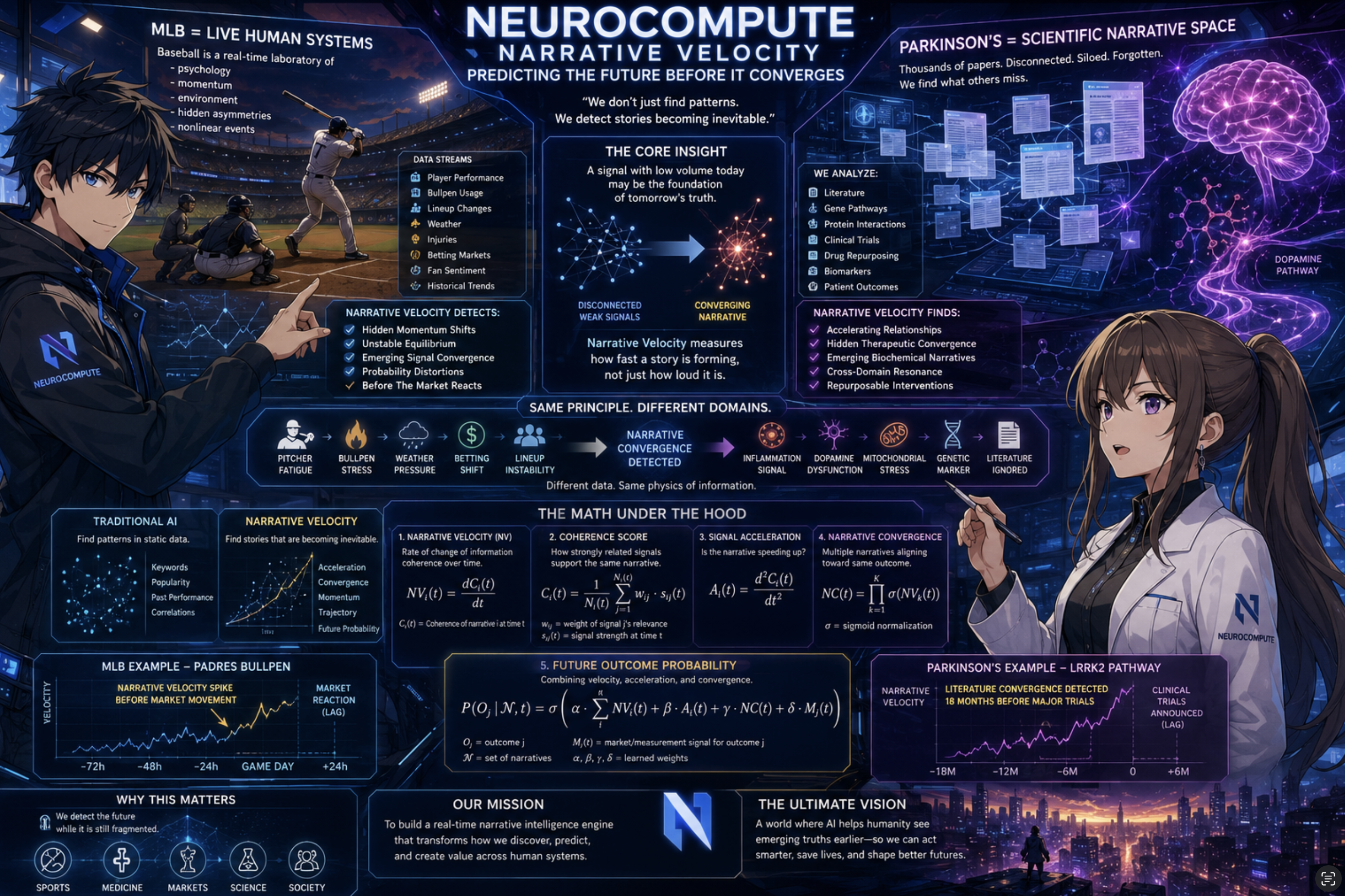
View analysis →Finding therapies hidden in 1,516 Parkinson’s papers.
Neurocompute scores biomedical literature, surfaces overlooked patterns, and turns Parkinson’s research into a living discovery terminal.
Ranked discovery teasers
E grade · PMID 41946271
View analysis →E grade · PMID 41902687
View analysis →E grade · PMID 42020934
View analysis →E grade · PMID 42030761
View analysis →E grade · PMID 41992280
View analysis →E grade · PMID 42029135
View analysis →E grade · PMID 41962553
View analysis →E grade · PMID 41952826
View analysis →E grade · PMID 42010394
View analysis →Database feed
All ranked Parkinson’s papers
Systematic review of six ED studies (n=2543) in adults ≥65 found OH screening rates of 5–100% and OH prevalence of 5–42%, with higher admission and trauma rates and reported associations with Parkinson's disease and cardiovascular medications.
Moderate relevance to Parkinson's research because it highlights under-recognition of orthostatic hypotension—a common autonomic feature in PD—that could improve case-finding and symptomatic management, but it offers little mechanistic or therapeutic discovery insight.
This cross-sectional TMS study (n=39) reports that reduced GABAergic intracortical corticomotor inhibition correlates with poorer static, dynamic, and functional balance in early-stage Parkinson's, with sitting-state TMS providing relatively stable measures.
Provides a measurable neurophysiological biomarker linked to balance dysfunction and a plausible target for neuromodulation or GABAergic interventions to improve postural stability in PD, though findings are preliminary and require replication and interventional validation.
This study validates a virtual-reality adaptation of the Color Trails Test that integrates full-arm motor actions with cognitive demands and finds that people with Parkinson's are slower, less accurate, and show altered kinematics (longer head-hand delays, lower peak velocities) compared with…
The VR-CTT provides an ecologically valid, quantitative platform with motor-cognitive and kinematic endpoints useful as sensitive outcome measures and a potential rehabilitation/training tool in PD, though it does not address molecular mechanisms or direct therapeutic targets.
This review synthesizes evidence that cardiovascular autonomic dysfunction in Parkinson's disease—manifesting as reduced heart rate variability, decreased MIBG uptake, neurogenic orthostatic hypotension, and related symptoms—is common, contributes to increased cardiovascular mortality and sudden…
While not identifying novel molecular targets, the paper highlights a clinically important, underexplored domain (cardiovascular dysautonomia) with clear biomarkers and management gaps that could motivate mechanistic studies, biomarker-driven trials, and repurposing of autonomic or cardioprotective…
Small pilot (n=20) found a single 15‑minute treadmill session using the Mobility Rehab Auditory Feedback system (tablet + wearable sensors providing verbal/metronome cues on arm swing, step duration, stride length, mid‑swing elevation) was safe and produced small-to-large immediate improvements in…
This study demonstrates a feasible, scalable symptomatic rehabilitation approach that can improve gait performance in mild–moderate PD and could be tested in longer, controlled trials or paired with other therapies, but it offers little mechanistic insight or immediate impact on disease-modifying…
In 188 people with Parkinson disease, imbalance between objective balance ability and self-confidence (discordance) correlated strongly with poorer perceived health, depression, and anxiety, with perceived health the single strongest predictor.
Although it lacks molecular targets, the study identifies modifiable psychosocial factors—perceived health, mood, and anxiety—that are actionable targets for interventions (behavioral, rehabilitative, or integrated care) to reduce fall risk and improve quality of life, informing clinical strategies…
This paper describes design and prototyping of a low-cost, wireless, gamified rehabilitation glove for home-based upper-limb therapy in Parkinson's disease.
The device could improve motivation and functional rehabilitation for PD patients at home, but it offers limited mechanistic insight or direct therapeutic-discovery value for disease-modifying treatments.
The paper develops an interpretable graph convolutional network that combines static and dynamic resting-state fMRI functional connectivity and inter-subject similarity to classify Parkinson's disease and identify key discriminative brain regions.
Although it does not advance molecular mechanisms or therapeutic targets, it provides a potentially useful diagnostic/biomarker approach and highlights brain regions that could inform future translational or mechanistic studies.
A bibliometric analysis of 2,532 publications (2010–2025) on Tai Chi and older adults showing growth in research with major clusters in balance, quality of life, depression, and cognition and an emergent, but superficial, link to Parkinson's disease.
While offering little mechanistic or therapeutic insight for Parkinson's drug discovery, the paper highlights growing interest in Tai Chi as a nonpharmacologic intervention relevant to PD rehabilitation and flags Parkinson's disease as an emerging clinical application worth mechanistic follow-up.
A small qualitative phenomenological study of 12 Parkinson's care partners identifies themes of adaptive resilience, emotional burden, and the evolving, ambiguous nature of caregiving.
Useful for informing family-centered care models and support interventions (occupational therapy, psychosocial programs) but offers little direct mechanistic or therapeutic-discovery value for Parkinson's drug development.
Qualitative study of 15 former carers used perspective mapping to produce a nine-domain, 52-concept framework describing the multifaceted caregiving needs in Parkinson's disease.
The framework is useful for developing carer-centered services and psychosocial interventions but offers little actionable mechanistic or therapeutic insight for Parkinson's drug discovery or biomarker development.
This study presents a <200 g wrist exoskeleton using equivalent-input-disturbance (EID) control to actively suppress pathological tremor, reporting 89–96% tremor power reduction and improved voluntary tracking in a 5-patient pilot (4 PD, 1 ET).
As a lightweight, wearable, non-pharmacologic approach with preliminary clinical validation, it offers a translatable symptomatic option to improve tremor control and daily function in PD patients, though it does not address underlying disease biology or long-term efficacy.
Retrospective comparison of 79 dystonia patients found pallidothalamic tractotomy produced substantially greater postoperative weight gain than GPi pallidotomy, with lesion mapping implicating Forel's field H1/caudal subthalamic region as a weight‑gain hotspot.
This highlights that ablative target selection can alter body‑weight regulation and helps localize circuits near the caudal subthalamic area relevant to metabolic effects of neurosurgical interventions, informing surgical planning and circuit-level hypotheses though it offers limited direct…
Long-read genome sequencing identified pathogenic CGG repeat expansions (>100 repeats) in GIPC1 as a cause of a novel childhood-onset hereditary ataxia with cerebellar atrophy and mild cognitive impairment.
Although not directly linked to Parkinson's, the finding highlights repeat-expansion–driven neurodegeneration and trafficking/RNA-toxicity mechanisms that could inform broadly applicable therapeutic strategies (e.g., antisense oligonucleotides or modulators of intracellular trafficking) across…
Large case-control study using fluorescence amplicon sizing and long-read sequencing finds expanded HSF1 intronic VNTRs are not enriched in essential tremor and show no distinguishing sequence features between patients and controls.
This negative validation reduces the likelihood that HSF1 VNTR expansions are a useful pathogenic mechanism or biomarker for movement-disorder therapeutics, helping narrow focus away from this genetic target for Parkinson's-related drug discovery.
Single-patient report of a novel frameshift SLC20A2 mutation (Asn384Lysfs*30) associated with widespread brain calcifications, parkinsonism and memory impairment, reduced plasma SLC20A2 consistent with loss-of-function, and a positive amyloid‑beta oligomer biomarker signal.
Low direct PD therapeutic relevance, but the finding flags SLC20A2 haploinsufficiency as a rare genetic cause of parkinsonism and suggests plasma SLC20A2/amyloid oligomer measures that could aid differential diagnosis or stratification in neurodegeneration research.
A large CNV GWAS in 10,815 PD cases and 8,901 controls identified and replicated exon 2–6 deletions in PRKN as enriched in early-onset PD and associated with earlier age at onset.
Confirms PRKN deletions as a clinically actionable genetic driver in early-onset PD, informing genetic testing, patient stratification for trials, and development of Parkin-targeted therapeutic approaches.
This review describes how CRISPR-enabled engineering of human pluripotent stem cells produces isogenic dopaminergic neuron models, reporter knock‑ins, and in vivo screens (including identification of cell-death regulators and chemogenetic control) to improve modeling and graft-based therapies for…
By providing causal genetic tools, scalable human DA neuron models, and strategies to enrich and control grafted cells, the work creates actionable platforms for target validation, high-content drug screening, and translational improvements to cell-replacement therapies in PD.
This study uses µMap photoproximity labeling with a small Ir catalyst to map and compare monomeric and fibrillar α‑synuclein interactomes in mouse brain lysate and neurons, identifying region-specific protein associations and validating selected hits with biochemical and imaging methods.
The method enables high-resolution, minimally perturbing identification of α‑synuclein loss- and gain-of-function interactors, which can reveal mechanistic targets and biomarkers relevant to Parkinson's therapeutic discovery.
This study identifies lactoperoxidase (LPO) as selectively expressed in human substantia nigra dopaminergic neurons, demonstrates LPO can catalyze multiple steps of melanin formation in vitro, and shows transgenic human LPO induces neuromelanin in rat SN, linking LPO activity to neuromelanin…
Pinpointing LPO as a human-specific enzymatic contributor to neuromelanin offers a mechanistic target and biomarker candidate, explains a key species difference in models, and suggests a route to modulate oxidative stress relevant to Parkinson's disease therapy development.