E grade · PMID 41995451
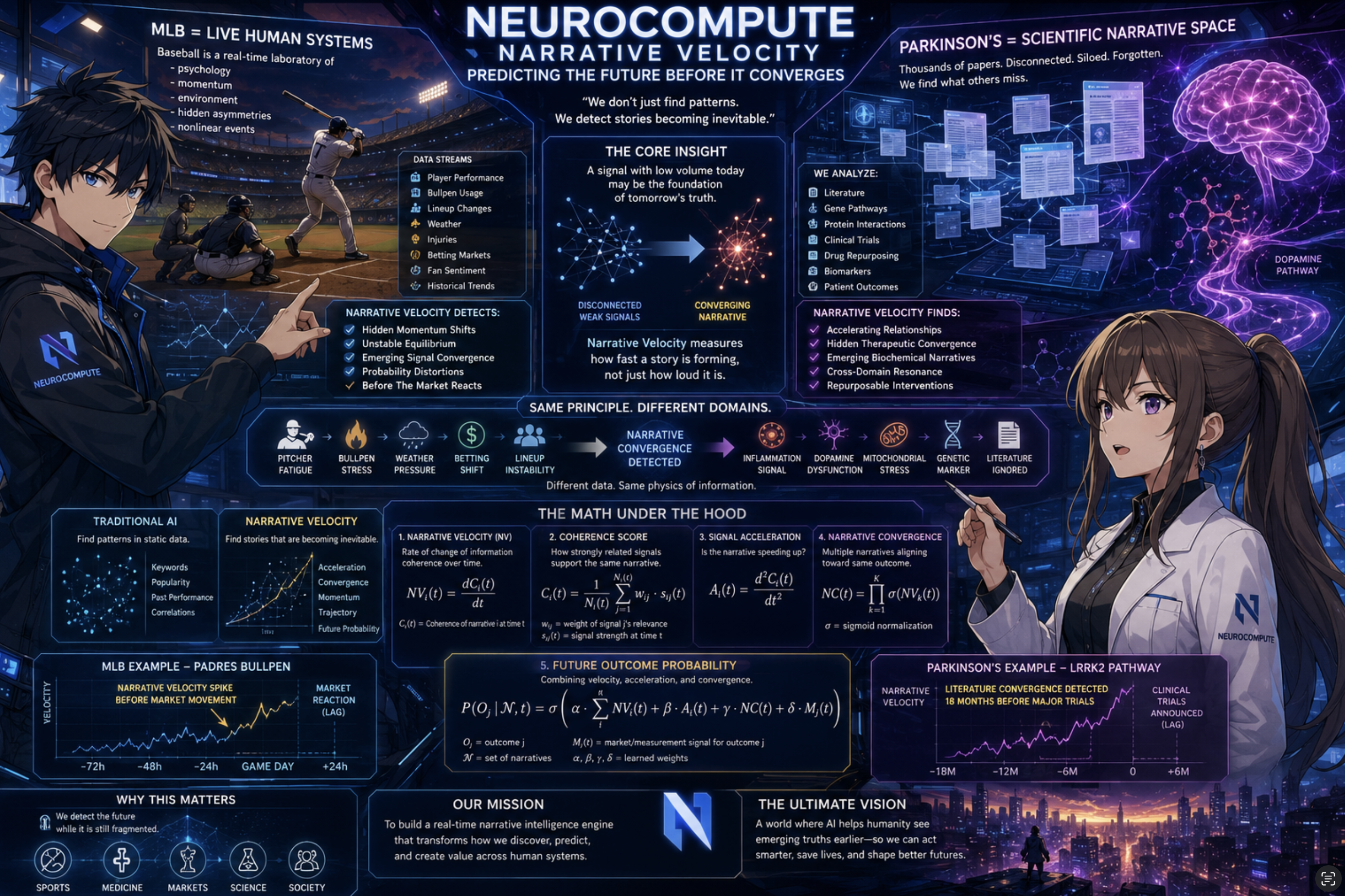
View analysis →Finding therapies hidden in 1,516 Parkinson’s papers.
Neurocompute scores biomedical literature, surfaces overlooked patterns, and turns Parkinson’s research into a living discovery terminal.
Ranked discovery teasers
E grade · PMID 42013784
View analysis →E grade · PMID 41984773
View analysis →E grade · PMID 42043105
View analysis →E grade · PMID 41938060
View analysis →E grade · PMID 41939735
View analysis →E grade · PMID 42018961
View analysis →E grade · PMID 41902021
View analysis →E grade · PMID 41924695
View analysis →E grade · PMID 42008672
View analysis →Database feed
All ranked Parkinson’s papers
Largest LATAM cohort study of levodopa-induced dyskinesia (LID) finding 25.4% prevalence overall (range 9.3–45.1%), increasing with disease duration, with fast progression but not sex associated with higher LID risk.
Provides population-specific epidemiologic data that can guide risk stratification, trial design, and motivate integration of genetic and environmental studies to uncover LID mechanisms relevant to diverse populations.
Observational study of 149 early PD patients found that higher coffee consumption (especially >1 cup/day) was modestly associated with better performance on select executive function tests (Go-No-Go, Calculation, Contrasting Program) after covariate adjustment, while smoking showed no cognitive…
Indicates caffeine might modestly correlate with preserved executive function in early PD, providing a low-risk repurposing hypothesis and justification for targeted replication and mechanistic studies relevant to symptomatic cognitive management.
Phase 1 trial shows adults with Parkinson's disease can significantly improve recognition of hypokinetic dysarthric speech through a validated listener-focused perceptual training protocol, with gains comparable to neurotypical listeners.
Although not disease-modifying, this feasible behavioral intervention has clear translational value for improving communication, social participation, and quality of life in people with PD, making it clinically relevant for symptomatic management.
The study implements a scalable high-throughput, high-content C. elegans imaging workflow to quantify dopaminergic neuron degeneration and dopamine-dependent behavioral deficits after exposure to several PFAS compounds and mixtures, identifying PFOS as the most potent and mixture toxicity driven by…
It provides a rapid in vivo screening platform to prioritize environmental chemicals that cause dopaminergic neurotoxicity—useful for flagging agents for further mechanistic or mammalian follow-up studies related to PD risk, though it offers limited direct therapeutic targets or clinical…
This study used empirical mode decomposition of center-of-pressure signals and machine learning (SFFS feature selection plus classifiers) to classify fall risk in 32 PD patients, identifying a 3-feature subset and achieving up to 0.96 subject-level AUC in the best condition.
Offers a robust, objective monitoring/stratification tool for fall risk and potential clinical-trial endpoints in PD, improving assessment and remote monitoring, but provides little direct mechanistic or therapeutic discovery insight.
In a cross-sectional cohort of 60 older adults, Parkinson's disease was associated with prolonged contraction time and reduced maximal muscle displacement in the lateral gastrocnemius (TMG), whereas sarcopenic participants had substantially lower hip and knee extension isometric strength.
The paper highlights distinct, measurable peripheral muscle phenotypes in PD versus sarcopenia that could inform functional biomarkers and guide targeted rehabilitation or monitoring, but it provides limited mechanistic or drug-target insights for therapeutic discovery.
In a propensity-matched multicenter cohort comparing 8,202 virtual to 8,202 in-person new neurology visits, overall 90-day neurologic follow-up, ED visits, and hospitalizations were similar, though Parkinson disease visits showed higher short-term follow-up after virtual encounters and some testing…
This supports telemedicine as a safe, pragmatic approach for initial Parkinson care and remote follow-up and could facilitate trial recruitment and decentralized monitoring, but it provides minimal direct insight for mechanistic or therapeutic discovery.
The study applied NMF and multimodal matrix factorization to EMG and joint angular-acceleration data from 19 Parkinson's patients during walking, extracting four EMG synergies and eight cross-modal synergies that link specific muscle groups (e.g., TA, SOL, RF) with pelvis-to-lower-limb kinematic…
While not identifying molecular targets, the joint EMG–kinematic synergy framework offers quantitative, potentially clinically actionable biomarkers for stratifying gait phenotypes, tracking motor progression, and evaluating rehabilitation or neuromodulation interventions in PD.
MRI analysis of early-stage Parkinson's patients found reduced cortical gyrification in left parahippocampal and lingual gyri and gyrification deficits in right parietal, temporal, and occipital regions that correlate with bradykinesia and functional capacity.
Suggests cortical gyrification could serve as a noninvasive biomarker for early diagnosis or progression monitoring linked to motor severity, but offers limited direct therapeutic or mechanistic targets for drug discovery.
In PD patients tested ON vs OFF dopaminergic medication and healthy controls, dopaminergic treatment increased perceived sense of agency—especially when actions matched but failed goals—reduced self-serving dishonest choices, and altered evidence accumulation for agency judgments linked to…
The study shows how dopaminergic therapy modulates corporeal self-awareness and moral decision-making, which can inform clinical management of cognitive/behavioral effects of dopaminergic drugs, but it offers limited direct leads for disease-modifying or target-based therapeutic discovery.
In 52 people with Parkinson's, cognition was not associated with objective or subjective dysphagia, but prolonged water-swallowing time correlated with self-reported swallowing problems and interacted with cognition.
The paper has limited therapeutic-discovery value but is clinically relevant: it highlights water-swallowing testing as a useful assessment metric and warns clinicians that intact cognition does not rule out dysphagia, informing patient evaluation and outcome measurement.
A Spanish PRISM real-world survey of 149 people with Parkinson's and 38 caregivers found high motor and non-motor symptom burden, widespread levodopa use, a 57% rate of reported impulse control behaviors, low use of rehabilitation therapies, and strong interest but low participation in clinical…
While not providing mechanistic or therapeutic leads, the dataset identifies clear unmet clinical needs, high non-motor and impulse-control symptom prevalence, and potential opportunities to improve care delivery and design/target recruitment for interventional trials in Spain.
This study identifies a homozygous PTRHD1 (c.155G>A, p.Cys52Tyr) mutation in a family with early intellectual disability and later-onset atypical parkinsonism, expanding the clinical phenotype and showing widespread PTRHD1 expression in adult brain.
It implicates PTRHD1 as a rare monogenic contributor to neurodevelopmental and neurodegenerative phenotypes—valuable for genetic classification and hypothesis generation but of limited immediate translational or therapeutic relevance without mechanistic links to established Parkinson's pathways.
Prospective study of 27 PD patients found cognitive and affective Theory of Mind abilities largely unchanged one year after bilateral subthalamic deep brain stimulation, with ToM performance correlating with overall cognition and specific neuropsychological domains.
This supports the cognitive/ToM safety profile of STN-DBS and helps guide patient counseling and selection, but provides limited mechanistic or therapeutic-discovery insights for Parkinson's disease drug development.
This study presents an automated Parkinson's disease severity prediction framework that combines ensemble feature extraction (IAOA-weighted features, RBM, t-SNE) with an Adaptive Multi-scale Temporal Convolutional Network (AMTCN) to classify UPDRS-based severity, reporting ~94% accuracy.
Improved and more interpretable severity prediction can aid clinical monitoring, patient stratification, and trial enrollment, but the work offers little direct mechanistic or therapeutic insight for drug discovery.
Qualitative survey and interviews with 47 patients (PD, ET, dystonia) who participated in externalized DBS LFP research revealing high overall satisfaction driven by altruism, low perceived personal benefit, limited burdens (travel, costs, longer stays), and a strong desire for results feedback and…
Though it offers no new mechanistic or therapeutic targets, the study provides practical insights to improve trial design, consent, retention, and patient-centered delivery of LFP/adaptive DBS research, which can indirectly accelerate development and adoption of DBS-based therapies.
Pilot fMRI feasibility study demonstrating that people with mild–moderate Parkinson’s can perform a Block Span Task in scanner, which engages expected visuospatial working-memory networks (superior temporal gyrus, superior medial frontal gyrus, precuneus, posterior cingulate).
This work has limited direct therapeutic discovery value but is useful as a tool-validation step for assessing visuospatial network dysfunction and may support future biomarker or cognitive-intervention studies if replicated and expanded.
PD patients report higher arousal than controls when observing walking tasks, with arousal increasing with environmental challenge (natural>built; high>moderate>low demand) while valence ratings are similar across groups.
Although not mechanistic or directly therapeutic, the work highlights heightened emotional reactivity to gait challenges in PD, which can inform assessment, rehabilitation strategies, and environment- or behavior-focused interventions to mitigate fall risk and anxiety.
In 55 Parkinson's patients, self-reported swallowing dysfunction correlated with sialorrhea, while cervical proprioception showed no association with either measure.
This supports a clinical link between dysphagia and drooling that can inform symptom assessment and rehabilitation strategies, but offers minimal mechanistic insight or direct therapeutic-discovery pathways.
Using spatial transcriptomic mapping and PRS conditioning, the study shows essential tremor shares substantial common-variant genetic signals with Parkinson's disease and cognition, and that removing these shared signals reduces PRS-based classification performance, implying common variants alone…
Although it provides limited direct therapeutic targets for Parkinson's, the paper highlights shared genetic architecture with PD and argues that rare variants, nonstandard variant types, and spatially resolved expression data may be more informative for discovering disease-specific mechanisms…