E grade · PMID 41896996
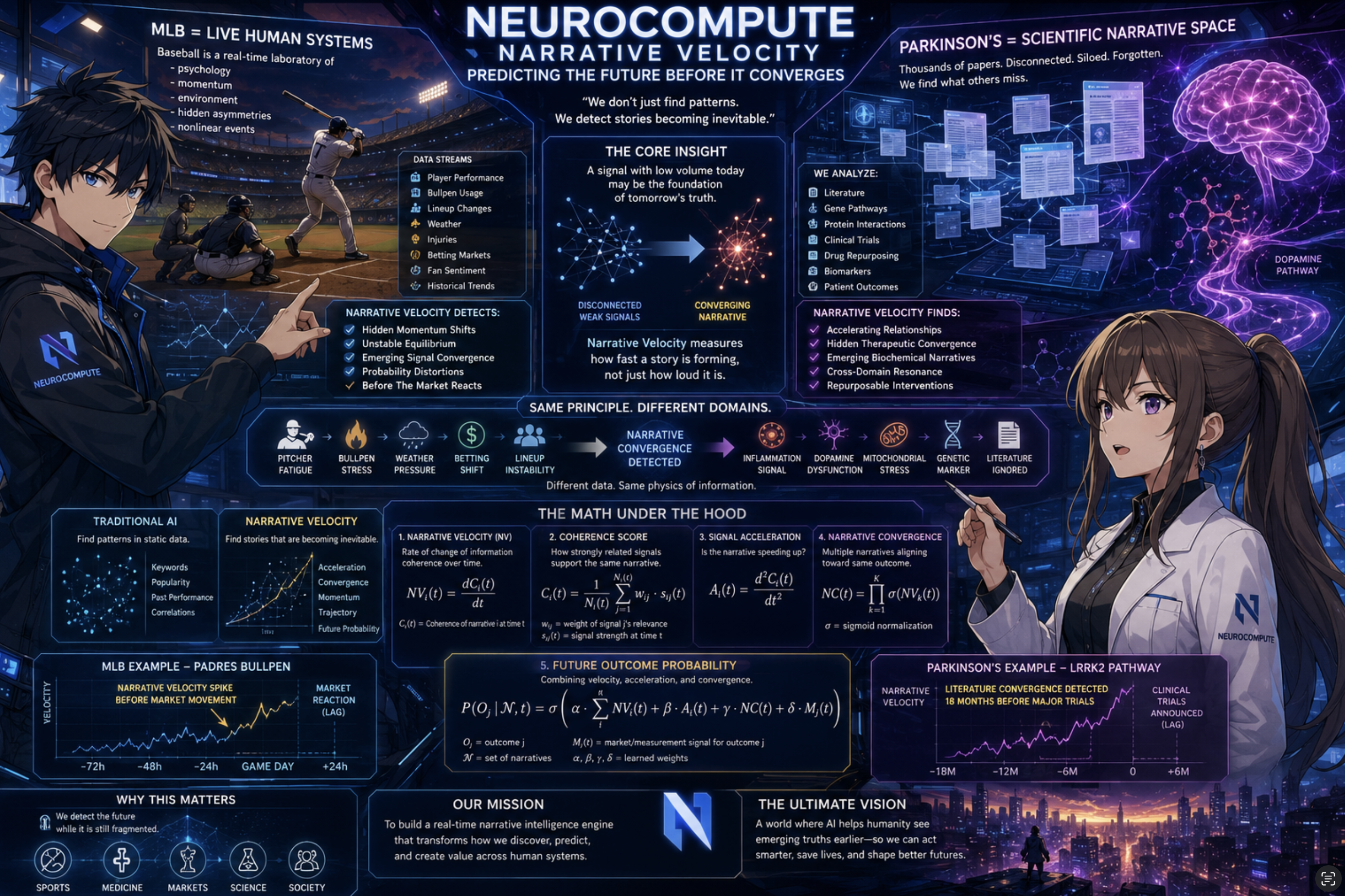
View analysis →Finding therapies hidden in 1,516 Parkinson’s papers.
Neurocompute scores biomedical literature, surfaces overlooked patterns, and turns Parkinson’s research into a living discovery terminal.
Ranked discovery teasers
E grade · PMID 41929290
View analysis →E grade · PMID 41929295
View analysis →E grade · PMID 42034047
View analysis →E grade · PMID 41934825
View analysis →E grade · PMID 42027070
View analysis →E grade · PMID 41957096
View analysis →E grade · PMID 41929045
View analysis →E grade · PMID 41992934
View analysis →E grade · PMID 41899891
View analysis →Database feed
All ranked Parkinson’s papers
This large randomized, double-blind, multicenter trial will test whether precision neuroimaging-guided continuous theta-burst stimulation targeting the left supplementary motor area improves motor symptoms in 290 Parkinson's patients versus sham, with primary outcome MDS-UPDRS III at day 8 and…
A positive result would provide high-quality clinical evidence for a noninvasive, reproducible neuromodulation therapy as an adjunctive symptomatic treatment for PD motor deficits and support broader translational development of precision rTMS protocols.
Large multicenter autopsy study of 3,353 donors quantifying clinicopathological concordance, showing ~10–20% misdiagnosis rates, 40% Alzheimer’s co-pathology in Lewy body disease, greater Lewy body burden in GBA1 carriers, and ancestry-related differences in pathological diagnoses independent of…
By linking genetics (notably GBA1), pathology, and ancestry at scale, the study informs biomarker development and patient stratification for trials—improving therapeutic targeting and cohort selection even though it does not report new molecular interventions.
Autopsy study using immunohistochemistry and RT‑QuIC on brain and gastrointestinal samples from 178 subjects reports GI‑only alpha‑synuclein pathology is rare while brain‑only pathology is substantially more common, and the count of SAA‑positive GI sites correlates with motor and GI autonomic…
This work refines the gut‑versus‑brain origin debate for synucleinopathy, validates RT‑QuIC SAA in GI tissue as a symptom‑linked biomarker useful for patient stratification, and suggests gut‑directed interventions may be relevant only to a minority—important for prioritizing therapeutic targets and…
The authors built a cross-species latent gene-expression space using a variational autoencoder trained on mouse spatial transcriptomics and embedded human orthologs to translate and predict human anatomical and disease-related brain changes from mouse models, validated for Alzheimer's and…
This quantitative translation tool helps identify which mouse models and disease stages best recapitulate human Parkinson's expression changes, improving model selection and thereby enhancing the translational relevance of preclinical therapeutic discovery.
Encapsulation of CDNF in collagen hydrogels enabled sustained intracerebral delivery that improved motor behavior in a rodent PD model and dose-dependently altered brain N‑glycosylation, particularly core‑fucosylated glycans.
Provides a translationally relevant biomaterial delivery approach for a neurotrophic therapy and links CDNF efficacy to reversible N‑glycome changes, suggesting both a mechanistic readout and potential biomarker for therapeutic development.
Using NMR and MD, the authors show that ATP's adenine and triphosphate moieties differentially bind α-synuclein—triphosphate forms strong contacts with N-terminal lysines that expand the protein while adenine makes weak multisite interactions—producing a concentration-dependent "hierarchical…
Provides a concrete molecular mechanism linking ATP to α-synuclein conformational regulation, highlighting ATP-mimetic moieties and site-specific interactions as actionable starting points for anti-aggregation strategies relevant to Parkinson's disease, though cellular and in vivo validation are…
Targeted sequencing of 61 neurodegeneration genes in 186 Sicilian patients identified pathogenic/likely pathogenic variants in ~21% (diagnostic yield 16.7%), with GBA showing the highest number of pathogenic hits and broad phenotypic associations across AD, PD, FTD and parkinsonism.
Highlights clinically actionable genetic stratification—particularly enrichment of GBA (lysosomal) variants—supporting patient selection, biomarker development, and translational relevance for GCase/lysosome-targeted Parkinson's therapeutics and diagnostics.
JAK2 is induced in aged midbrain dopaminergic neurons and physically interacts with Nurr1 to enhance its nuclear stability and transcriptional activity (independent of canonical JAK/STAT signaling), with constitutively active JAK2 V617F increasing Nurr1 protein and reducing oxidative-stress…
This reveals a druggable, noncanonical regulator of Nurr1 stability that could be leveraged to boost dopaminergic neuron resilience in aging and Parkinson's disease, though oncogenic concerns around JAK2 activation and lack of in vivo therapeutic validation temper immediate translational potential.
The authors developed and validated a multimodal, imaging-informed model that integrates contact coordinates, electric fields, tract activations, and network data to predict motor improvement and reliably identify optimal or adjacent STN-DBS contacts across multiple cohorts.
While not a molecular therapeutic, this clinically validated, multimodal imaging approach has clear translational value for personalizing and streamlining DBS programming, improving patient outcomes and efficiency in Parkinson's neuromodulation care and trials.
This study presents a reproducible, explainable two-stage AI framework using vertical ground reaction force signals to both detect Parkinson's disease (AUC ≥ 0.93) and predict continuous H&Y severity (Spearman ρ = 0.921), and reports gait changes detectable up to ~4 years before diagnosis in a…
Delivers a clinically relevant, wearable-compatible digital biomarker and interpretable pipeline for early screening and longitudinal monitoring of PD that can improve patient stratification and trial endpoints, though it does not expose molecular therapeutic targets.
This study presents StimVision, a smartphone video-based, markerless kinematic pipeline that quantifies hand movement features to objectively rank and optimize DBS programming within sessions in Parkinson’s patients.
By providing scalable, quantitative motor biomarkers and a patient-specific improvement score, the method can make DBS programming more efficient and reproducible, enable comparative assessment against dopaminergic therapy, and facilitate objective endpoints for clinical optimization and trials.
Prospective open-label study (n=45, 32 at 5 years) showing unilateral focused‑ultrasound subthalamotomy gives sustained, side-specific motor improvement (54% off‑med MDS‑UPDRS‑III improvement for treated side; overall 27% reduction) with increased LEDD, stable QoL/function, and no late adverse…
Demonstrates durable, noninvasive, clinically actionable symptomatic benefit of STN‑FUS as a long‑term alternative to invasive neurosurgical approaches, informing therapeutic strategy and device development despite lacking disease‑modifying mechanistic insight.
Using PICUP and targeted tyrosine mutations, the study maps transient intra- and inter-molecular contacts of α‑synuclein across solution, membrane-bound, oligomeric and fibrillar states, finding that membrane binding disrupts N–C intramolecular contacts while C‑terminal intermonomer contacts…
By defining state-specific α‑synuclein contact interfaces—especially persistent C‑terminal intermonomer interactions—this work clarifies mechanistic steps of aggregation, highlights a plausible target region for interventions or biomarker development, and provides a robust protocol useful for…
Using a tract-of-interest DTI/TFAS approach on 206 scans, the study detected stage-correlated fractional anisotropy reductions in white-matter tracts mapped to the six neuropathological stages of PD and used these patterns to classify in vivo disease-stage progression.
Offers a noninvasive MRI-based framework to stage and track PD-related neurodegeneration that could be used as a surrogate biomarker for patient stratification and outcome measurement in therapeutic trials, though it does not address molecular mechanisms or interventions.
This diffusion MRI study found progressive reductions in cortical parallel diffusivity (ParlPD) from nonmanifest to manifest genetic PD, with more pronounced cortical microstructural alterations in GBA1 versus LRRK2 carriers.
Identifies a noninvasive microstructural imaging biomarker useful for early detection, staging, and stratifying genetic PD cohorts (particularly GBA1) for trials and progression monitoring, offering translational value despite limited mechanistic or therapeutic insights.
The study presents a machine-learning pipeline that produces a patient-specific heterogeneity score (HET) from multimodal MRI with SHAP explainability, distinguishing MSA subtypes from PD, identifying key affected regions (olivopontocerebellar and striatonigral areas and widespread white matter),…
Delivers a quantitative, explainable imaging biomarker useful for diagnosis, patient stratification, and sensitive longitudinal monitoring—tools that can improve clinical trial selection and outcome measurement and thereby indirectly accelerate therapeutic development despite not revealing…
In a 5-year longitudinal study of 1,219 early PD patients, higher striatal DAT uptake on DAT-SPECT was associated with slower progression of autonomic dysfunction.
Supports striatal DAT availability as a prognostic biomarker for autonomic decline that can aid patient stratification and trial design, though it offers limited direct insight into therapeutic mechanisms or targets.
Quantitative susceptibility mapping found increased dentate nucleus iron deposition in tremor-dominant PD versus PIGD and controls, with DN susceptibility correlating with tremor severity and, combined with levodopa dose, distinguishing subtypes (AUC 0.898).
Provides a noninvasive imaging biomarker tied to tremor-related CTC circuit pathology and iron dysregulation that could help stratify patients for subtype-specific trials and suggest exploration of iron-modulating therapies.
Open dataset of simultaneous bilateral wrist accelerometry and patient symptom diaries from 66 Parkinson's patients (≈394 total days) enabling development and validation of wearable-based motor symptom monitoring.
Provides a real-world, labelled dataset to develop objective, continuous digital biomarkers and remote monitoring endpoints that can improve assessment of motor fluctuations and support clinical trial measurements, though it does not address underlying disease mechanisms or novel therapeutics.
Using automated FreeSurfer subnuclear segmentation and XGBoost on two independent cohorts, the study found marked atrophy in lateral, paraventricular, and pulvinar thalamic nuclei in PSP and achieved AUC 0.96 for distinguishing PSP from PD based on thalamic nuclei volumes.
Identifies a robust, translatable MRI-based subregional thalamic volumetric biomarker that can improve differential diagnosis and trial cohort selection for PSP (and thereby indirectly aid therapeutic development), though it offers limited direct mechanistic or targetable insights for Parkinson's…