1
[The effectiveness of citicoline in the treatment of cognitive disorders].
45.0
AI
E grade · PMID 41984564
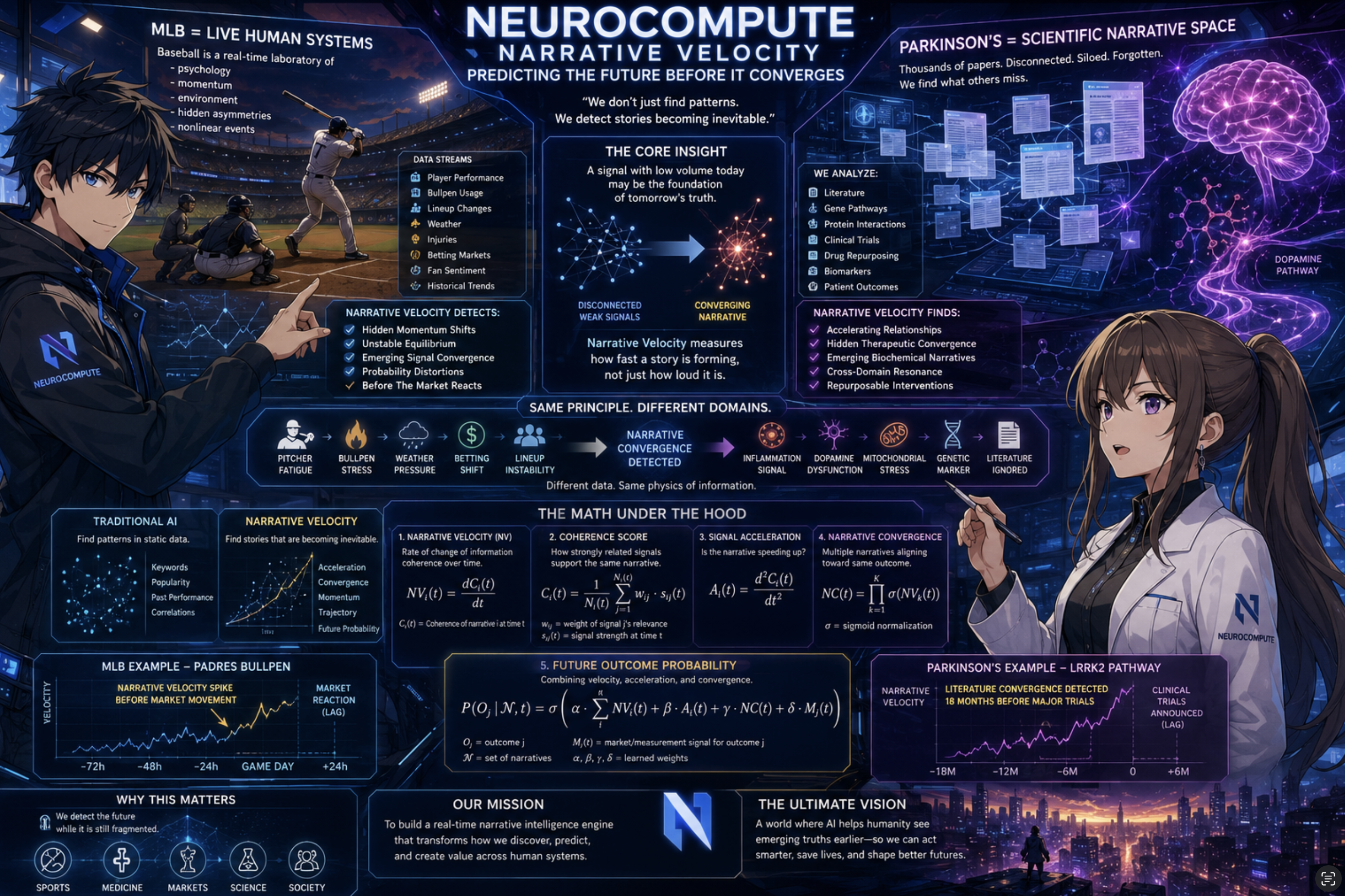
View analysis →Neurocompute scores biomedical literature, surfaces overlooked patterns, and turns Parkinson’s research into a living discovery terminal.
E grade · PMID 41984564
View analysis →E grade · PMID 42045162
View analysis →E grade · PMID 42003785
View analysis →E grade · PMID 41904258
View analysis →E grade · PMID 42009672
View analysis →E grade · PMID 41983317
View analysis →E grade · PMID 41978376
View analysis →E grade · PMID 41944724
View analysis →E grade · PMID 41933664
View analysis →E grade · PMID 41986243
View analysis →This review/meta-analysis reports that citicoline improves cognitive impairment across vascular and neurodegenerative conditions and cites evidence for benefit in mild cognitive impairment in Parkinson's disease with suggested dosing regimens (e.g., 1000 mg/day for 12–18 months).
The paper highlights a clinically tested, readily repurposable agent with pragmatic dosing data for symptomatic cognitive benefit in PD, offering translational trial potential, but it lacks PD-specific mechanistic or disease‑modifying evidence (alpha‑synuclein, mitochondrial, inflammatory, or…
This entry is a correction notice to a report on potent, selective, CNS-penetrant macrocyclic LRRK2 inhibitors for Parkinson's disease and contains no new experimental abstract or actionable data.
While LRRK2-targeting, CNS-penetrant macrocyclic inhibitors are highly relevant to PD therapeutic development, a correction notice itself adds little translational value—researchers should consult the original article for the substantive data and implications for drug discovery.
This study finds elevated monocyte LRRK2 kinase activity (pRab10Thr73) in PD patients carrying the Asian-prevalent p.G2385R variant—markedly higher in rare double p.G2385R/p.R1628P carriers—and reduced pLRRK2Ser935 across PD groups, with a subset of idiopathic PD patients also showing increased…
Provides actionable blood-based LRRK2 activity biomarkers that support biochemical stratification and target-engagement monitoring to expand and refine LRRK2 inhibitor trials beyond genetically defined carriers.
Sequencing of LRRK2 in 20,519 Chinese individuals reveals enrichment of known pathogenic/likely pathogenic variants in PD, identifies novel candidate pathogenic variants (e.g., p.A312V, p.M968K, p.R1320S), and confirms common PD-associated alleles (p.A419V, p.R1628P, p.G2385R) with no similar…
This large-population genetic map of LRRK2 enables patient stratification and clinical-trial enrichment for LRRK2-targeted therapies, prioritizes novel variants for functional follow-up, and supports development of genotype-guided biomarkers and personalized PD interventions.
Using resting-state fMRI and a novel Weighted Eigenvector Dynamics Analysis, the study shows that STN-DBS and noninvasive STN-targeted temporal interference stimulation normalize cortical metastable dynamics by restoring occupancy of a metastable substate (a VN–SMN/VAN decoupling) that correlates…
Provides a translatable, network-level biomarker and mechanistic target for optimizing invasive and noninvasive neuromodulation in PD, potentially improving patient selection and stimulation strategies for motor symptom relief.
This paper presents a biointegrable soft neural interface enabling stable multi-regional recordings in Parkinson's disease mice and shows that wireless magnetogenetic DBS selectively modulates pathological beta-band oscillations and cortico‑basal ganglia‑thalamic synchrony, with therapeutic effects…
By combining a minimally damaging recording platform with mechanistic electrophysiology, the study identifies durable circuit-level modulation and candidate biomarkers (beta oscillations, inter-regional synchrony) that could guide development and optimization of novel, potentially translatable…
The authors develop an MspA nanopore single-molecule assay that resolves three reproducible current states of monomeric α‑synuclein, maps them to α‑helical and random‑coil subdomains, and generates a biophysical parameter matrix to profile structural heterogeneity of variants.
By directly sensing monomeric α‑synuclein conformations at single‑molecule resolution, this method can reveal early misfolding mechanisms, enable screening for compounds that stabilize nonpathogenic conformers, and serve as a potential biomarker platform for Parkinson's therapeutic discovery.
31P MR spectroscopy detected altered midbrain energy metabolism (lower Pi/PCr, higher ATP/Pi) in early-stage PD versus mimics, correlated with nonmotor/autonomic symptoms, and achieved high diagnostic accuracy (AUC 0.90) outperforming iron and neuromelanin MRI.
This provides a noninvasive, quantitative biomarker of mitochondrial/energy dysfunction with strong translational value for early differential diagnosis, patient stratification, and as a potential target-engagement or efficacy readout for metabolism-focused PD therapies.
Using a viral hTyr rat model to induce neuromelanin, the study shows that NM accumulation alters nigral dopamine neuron survival, intrinsic firing and mitochondrial function with higher NM levels in males and sex-biased motor and non-motor (anxiety) phenotypes.
By linking neuromelanin buildup to mitochondrial dysfunction and sex-specific vulnerability in a manipulable preclinical model, the work offers a mechanistic target and platform for developing sex-tailored neuroprotective strategies and biomarkers for Parkinson's disease.
This study demonstrates that an automated programming algorithm using intraoperatively recorded evoked resonant neural activity (ERNA) produces acute motor improvements equivalent to expert clinician and imaging-guided STN-DBS settings in Parkinson's patients, with ERNA recordings taking under one…
Offers a rapid, objective biomarker-driven approach to standardize and scale DBS programming—improving consistency, enabling workflow efficiency and potential closed-loop neuromodulation—representing high translational clinical value though not a novel molecular therapeutic target.
Using intraoperative STN local field potentials and simultaneous cortical ECoG from seven PD patients, the study shows cortico‑STN beta-band coupling is significantly elevated during brief high‑amplitude beta bursts and collapses to surrogate levels outside those bursts.
This provides an actionable, time‑resolved biomarker (beta bursts) that supports burst‑targeted adaptive deep brain stimulation strategies and improved closed‑loop neuromodulation for Parkinsonian motor symptoms.
The paper presents a wireless, minimally invasive magnetomechanical deep brain stimulation using magnetite nanodiscs to remotely modulate subthalamic nucleus activity and restore motor function in hemiparkinsonian mice.
It offers a potentially translatable, electrode-free DBS alternative that can reversibly control Parkinsonian motor symptoms without implants or genetic modification, providing a novel therapeutic delivery strategy despite remaining questions about safety, delivery, and long-term efficacy.
This study presents TuneS, a patient-specific, model-based pipeline to optimize deep brain stimulation contact configurations and targets (including STN motor subdivisions and streamlines) to maximize intended target engagement while minimizing stimulation of avoidance regions.
By providing a systematic, constraint-aware way to predict and evaluate DBS settings for individual PD patients, TuneS can improve clinical outcomes, reduce side effects, and accelerate optimization in both routine care and clinical trials, though it does not address underlying disease-modifying…
Using DOPC-cholesterol giant unilamellar vesicles, the paper demonstrates that the N-terminal region of α‑synuclein is required for membrane binding and vesicle clustering, while full-length and C‑terminal truncated forms promote clustering and membrane permeabilization, with monomers causing…
By pinpointing the N-terminus as essential for membrane interaction and showing variant-dependent pore formation, the work provides a mechanistic handle that could guide strategies to block α‑synuclein–membrane binding and reduce membrane permeabilization implicated in Parkinson’s disease pathology.
Longitudinal analysis of 1,238 PPMI participants shows CSF alpha-synuclein seed amplification assay results are highly stable over a median 2-year follow-up (~90%+ concordance across PD, prodromal, and control groups) with low rates of conversion between positive and negative.
Confirms aSyn-SAA is a reliable, durable biomarker suitable for patient selection, stratification, and longitudinal outcome or engagement measures in PD therapeutic trials and prodromal detection efforts.
Phase 1 randomized crossover thorough QTc study in 37 healthy volunteers found BIA 28-6156, an allosteric GCase activator for GBA-associated Parkinson’s, produced no clinically relevant QTc prolongation and was generally well tolerated.
By demonstrating cardiac safety and tolerability of a GBA-targeted small molecule, this de-risks further clinical development of a potentially disease-modifying therapy for GBA-associated PD and supports progression to efficacy trials.
MAFNet is an end-to-end deep‑learning pipeline that integrates temporal denoising, swarm-based feature selection, and graph‑attention multimodal fusion to stage Parkinson's disease from SNPs, neuroimaging, and UPDRS data, reporting 97.6% accuracy on PPMI (n=200) and nominating LRRK2 variants,…
The method has strong translational potential for biomarker-driven patient stratification and real‑time clinical staging to support precision trials and therapeutic decision‑making, but its high reported performance and biomarker claims need replication in larger, independent cohorts before…
This cross-cohort study found targeted plasma proteomics markedly outperformed whole-blood transcriptomics and multimodal fusion for classifying Parkinson's disease (best proteomic Random Forest AUROC=0.872) and derived a Proteomic Severity Index that explained ~28% of motor severity variance with…
By demonstrating robust, externally validated blood-based proteomic biomarkers for PD and a severity index, the work provides a practical, translatable tool for diagnosis, patient stratification, and trial endpoint development—even though it does not directly identify new therapeutic targets.
The paper presents a robust bacterial coexpression method to produce authentic Ser129-phosphorylated α-synuclein and demonstrates that true pS129 differs from the S129D phosphomimetic in local structure, aggregation behavior, and modest neuronal toxicity.
By providing a scalable source of chemically authentic pS129, the work corrects potential artifacts from phosphomimetics, enabling more accurate mechanistic studies and drug screening efforts (including kinase-targeting strategies) relevant to Parkinson's disease therapeutics.
Whole-exome sequencing, burden testing, Mendelian randomization, and colocalization in a European cohort identified enrichment of rare variants in multiple DNAJC genes and provide convergent genetic evidence implicating DNAJC13 (and shared signals for DNAJC19) as Parkinson's disease susceptibility…
By genetically linking DNAJC family members—chaperone/co‑chaperone proteins involved in protein homeostasis and endosomal/vesicular trafficking—to PD, the study highlights mechanistic pathways (protein folding, endosome‑lysosome dysfunction) that are relevant and potentially targetable for drug…