E grade · PMID 41936714
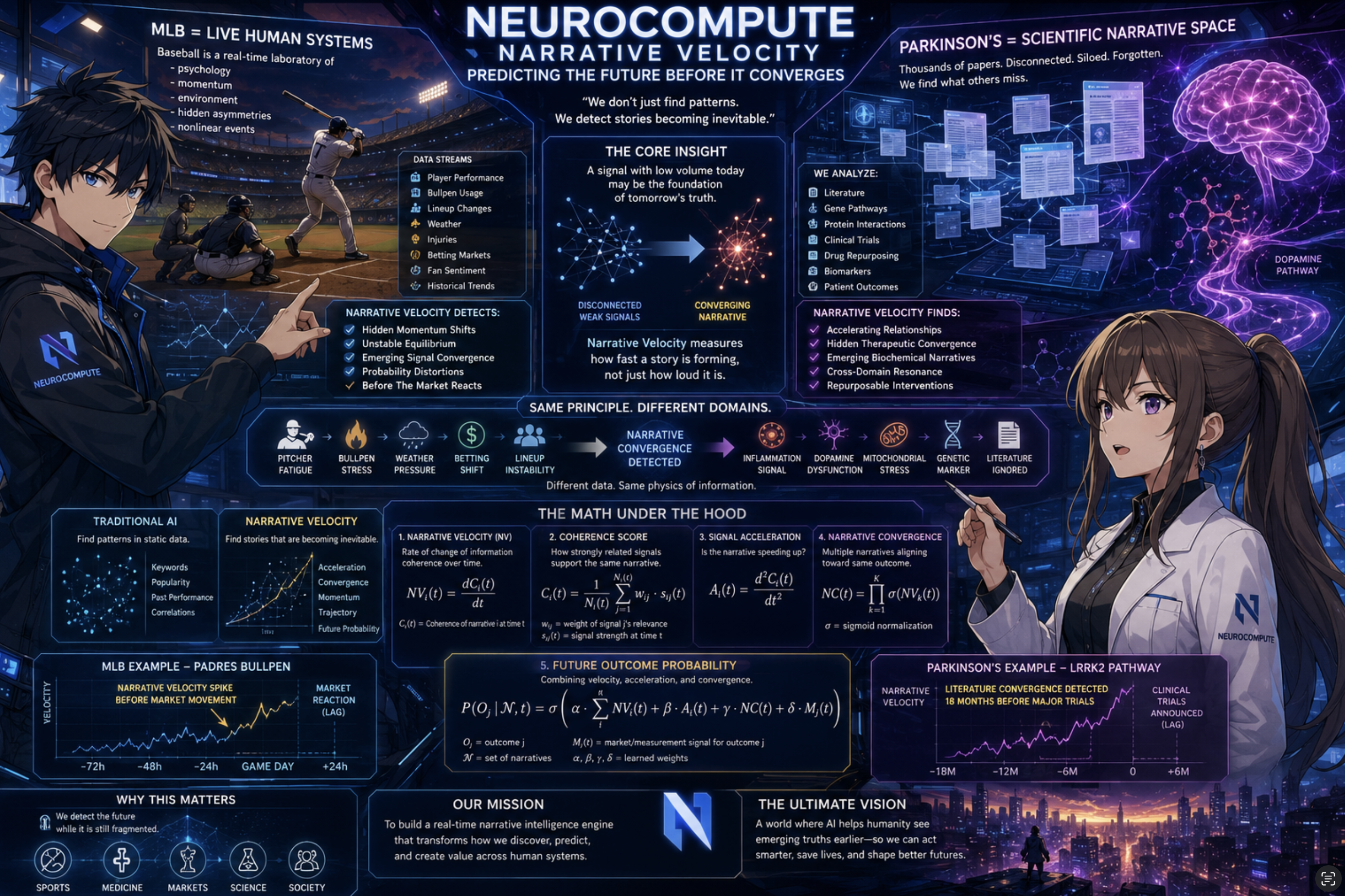
View analysis →Finding therapies hidden in 1,516 Parkinson’s papers.
Neurocompute scores biomedical literature, surfaces overlooked patterns, and turns Parkinson’s research into a living discovery terminal.
Ranked discovery teasers
E grade · PMID 41978221
View analysis →E grade · PMID 41974432
View analysis →E grade · PMID 42013009
View analysis →E grade · PMID 41948786
View analysis →E grade · PMID 41937436
View analysis →E grade · PMID 41925063
View analysis →E grade · PMID 41935079
View analysis →E grade · PMID 41916085
View analysis →E grade · PMID 41994333
View analysis →Database feed
All ranked Parkinson’s papers
A 17-year real-world analysis of antiparkinsonian drug prescriptions in Korean Parkinson's patients describing temporal trends and utilization patterns across medication classes.
Provides useful surveillance of prescribing patterns, uptake of therapies, and potential gaps in real-world treatment that can guide clinical practice and health-policy decisions, but offers limited mechanistic or translational insight for novel therapeutic discovery.
This scoping review maps 19 studies using wearable, portable, and contactless digital technologies to assess diverse sleep disturbances in Parkinson's disease, classifying tools by technical maturity and highlighting limited disease-specific validation and small cohorts.
By identifying emerging digital sleep biomarkers and gaps in multimodal, validated longitudinal monitoring, the paper points to opportunities to develop scalable endpoints and patient-centered phenotyping that could improve trial design and therapeutic evaluation in PD, though prospective…
This review outlines unique olfactory nerve features and argues that PD-related hyposmia more likely reflects systemic vulnerabilities in energy metabolism and neural network organization than solely peripheral alpha‑synuclein aggregation, noting that nasal seed‑amplification assays for…
By challenging simple propagation models and highlighting metabolism, network dysfunction, and limitations of nasal alpha‑syn biomarkers, the paper steers therapeutic discovery toward metabolic/neuroprotective strategies and multimodal biomarker approaches rather than focusing only on peripheral…
A neuroradiology review summarizing advanced MRI methods (DCE Ktrans, ASL kw, ultra-high-field MRI, AI post-processing) for detecting and quantifying blood-brain barrier breakdown across neurodegenerative diseases, with discussion of potential biomarker standardization for diagnosis and…
Although not providing new therapeutic targets, the paper outlines clinically translatable imaging biomarkers that could enable patient stratification and objective outcome measures for PD trials aimed at BBB, vascular, or inflammation-related interventions, thereby aiding translational and…
Meta-analysis of 7,042 PD patients found GI symptoms—particularly constipation—were associated with higher prevalence of PD dementia (RR 1.37) and, in a subgroup of prospective studies, with a mean MOCA decline of ~1.26 points over 5 years, though causation was not established.
Flags constipation as a potential biomarker and modifiable gut–brain axis target that justifies monitoring and prospective intervention trials (microbiome, motility, anti-inflammatory strategies) despite the current lack of mechanistic or therapeutic evidence.
Retrospective review of 574 ED visits for falls in older adults found 33% admitted and identified female sex, age ≥78, ambulance arrival, comorbidities including Parkinson's disease, multimorbidity, and use of fall‑risk‑increasing medications — with fractures and intracranial hemorrhage strongly…
Findings inform clinical risk stratification and fall‑prevention strategies relevant to people with Parkinson's disease but provide little in the way of mechanistic insight or direct therapeutic targets for PD drug discovery.
Review synthesizing preclinical and some clinical evidence for repurposed drug classes (chemical chaperones, GLP‑1 receptor agonists, iron chelators, c‑Abl TKIs) across neurodegenerative diseases and proposing rational combinatory therapies to target multiple pathogenic mechanisms relevant to…
Offers a translational, repurposing-focused strategy to combine agents with complementary mechanisms and existing safety data, which could accelerate development of multi-target disease-modifying treatments for Parkinson’s disease.
Comprehensive review of ATP13A2 structure, function, pathology, and cross-species cellular and animal models, linking lysosomal polyamine, metal cation, and calcium dysregulation to ATP13A2-linked neurodegeneration including Kufor-Rakeb syndrome.
By consolidating mechanistic insights and preclinical models that tie lysosomal dysfunction and metal/polyamine homeostasis to neuronal loss, the paper highlights actionable pathways and experimental systems that can be used for target validation, biomarker development, and therapeutic screening…
This review reframes Parkinson's disease as a heterogeneous syndrome, synthesizing genetic (SNCA, LRRK2, VPS35, RAB32, PRKN, PINK1, GBA1 and >90 GWAS loci) and neuroinflammatory evidence that converges on pathways like alpha‑synuclein aggregation, lysosomal dysfunction, mitochondrial impairment,…
By integrating genetic and immune mechanisms the paper highlights convergent, actionable biological pathways and patient‑stratification opportunities that can guide disease‑modifying therapeutic discovery and biomarker development.
This review outlines the rationale and early preclinical efforts to use chimeric antigen receptor–engineered regulatory T cells (CAR Tregs) to target misfolded/aggregated proteins and suppress neuroinflammation in neurodegenerative diseases, including Parkinson's disease.
While conceptual and preclinical, CAR Treg strategies offer a novel immunomodulatory approach to reduce inflammation driven by protein aggregates and could be translated into targeted therapies for Parkinson's disease if specificity, safety, and delivery challenges are resolved.
An author response reporting that relative brain hyperperfusion, independent of nigrostriatal dopamine depletion, correlates with motor dysfunction in patients with Parkinson disease.
Points to a possible non-dopaminergic neurovascular contribution and an imaging biomarker for motor symptoms, but offers limited mechanistic or therapeutic actionable insight (and lacks a full abstract/primary data).
This reader response highlights an association between relative brain hyperperfusion, independent of nigrostriatal dopamine depletion, and motor dysfunction in patients with Parkinson disease.
If replicated, the finding points to non-dopaminergic vascular or perfusion-related contributors and an imaging biomarker that could inform pathophysiology and patient stratification, but it offers limited immediate therapeutic targets or translational detail.
This systematic review reports that olfactory mucosa-derived mesenchymal stem cells express neural and mesenchymal markers, secrete neurotrophic factors (BDNF, GDNF, NGF), and show preliminary preclinical promise for neurological disorders including Parkinson's disease, but highlights inconsistent…
OM-MSCs represent an accessible, potentially autologous neurotrophic cell source relevant to neuroprotection/regeneration in Parkinson's, but further standardized, safety-focused and efficacy-driven studies are required before therapeutic translation.
Case report/review of repurposing oxybutynin (an antimuscarinic) to treat excessive sweating in Parkinson's disease, showing symptomatic benefit but no evidence of disease modification.
Useful as a practical, low-risk symptomatic option for autonomic hyperhidrosis in PD, but of limited value for Parkinson's therapeutic discovery since it lacks mechanistic, biomarker, or neuroprotective relevance.
Review of recent brain–computer interface recording and stimulation technologies, emphasizing closed‑loop systems and BCI‑driven DBS and their potential applications to movement disorders including Parkinson’s disease.
Although it doesn't target molecular disease mechanisms, the paper is moderately useful for Parkinson’s therapeutics because advances in BCI-driven, closed‑loop neuromodulation could meaningfully improve symptomatic control, personalization, and clinical translation of DBS-based interventions.
Case report where 18F‑Flortaucipir PET showed asymmetric basal ganglia uptake in an amyloid‑negative patient with corticobasal syndrome, supporting a 4R tauopathy phenotype and suggesting expanded utility of this tracer beyond its current FDA indication.
Supports use of tau PET as a diagnostic biomarker in 4R tauopathies associated with atypical parkinsonism, which could improve patient selection and outcome measures for tau‑targeted therapeutic development.
Narrative review of neurology studies (2020–2025) using the German IQVIA Disease Analyzer highlighting outpatient diagnoses, prescribing patterns, and methodological strengths and limitations across disorders including Parkinson’s disease.
Provides useful real-world epidemiology and treatment-pattern context for Parkinson’s but offers minimal mechanistic, biomarker, or intervention insights needed for direct therapeutic discovery, so it mainly guides study design and complementary data needs.
This systematic review of seven small trials (123 participants) reports that mesenchymal stem cell therapy in MSA is generally safe and was associated in some studies with dose‑dependent slowing of clinical progression, but findings are heterogeneous across routes, doses, and study designs.
MSCs act via anti‑inflammatory and trophic mechanisms that are potentially disease‑modifying for synucleinopathies, making this preliminary clinical signal of neuroprotection relevant to Parkinson's therapeutic discovery, though evidence is limited and requires larger, standardized trials to assess…
Proof-of-concept study showing mobile EEG can detect condition-dependent behavioral and event-related potential changes during an inhibitory-control task while walking in Parkinson's disease, with levodopa primarily modulating early sensory-perceptual components and DBS affecting later cognitive…
Provides a feasible ambulatory neurophysiological biomarker for cognition–gait interactions that can help design and power trials of levodopa/DBS and other interventions, though it offers limited direct therapeutic mechanistic targets.
Small within-subject pilot (n=20) found 7 weeks of bi-weekly group Cognitive Stimulation Therapy improved cognition in people with Parkinson's disease dementia, with increased caregiver assistance and high satisfaction.
Relevant as a non‑pharmacologic, symptomatic approach for cognitive symptoms in PDD, but offers limited mechanistic insight, biomarker data, or direct value for Parkinson's drug discovery due to small sample and preliminary design.