E grade · PMID 41898179
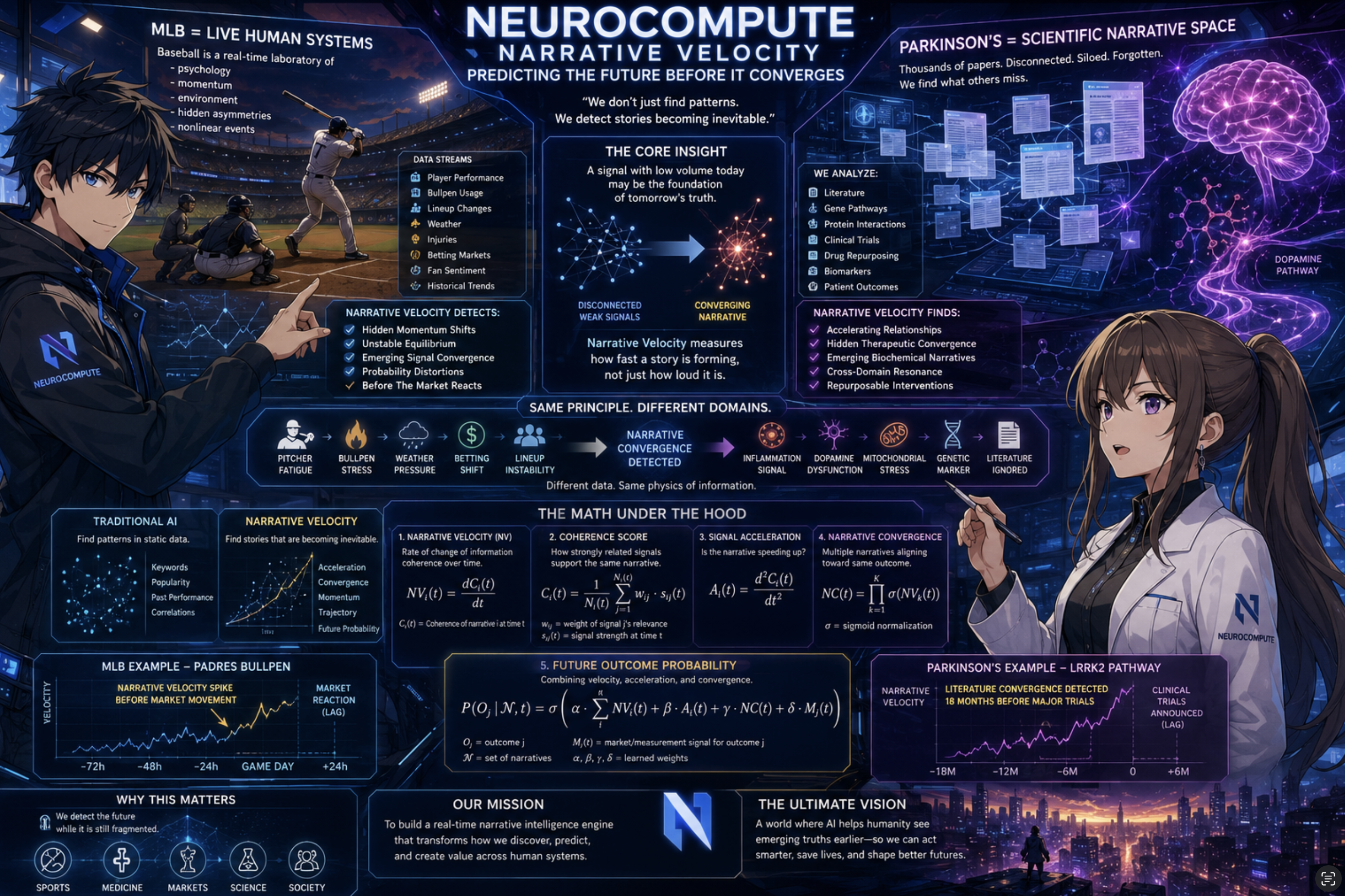
View analysis →Finding therapies hidden in 1,516 Parkinson’s papers.
Neurocompute scores biomedical literature, surfaces overlooked patterns, and turns Parkinson’s research into a living discovery terminal.
Ranked discovery teasers
E grade · PMID 41948713
View analysis →E grade · PMID 41933952
View analysis →E grade · PMID 41910596
View analysis →E grade · PMID 41967903
View analysis →E grade · PMID 42000588
View analysis →E grade · PMID 41915165
View analysis →E grade · PMID 41970459
View analysis →E grade · PMID 41907493
View analysis →E grade · PMID 41923675
View analysis →Database feed
All ranked Parkinson’s papers
Systematic review and meta-analysis of 17 randomized sham-controlled trials (n=654) found that sham non-invasive neuromodulation gives small, short-term improvements in UPDRS Part III while active stimulation produces larger, more durable benefits, with placebo effects varying by outcome and time.
Provides practical guidance for trial design—outcome selection, assessment timing, expectancy management, and comparator choice—to better distinguish true neuromodulation efficacy from transient placebo responses and improve translational validity.
This review argues that multimodal AI models combining MRI, PET, EEG, and digital phenotyping can detect preclinical neurodegenerative changes earlier than conventional markers and advocates explainable, longitudinal approaches for risk stratification and trial enrichment.
The paper is useful for Parkinson's therapeutic discovery primarily as a roadmap for developing earlier, more precise biomarkers and patient-selection tools to improve trial power, but it provides little actionable mechanistic or therapeutic insight.
A randomized, double-blind trial in 34 people with Parkinson's disease showed that home-based high-intensity combined inspiratory and expiratory muscle training (60% MIP/MEP, 20 min twice daily for 8 weeks) significantly improved maximal respiratory pressures, inspiratory endurance, dyspnoea, and…
This trial identifies a practical, low-risk rehabilitative therapy that improves respiratory function and symptoms in PD patients—valuable for clinical care and quality of life—but it offers limited mechanistic or disease-modifying insights for Parkinson's therapeutic discovery.
Retrospective review across six EDs found only 32.3% of Parkinson's patient encounters received their home carbidopa-levodopa in the ED and fewer than 10% received it within defined timeliness standards, with mean time to administration ~6 hours.
Clinically important identification of a widespread, actionable care-delivery failure that increases risk of iatrogenic deterioration in PD patients and supports targeted operational interventions (protocols, EHR alerts, staff training) rather than novel molecular therapeutic discovery.
Narrative review critically examining the conceptualization, assessment methods, and pathophysiological evidence for rigidity in Parkinson's disease and identifying gaps and methodological recommendations.
Improving definition and measurement of rigidity can strengthen clinical phenotyping and trial endpoints, but the paper provides limited new mechanistic targets or direct therapeutic leads for Parkinson's drug discovery.
A PRISMA-guided systematic review found that while patients with idiopathic Parkinson's can learn to self-modulate neural signals via fMRI, EEG, or DBS neurofeedback, consistent improvements on validated clinical or behavioral outcomes are lacking due to small samples and methodological…
Indicates neurofeedback has mechanistic plausibility and translational potential but currently insufficient, underpowered clinical evidence—prioritizing larger, standardized trials and standardized effect-size reporting could determine its real therapeutic value for PD.
Narrative review synthesizing evidence on motor and non-motor drivers of health-related quality of life in advanced Parkinson's disease, the impact on caregivers, the use of patient-reported outcome measures, and how advanced therapies affect HRQoL outcomes.
Useful for guiding patient-centered outcome selection and trial/endpoints design and for informing clinical care priorities, but offers limited mechanistic or therapeutic-discovery insights for novel drug development.
Large cross-sectional cohort of 10,929 Australians with Parkinson's characterizing demographics, environmental exposures, comorbidities, and sex differences with planned genomic and digital phenotyping.
Establishes a powerful, scalable resource for genetic analyses, risk stratification, biomarker discovery, and sex-specific research that can enable target identification and therapeutic cohort recruitment, though its cross-sectional, self-reported design limits immediate mechanistic or…
In a cross-sectional cohort of 344 PD patients, cognitive impairment (56.4%) was associated with higher overall pain severity and specific pain subtypes (chronic, central, visceral, off-period dystonia, radicular), with MMSE scores correlating with chronic, radicular, and visceral pain.
Although not mechanistic, the study identifies clinically measurable pain phenotypes linked to cognitive decline that could help stratify patients, prioritize symptom-targeted interventions, and refine inclusion criteria for trials addressing cognition or pain in Parkinson's disease.
Retrospective real-world analysis found bilateral STN-DBS produced short-term improvements in most neuropsychiatric symptoms but a marked increase in cognitive decline between 1–5 years post-DBS, with recent pre-DBS mood symptoms and hallucinations predicting later complications.
Offers clinically actionable data for patient selection, risk stratification, and post-DBS monitoring that can guide trial design and adjunctive therapeutic strategies to mitigate late cognitive decline, but provides limited mechanistic insight for direct drug-discovery targets.
This study reports a cobalt-doped CuO/multiwalled carbon nanotube electrochemical sensor that detects dopamine with high sensitivity (65.001 μA·μM⁻¹·cm⁻²), a low detection limit (0.0285 μM), and good selectivity against common interfering neurotransmitters.
While not offering therapeutic mechanisms or targets, the low-cost, sensitive dopamine sensor could be a useful tool for preclinical Parkinson's research and neurotransmitter monitoring, enabling better measurement of dopaminergic changes in experimental models.
Cross-sectional UK study using the FROM-16 found that Parkinson's disease substantially impairs quality of life for family members/partners (mean score 15.3), with 45% experiencing a very large effect and greater impact when the patient was male.
While it offers little mechanistic or therapeutic target insight, the study underscores a measurable, common caregiver/family burden that is important for designing clinical care, support services, and incorporating family-reported outcomes into PD trials and care pathways.
In 113 adults from Northeastern Brazil, Shulman's Clock Drawing Test showed limited overall sensitivity and accuracy, was affected by age and low education, had high sensitivity for major neurocognitive disorder due to Alzheimer's, moderate sensitivity for non‑AD major NCDs (including Parkinson's…
This paper provides little direct value for Parkinson's therapeutic discovery because it offers no mechanistic or biomarker targets, but its note that CDT has moderate sensitivity for Parkinson's-related major neurocognitive disorder may inform clinical screening or cohort selection in dementia…
Retrospective comparison of 40 Lewy body disease patients treated with ECT versus schizophrenia and affective disorder cohorts found ECT to be safe and to provide short-term improvement—particularly for psychosis and catatonia—though 2-year psychiatric readmission was high.
This supports ECT as a clinically useful symptomatic treatment for severe neuropsychiatric manifestations in LBD when pharmacotherapy is limited, but it offers limited mechanistic or therapeutic-discovery insights for Parkinson's disease drug development.
A review synthesizing recent findings on how PINK1 and parkin regulate mitophagy/autophagy and how defects in these pathways may contribute to Parkinson disease.
By tying familial PD genes to mitophagy dysfunction, the paper reinforces a mechanistic, druggable axis for therapeutic targeting and biomarker development, though as a review its direct experimental or translational novelty is limited.
This study uses longitudinal histopathology and network dynamical modeling in a mouse α-synuclein model to show that regional pathology follows rise-and-fall trajectories that collapse onto a one-dimensional vulnerability axis tied to monoaminergic neuron composition and expression of proteostatic…
By linking dynamic propagation patterns to specific cellular and transcriptomic features (proteostasis, metabolism, monoaminergic identity), the work highlights actionable molecular and cellular correlates of regional vulnerability that can guide target prioritization, biomarker development, and…
Review summarizing how α-synuclein seed-amplification assays (SAAs) and their biophysical/procedural variables can be tuned to generate reproducible kinetic signatures that differentiate PD, DLB, and MSA strains.
By enabling standardized, strain-sensitive biochemical diagnosis and robust patient stratification, optimized α-syn SAAs can directly improve clinical trial design, target engagement assessment, and development of α-synuclein–directed therapies.
Using alchemical free energy simulations, the study shows cysteine oxidation can either destabilize or stabilize proteins depending on context—predicting decreased stability and local unfolding for URN1-FF while oxidation of DJ-1 increases monomer stability and slightly destabilizes dimerization.
Because DJ-1 is a Parkinson’s-linked, redox-sensitive protein, the mechanistic insights and general computational protocol could inform strategies to modulate DJ-1 stability or redox state for neuroprotective therapeutic development.
This prospective 3T MR-STAT relaxometry study found highly repeatable T1 changes in thalamus, globus pallidus, and putaminal subregions that significantly distinguish neurodegenerative from non-neurodegenerative parkinsonism in clinically uncertain patients, while T2 differences were…
Provides a noninvasive, repeatable MRI biomarker that could improve diagnostic stratification of clinically uncertain parkinsonian patients and help select/enrich cohorts for therapeutic trials, though it does not address molecular disease mechanisms or treatment targets.
Using directional OCT in 14 PD patients versus 18 controls, the study separated true ONL from Henle fiber layer and found a thicker photoreceptor nuclear layer, a thinner photoreceptor process layer, and reduced ellipsoid zone reflectivity in PD, changes not detectable with standard OCT.
By revealing photoreceptor structural shifts and lower mitochondria-rich EZ reflectivity, this noninvasive imaging approach offers a potential biomarker for metabolic/mitochondrial involvement in PD that could support patient stratification, monitoring, and therapeutic hypotheses targeting…