D grade · PMID 41922387
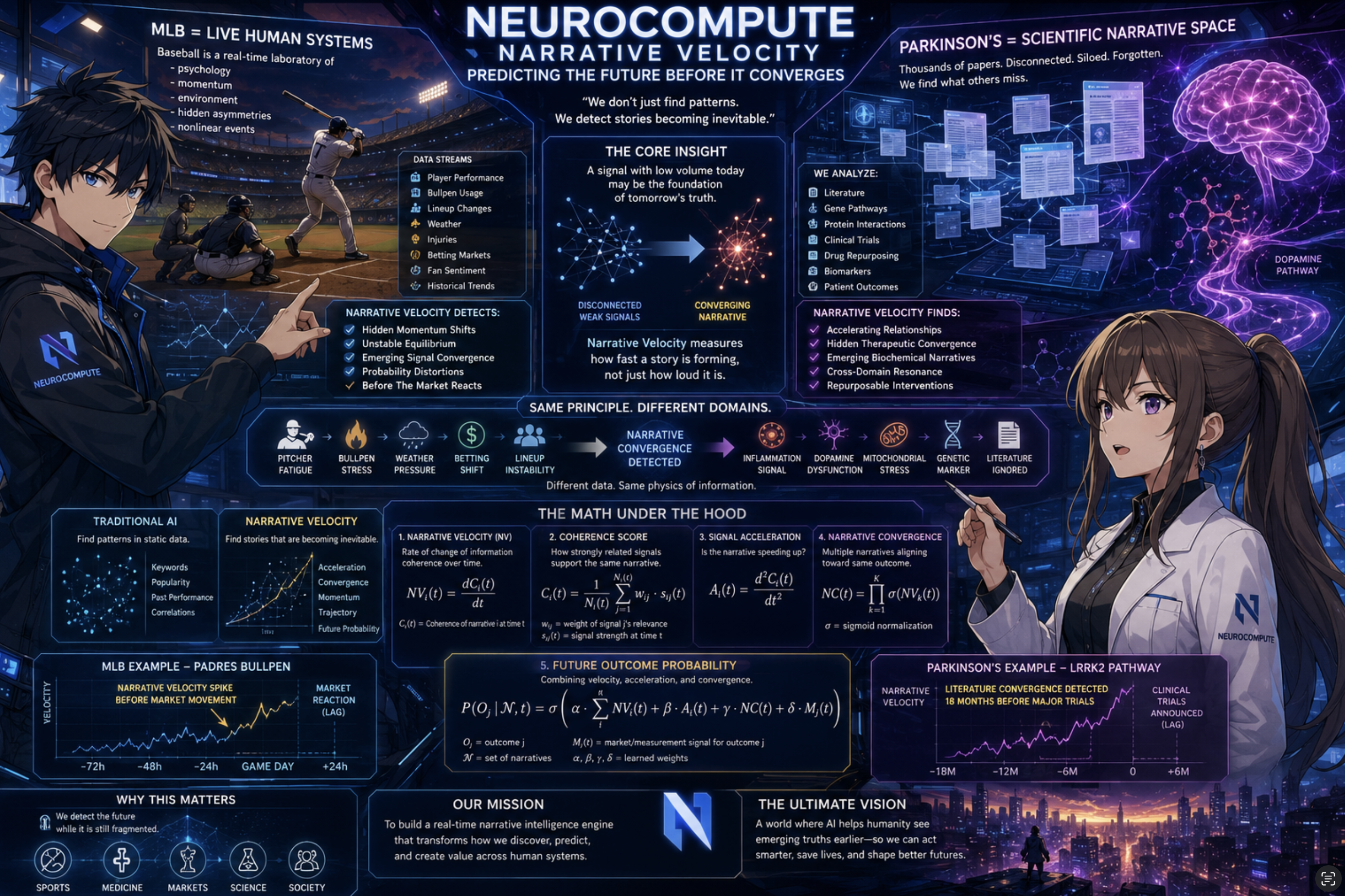
View analysis →Finding therapies hidden in 1,516 Parkinson’s papers.
Neurocompute scores biomedical literature, surfaces overlooked patterns, and turns Parkinson’s research into a living discovery terminal.
Ranked discovery teasers
D grade · PMID 41908275
View analysis →D grade · PMID 42047110
View analysis →D grade · PMID 41919631
View analysis →D grade · PMID 42003980
View analysis →D grade · PMID 41972294
View analysis →D grade · PMID 42002003
View analysis →D grade · PMID 41972402
View analysis →D grade · PMID 41963090
View analysis →D grade · PMID 42025272
View analysis →Database feed
All ranked Parkinson’s papers
This study identifies distinct gut microbial taxa and elevated fecal short‑chain fatty acids (notably isovaleric/isobutyric/valeric acids) that distinguish drug‑naïve early PD from healthy controls and essential tremor with validated diagnostic AUCs of ~0.78–0.864.
Non‑invasive microbiome and SCFA signatures could enable earlier PD diagnosis and patient stratification and point to gut–brain metabolic pathways amenable to biomarker‑guided trials or microbiome‑targeted interventions.
AI-based video kinematic analysis of 53 PD patients undergoing levodopa challenge and STN-DBS showed that levodopa and DBS produce distinct, domain-specific improvements in bradykinesia (speed, amplitude, variability), with AI metrics detecting treatment effects not evident on conventional…
Provides a translational digital biomarker approach that sensitively distinguishes medication versus DBS effects, supporting personalized treatment profiling, improved monitoring, and more sensitive endpoints for clinical trials in Parkinson's disease.
A 5-year economic model across five countries finds subcutaneous foslevodopa/foscarbidopa reduces OFF-time in advanced PD and produces substantial net societal cost savings despite higher drug acquisition costs.
Clinically and policy-relevant evidence that continuous subcutaneous LD/CD can lower care burden and overall costs—valuable for adoption and trial/pricing decisions—though it offers no novel mechanistic or biomarker insights for therapeutic discovery.
This review examines the promise and practical challenges of adaptive deep brain stimulation (aDBS) for Parkinson's disease, focusing on biomarker variability, control strategies, hardware limits, patient selection, and pathways to clinical implementation.
While not a molecular or drug-focused study, the paper is highly relevant to translational therapeutic development because aDBS provides a platform for validated physiological biomarkers, personalized symptom control, and integrated outcome measures that can accelerate development of…
Event-related EEG delta/theta (<8 Hz) phase coherence during a visual oddball task differentiated healthy controls from PD-MCI, PDD, and DLB with AUCs ~0.75–0.92 and high accuracy/sensitivity in several comparisons.
Offers a noninvasive, objective biomarker for cognitive impairment in Parkinson's and Lewy body dementia that could aid patient stratification and serve as an electrophysiological endpoint for trials of cognitive-enhancing or disease-modifying therapies.
This paper presents a vertically oriented Ti3C2Tx (MXene) grid electrode loaded with Au as a wearable microfluidic electrochemical sensor that detects levodopa in sweat with two linear ranges (1–30 µM and 30–160 µM) and a 37 nM detection limit, integrated into a flexible electronic system and…
Offers a translational, high‑sensitivity wearable platform for real‑time levodopa monitoring to support personalized dosing and symptom management in Parkinson's patients, though it does not address disease mechanisms or new therapeutic targets.
In unilateral 6‑OHDA Parkinsonian rats, chemogenetic activation (hM3Dq) of ventral hippocampus CaMKIIα+ neurons produced antidepressant and anxiolytic effects and raised dopamine in mPFC, dHIP and vHIP, whereas inhibition (hM4Di) produced region‑specific monoamine decreases without behavioral…
This work pinpoints a specific hippocampal cell‑type circuit that modulates limbic dopamine/serotonin and alleviates PD‑related depression/anxiety, offering a plausible target for neuromodulation or circuit‑based therapies even though the chemogenetic approach itself is not yet directly…
In this 36-month prospective case-control study, bilateral subthalamic nucleus DBS improved motor symptoms and reduced medication burden without causing additional overall cognitive decline compared with best medical therapy, though both groups showed similar declines in attention/working memory…
Clinically relevant evidence that STN-DBS offers sustained motor benefit and appears cognitively safe over 3 years, informing treatment decisions and trial design despite offering little molecular/mechanistic insight for novel drug discovery.
This study shows that in two mouse PD models, tremor-dominant alpha-synucleinopathy (3K) produces selective dysfunction in cerebellar-recipient motor thalamus (CBMT) whereas dopamine-depletion (6-OHDA) produces broader thalamic abnormalities (CBMT and BGMT) with reduced firing and movement-related…
By pinpointing cerebellar-thalamic circuit dysfunction in an alpha-synuclein model that manifests tremor, the work highlights a non-dopaminergic circuit-level target that could guide development of therapies or circuit-based interventions for PD symptoms refractory to dopamine replacement.
PD patients with pathological fatigue show a selective loss of normal sensory attenuation on a force-matching task, and the degree of attenuation reduction correlates with subjective fatigue but not with motor severity or other nonmotor symptoms.
By linking fatigue to a specific sensorimotor processing deficit this study proposes a measurable biomarker and a mechanistic target (sensory attenuation circuitry) that could guide development of targeted neuromodulation, sensory retraining, or symptom-focused clinical trials for PD fatigue.
This study demonstrates that patient-reported visual analogue scales (VAS) during bilateral STN-DBS programming are generally reliable and reproducible, with variability influenced by motor phenotype, stimulation duration, and contralateral stimulation state.
Structured, reliable VAS feedback can serve as a practical patient-reported digital biomarker to standardize and remote-optimize DBS programming and inform multimodal or closed-loop DBS strategies, improving therapeutic delivery though it does not address underlying disease biology.
Autopsy study of 189 mostly young Mexico City individuals found frequent early Alzheimer-type changes, alpha-synuclein, and TDP-43 pathology that overlap and associate with PM2.5 exposure in children and young adults.
This highlights early, pollution-associated alpha-synuclein accumulation as a potential environmental risk marker and cohort for biomarker development and prevention-focused studies relevant to Parkinson's, but offers limited mechanistic or direct therapeutic targets.
Pilot randomized clinical trial in 12 people with Parkinson’s found that exhale-swallow-exhale respiratory-swallow training increased exhale-swallow-exhale usage and, particularly with variable practice, improved swallowing safety and efficiency (less residue and lower penetration-aspiration…
Provides clinically actionable evidence for a non-pharmacologic rehabilitation method that may reduce aspiration risk and improve quality of life in PwPD and guides design of larger confirmatory trials, though it has limited direct implication for molecular or disease-modifying therapeutic…
Retrospective study showing that standard SMwI outperforms SWI- and neuromelanin-derived reconstructions for differentiating early Parkinson’s disease from controls by clinical diagnosis, though SWI-driven SMwI approaches standard SMwI when PET is used as the reference.
Offers a practical fallback imaging biomarker for detecting nigral changes and improving patient selection/stratification in trials when dedicated SMwI is unavailable, but provides limited direct insight into disease mechanisms or therapeutic targets.
Nationwide Finnish cohort study found psychotropic use (notably benzodiazepines and related drugs before diagnosis and antidepressants thereafter) increased from 18% to 35% in people with Parkinson's over a 10-year window and psychotropic polypharmacy was consistently higher than in matched…
While not mechanistic, the work documents early and progressive treatment of non-motor symptoms and a medication-related safety concern (falls/fractures) that could drive trials of safer symptomatic treatments, deprescribing interventions, or earlier non-pharmacologic management strategies.
Bibliometric analysis mapping global research on frailty in Parkinson's disease, showing rapid growth and shifting focus toward clinical management, rehabilitation, and emerging mechanistic interest in gait and the brain–gut axis.
Although not experimental, the paper identifies emerging mechanistic (brain–gut) and clinical (rehabilitation, early detection) priorities that can help prioritize translational research and inform therapeutic target selection for PD-related frailty.
A 12-week multicomponent aquatic training program in 28 mild–moderate PD patients improved bradykinesia and functional measures (walking speed, sit-to-stand), but gains largely diminished at 4-week follow-up.
Offers modest clinical relevance as a non-pharmacological symptomatic intervention that may inform rehabilitation practice and trial design, but has limited therapeutic discovery value for drug development due to small, uncontrolled sample and no mechanistic or biomarker data.
A large nationwide retrospective cohort found that Parkinson disease was independently associated with a roughly 1.9-fold higher risk of a composite kidney outcome (ESKD, initiation of kidney replacement therapy, or ≥30% eGFR decline).
Clinically relevant for Parkinson's care and for trial/drug safety considerations (need for kidney monitoring and dose adjustments), but offers limited actionable mechanistic or targetable insight for Parkinson's therapeutic discovery.
This study finds that intramuscle synergies—patterns of motor unit recruitment at the spinal level—are selectively disrupted in essential tremor (reduced flexibility of motor unit recruitment) but are not altered in Parkinson's disease compared with controls.
The work identifies a potential spinal-level biomarker and mechanistic target for essential tremor interventions, but it offers limited direct actionable insight for Parkinson's therapeutic discovery.
Retrospective analysis of 98 Parkinson's patient–caregiver pairs found strong positive correlations between patient-reported Dysphagia Handicap Index and caregiver-reported DHI-Companion scores across early, mid, and late disease stages.
This validates caregiver-reported dysphagia measures as reliable complementary endpoints for clinical monitoring and trials of swallowing interventions in PD, but offers limited mechanistic or therapeutic discovery insights.