1
Hippocampal-striatal interaction in Parkinson's disease with mild cognitive impairment.
52.0
AI
D grade · PMID 42016529
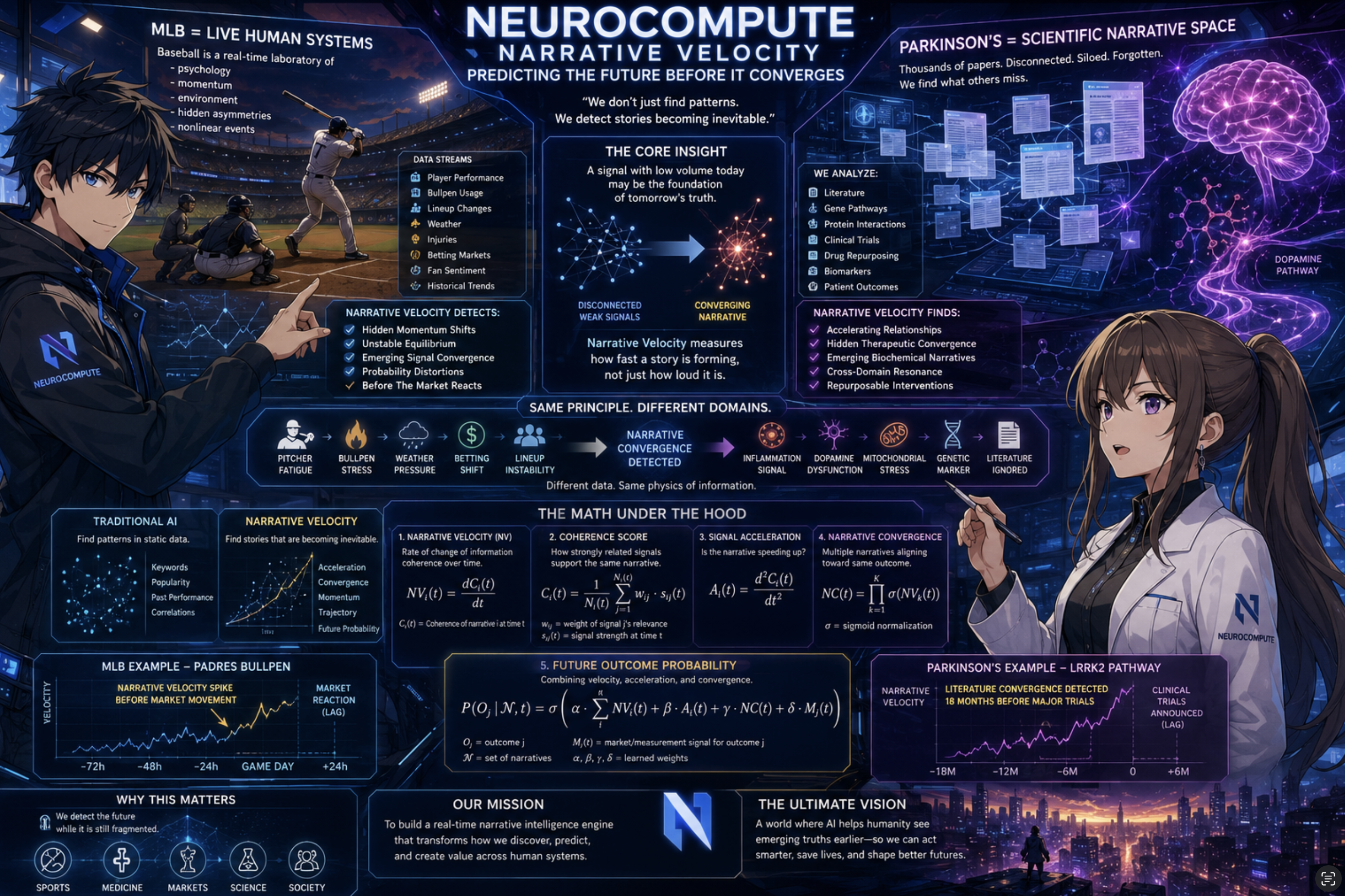
View analysis →Neurocompute scores biomedical literature, surfaces overlooked patterns, and turns Parkinson’s research into a living discovery terminal.
D grade · PMID 42016529
View analysis →D grade · PMID 41975757
View analysis →D grade · PMID 41938802
View analysis →D grade · PMID 42041795
View analysis →D grade · PMID 41917074
View analysis →D grade · PMID 41923450
View analysis →D grade · PMID 41898177
View analysis →D grade · PMID 41926928
View analysis →D grade · PMID 41906303
View analysis →D grade · PMID 42014723
View analysis →This PET and MRI study of 53 PD patients finds that asymmetry of striatal VMAT2 uptake and hippocampal CA2/3 subfield volumes are associated with cognitive impairment and interact to predict global cognition, especially in PD-MCI.
Provides candidate imaging biomarkers (striatal dopaminergic and hippocampal subfield asymmetry) that could aid stratification and endpoint selection for trials targeting cognitive decline in PD, though results are exploratory and sample-limited.
This prospective NM-MRI study shows semi-automated substantia nigra volumetry reliably detects an ~18% volume reduction in early Parkinson's disease but has only moderate diagnostic accuracy (AUC 0.70) and no clear correlation with motor severity.
While not revealing therapeutic mechanisms, the technique provides a reliable, noninvasive imaging biomarker that could support patient stratification and multimodal outcome measures in clinical trials, though it is insufficient as a standalone diagnostic or severity marker.
Longitudinal cluster analysis of 209 PPMI PD patients identified slow, intermediate, and rapid motor progression trajectories, found higher baseline BMI linked to faster motor decline, and showed that detailed baseline clinical and genetic/SAA profiles poorly predicted individual outcomes.
The study underscores profound individual variability that complicates clinical trial design and patient stratification and flags BMI as a potential modifiable factor to investigate, but it offers limited direct mechanistic or therapeutic leads.
Pilot study using 2D sagittal-plane videogrammetry (Kinovea) to quantify knee ROM, within-subject variability, and interlimb coordination in 8 PD patients (ON/OFF meds) versus 27 controls, finding reduced ROM, increased variability, and impaired bilateral timing in OFF that partially improves with…
Offers a low-cost, interpretable gait-kinematic biomarker sensitive to dopaminergic state that could aid clinical monitoring or serve as an outcome measure in therapeutic trials, though small sample size and lack of mechanistic targets limit direct drug-discovery impact.
This study applies multiparametric MRI (R1, R2*, proton density, MTsat) to identify cortical microstructural differences in Parkinson's patients versus controls and links regional imaging changes to motor severity, levodopa dose, and cognitive impairment.
Although it does not identify therapeutic mechanisms, the paper establishes MPM as a sensitive, biologically informed noninvasive biomarker for cortical pathology and disease progression that can aid patient stratification and outcome measurement in PD therapeutic development.
Immunofluorescence analysis of skin biopsies from 17 small-fiber neuropathy patients (8 idiopathic) found no alpha-synuclein deposition in PGP9.5-positive nerve terminals, suggesting synucleinopathy is not common in idiopathic SFN.
This negative pilot finding reduces the likelihood that peripheral skin alpha-synuclein is a broadly useful biomarker or target in idiopathic SFN and implies peripheral synuclein pathology may be specific to systemic synucleinopathies, informing biomarker strategies and patient selection for…
This review summarizes the strengths and limitations of transcranial sonography (TCS) for assessing atypical parkinsonian syndromes, emphasizing its accessibility and low cost but noting it is not part of formal diagnostic criteria and has limited specificity.
While TCS has limited mechanistic or therapeutic implications, it may offer a low‑cost, scalable adjunctive biomarker to help stratify atypical parkinsonism patients in clinical studies and improve diagnostic confidence for trial enrollment.
This study found that 3–8% of [123I]ioflupane DAT‑SPECT scans are "difficult-to-interpret" using a 6-point visual scale and that binary (normal/abnormal) decisions are much less accurate in these inconclusive cases, which the authors recommend report as "inconclusive".
While not identifying therapeutic targets, the work is clinically valuable for Parkinson's research because it quantifies a nontrivial rate of equivocal DAT-SPECTs that can confound diagnosis, patient selection, and biomarker endpoints in trials and thus helps improve study design and…
The paper describes discovery and optimization of CNS-penetrant, selective macrocyclic LRRK2 inhibitors, overcoming genotoxicity and PXR/kinome liabilities to produce lead compound 12 with good brain exposure and a low projected human dose.
LRRK2 is a genetically validated PD target, so a potent, brain-penetrant, nongenotoxic inhibitor with favorable selectivity and dosing potential is a strong preclinical candidate for translation toward Parkinson's disease therapies.
In PD patients undergoing DBS surgery, many STN neurons encode go and stop signals and a bursting subpopulation shows enhanced coupling to local delta oscillations that correlates with failed action cancellation.
Identifies a circuit-level mechanism (bursting and delta coupling) in the human STN that could serve as a biomarker or target for refining DBS/closed‑loop stimulation to improve inhibitory control and impulsivity in Parkinson's disease.
Presents an immuno-infrared sensor that uses antibody capture and amide I absorbance to detect protein misfolding in blood for early Alzheimer's and Parkinson's diagnosis.
A blood-based misfolding biomarker could enable population screening and earlier patient stratification to improve Parkinson's clinical trial enrollment and timing of interventions, accelerating translational efforts despite not identifying new therapeutic targets.
Small case-control study finds that peak pupil constriction velocity—unaffected by symptomatic dopaminergic therapy—correlates with autonomic symptoms in early, drug‑naïve Parkinson's disease, while other pupil parameters poorly distinguish patients from controls.
Offers a noninvasive, medication‑resistant physiological biomarker of autonomic dysfunction useful for patient stratification or monitoring in trials, but provides limited mechanistic insight or immediate therapeutic targets.
This review argues that oligodendrocytes maintain CNS iron via regulated uptake/storage and selenoprotein-centered antioxidant defenses, and that disruption of these systems makes them vulnerable to ferroptosis, contributing to demyelination and neurodegeneration including relevance to Parkinson's…
It points to actionable therapeutic avenues—iron modulation, boosting antioxidant/selenoprotein pathways, and ferroptosis inhibition—that could be leveraged or repurposed in PD to protect glia, limit iron-driven toxicity, and potentially slow disease progression.
Narrative review synthesizing human and experimental evidence that chronic heavy alcohol consumption exacerbates neurodegeneration—via oxidative stress, mitochondrial dysfunction, lipid peroxidation, inflammatory signaling, disrupted neurotrophic pathways, impaired dopaminergic neurotransmission,…
Identifies multiple actionable mechanisms (mitochondrial dysfunction, neuroinflammation, dopaminergic impairment, gut–brain axis) relevant to PD that support both lifestyle intervention and potential therapeutic or repurposing strategies, though the review is broad and not PD-specific.
Perspective summarizing development and design strategies for ligands that simultaneously target two serotonin receptor subtypes, citing clinical examples (flibanserin, pimavanserin, eltoprazine) and emerging approaches like biased signaling and optopharmacology with relevance to CNS disorders…
Useful for Parkinson's therapeutic discovery because it highlights clinically relevant serotonergic agents (notably pimavanserin) and rational multi-target design/repurposing opportunities for symptomatic management, though it lacks new preclinical or disease‑modifying mechanisms (e.g.,…
c-Abl–mediated phosphorylation of α-synuclein at Tyr39 promotes heterotypic primary nucleation and fragmentation-driven secondary aggregation into short, toxic oligomeric/fibrillar assemblies that bind and stabilize Fe2+, enabling Fenton-like oxidative activity.
Provides a mechanistic, druggable link between c-Abl/pY39-driven α-synuclein aggregation and iron-dependent oxidative toxicity, pointing to c-Abl inhibition, pY39-targeted aggregation blockers, or iron-modulating therapies as actionable strategies for PD.
The study uses multi-omics, biochemical assays, and PFF mouse models to identify tripeptidyl peptidase II (TPPII) as the primary serine endopeptidase that maintains lysosomal function and promotes clearance of α-synuclein seeds, with TPPII overexpression reducing aggregation and propagation in vivo.
By linking a specific, druggable protease to lysosomal degradation of α-synuclein seeds and demonstrating in vivo neuroprotective effects, the work highlights TPPII as a translationally relevant target for therapies (e.g., gene delivery or small-molecule activators) to slow or prevent Parkinson's…
The study identifies angelic acid as a small-molecule lead that disrupts β-sheet-rich α-synuclein fibrils in vitro, docks to β-sheet interfaces across fibril polymorphs, fragments fibrils, and markedly reduces intracellular α-synuclein accumulation and modestly alleviates fibril-induced…
This paper presents an actionable, pathology-targeting lead with biophysical and cellular evidence for fibril disassembly, making it a promising starting point for medicinal chemistry optimization and in vivo evaluation toward a potential disease-modifying Parkinson's therapy.
In cell models of dopaminergic and hippocampal neurons, six FTDP-17T TAU mutations drive GSK-3β–dependent phosphorylation at Ser202/Ser396/Ser404, producing phospho-tau oligomers that localize to ER and mitochondria, activate ER stress/UPR and mitochondrial pro-apoptotic cascades (ROS, Δψm loss,…
Points to a druggable mechanism—GSK-3β–mediated tau phosphorylation leading to ER/mitochondrial dysfunction—that links tau pathology to dopaminergic neuron loss and offers actionable targets (kinase inhibition, ER/mitochondrial protection) for developing or repurposing therapeutics for…
Using chronic at-home recordings from three PD patients, the authors demonstrate that Bayesian hidden Markov time-history models applied to cortical entrained-gamma (and STN beta) biomarkers improve hyperkinetic-state detection, prediction smoothness, and overall F1 accuracy versus instantaneous…
This work provides actionable, translational advances for adaptive deep brain stimulation—showing a practical modeling approach and choice of biomarker that can make real-time symptom-responsive neuromodulation more accurate and robust, accelerating device-level improvements even though it does not…