AI-POWERED RESEARCH INTELLIGENCE

Finding therapies hidden in 1,516 Parkinson’s papers.

Neurocompute scores biomedical literature, surfaces overlooked patterns, and turns Parkinson’s research into a living discovery terminal.

1,516Papers indexed
984Papers AI scored
998Ranked papers
0.7%Coverage
LIVE RESEARCH INTELLIGENCE
↑ Narrative velocity rising ↑ New papers ingested ↑ Cross-paper convergence detected ↑ AI score dials updating ↑ Research blind spots surfacing
TOP SIGNALS TODAY

Ranked discovery teasers

View all discoveries →
RESEARCH TERMINAL

All ranked Parkinson’s papers

1516 results
D
AI72.0
Base47.6
Rank46.5
AI Summary

This review synthesizes evidence that skin biopsy detection of phosphorylated α-synuclein and α-synuclein seed amplification assays can identify pathological peripheral α-synuclein in prodromal synucleinopathies (notably iRBD and PAF), often before nigrostriatal degeneration, and may predict…

Why It Matters

By highlighting a minimally invasive, scalable biomarker for early and preclinical identification and enrichment of at-risk cohorts, the work supports better patient selection and outcome measures for disease‑modifying PD trials and accelerates translational therapeutic development.

D
Parkinson's disease and the concept of resilience, cognitive, and motor reserve.
PMID 42047602 Published: 2026-04-28 Ingested: 2026-04-28 08:58 PM Journal of Parkinson's disease
AI55.0
Base47.6
Rank46.5
AI Summary

This review synthesizes recent longitudinal, neuroimaging, and lifestyle evidence to extend a conceptual framework of cognitive and motor reserve in Parkinson's disease and outlines methodological and translational directions for integrating resilience into staging and personalized interventions.

Why It Matters

By identifying modifiable lifestyle factors, potential neuroimaging markers, and methodological pathways to quantify reserve, the paper highlights avenues for prognostic biomarker development and stratified intervention strategies that could inform therapeutic discovery, though it does not provide…

D
Sarcopenia, body composition, physical performance, and clinical features in Parkinson's disease: a cross-sectional comparative study.
PMID 41924518 Published: 2026-01-01 Ingested: 2026-04-28 08:58 PM Frontiers in endocrinology
AI40.0
Base47.6
Rank46.5
AI Summary

Cross-sectional study of 124 PD patients versus matched controls found similar sarcopenia prevalence but PD patients had worse balance, higher fall risk, reduced handgrip strength and appendicular muscle mass at lower percentiles, smaller calf circumference and lower fat mass despite higher protein…

Why It Matters

Signals subtle yet clinically relevant declines in muscle mass and function in mild-to-moderate PD that can guide rehabilitation, nutritional interventions, and selection of trial endpoints for mobility/fall prevention, though it provides limited direct molecular targets for drug discovery.

D
AI80.0
Base49.2
Rank46.3
AI Summary

The paper reports that Parkin ubiquitinates NLRP3 at K353 to drive its degradation via chaperone-mediated autophagy, suppressing PANoptosis and protecting dopaminergic neurons in rotenone cell and mouse PD models, with Parkin overexpression, CMA activation, or NLRP3 inhibition (MCC950) mitigating…

Why It Matters

Provides an actionable, disease-relevant mechanism linking Parkin to inflammasome regulation and identifies NLRP3 inhibition and CMA activation as translatable therapeutic strategies with preclinical in vivo support for Parkinson's disease.

D
Neural cell state modulation by PARK2 and dopaminergic neuroprotection by small molecule Parkin agonism.
PMID 41959321 Published: 2026-04-04 Ingested: 2026-04-28 08:58 PM bioRxiv : the preprint server for biology
AI80.0
Base49.2
Rank46.3
AI Summary

This study demonstrates that Parkin is essential for neuronal maturation and resilience and introduces a small-molecule Parkin agonist (FB231) that reduces α-synuclein pathology and protects dopaminergic neurons in human iPSC-derived cultures and a gut α-synuclein mouse model.

Why It Matters

By providing a drug-like activator of Parkin with both cellular and in vivo neuroprotective effects against α-synuclein-driven pathology, the work presents a actionable, translational strategy for disease-modifying Parkinson's therapeutics.

D
Sex differences in levodopa pharmacokinetics in early Parkinson's disease: implications on levodopa-related complications.
PMID 42022556 Published: 2026-01-01 Ingested: 2026-04-28 08:58 PM Frontiers in pharmacology
AI68.0
Base49.2
Rank46.3
AI Summary

In a 2-year longitudinal study of 28 levodopa‑naïve Parkinson's patients, women had significantly higher levodopa AUC and Cmax than men, and in women (but not men) higher exposure correlated with greater wearing‑off and dyskinesia.

Why It Matters

Provides clinically actionable evidence that sex-specific levodopa pharmacokinetics predispose women to motor complications, supporting early plasma monitoring and sex‑adjusted dosing to reduce levodopa-related adverse effects and personalize therapy.

D
Directional functional influence of the locus coeruleus on the whole brain in tremor-dominant and akinetic-rigid Parkinson's disease.
PMID 41921429 Published: 2026-03-29 Ingested: 2026-04-28 08:58 PM Parkinsonism & related disorders
AI65.0
Base49.2
Rank46.3
AI Summary

This human neuroimaging study reports reduced locus coeruleus neuromelanin signal in PD and subtype-specific directional effective connectivity patterns between the LC, cerebellum, and cortical regions that correlate with motor severity in tremor-dominant versus akinetic-rigid patients.

Why It Matters

It identifies a noninvasive LC biomarker and subtype-specific functional signatures that could inform patient stratification and development of noradrenergic-targeted or personalized neuromodulation therapies in Parkinson's disease.

D
From General-Purpose to Disease-Specific Features: Aligning LLM Embeddings on a Disease-Specific Biomedical Knowledge Graph for Drug Repurposing.
PMID 41959530 Published: 2026-03-10 Ingested: 2026-04-28 08:58 PM bioRxiv : the preprint server for biology
AI65.0
Base49.2
Rank46.3
AI Summary

Introduces CLEAR, a method that aligns LLM embeddings with a disease-specific knowledge graph to improve computational drug-repurposing predictions for ADRD, including Parkinson disease–related dementia, reporting up to 30% performance gains.

Why It Matters

Offers a scalable, context-grounded computational approach to prioritize FDA-approved repurposing candidates for Parkinson-related dementia and other ADRD in data-sparse settings, potentially accelerating translational follow-up despite lacking in vitro/in vivo validation.

AI Summary

In a randomized trial of 105 Parkinson's patients with constipation, adjunct Bifidobacterium animalis subsp. lactis combined with Liuwei'anxiao Capsule improved bowel movement frequency, stool form, patient-reported constipation scores and achieved a higher overall response rate versus either…

Why It Matters

This study offers a clinically actionable, microbiome-modulating adjunct therapy for a common and quality-of-life–limiting PD nonmotor symptom, supporting the gut–brain axis as a translational target and motivating follow-up trials to assess effects on broader PD outcomes or disease progression.

D
AI64.0
Base49.2
Rank46.3
AI Summary

In a double-blind, sham-controlled RCT of 60 Parkinson's patients (H&Y 1–3), twice-daily high-intensity tACS added to multidisciplinary intensive rehabilitation produced significantly greater and durable improvements in PDQ-39 quality-of-life scores and reductions in depression and apathy up to 24…

Why It Matters

This trial delivers clinically actionable evidence that noninvasive high-intensity tACS can be a scalable, low-risk adjunct to rehabilitation to improve long-term QoL and non-motor symptoms in PD, making it a promising candidate for translation and for follow-up mechanistic and biomarker-driven…

D
Incense Aerosol-Induced Neurotoxicity Disrupts α-Synuclein Homeostasis in a Cellular Parkinson's Disease Model, Distinct from Cigarette Aerosols.
PMID 41911441 Published: 2026-04-20 Ingested: 2026-04-28 08:58 PM Chemical research in toxicology
AI62.0
Base49.2
Rank46.3
AI Summary

In alpha‑synuclein–overexpressing SH‑SY5Y cells, incense aerosol extracts—particularly the organic phase—induce ROS‑linked mitochondrial dysfunction, programmed cell death, and a shift of alpha‑synuclein from oligomers to monomers, with limited rescue by classical antioxidants compared with…

Why It Matters

Points to incense smoke as a distinct environmental driver of alpha‑synuclein mis‑homeostasis and mitochondrial injury, offering mechanistic targets and the rationale that PD interventions may need to address non‑canonical toxicants/mechanisms beyond general antioxidant strategies.

D
AI62.0
Base49.2
Rank46.3
AI Summary

This review highlights MRI-guided high-intensity focused ultrasound (MRgHIFU) as a noninvasive, tract-based neuromodulation approach using patient-specific diffusion MRI and advanced sequences to directly target pathological white-matter tracts (e.g., dentatorubrothalamic in ET, pallidothalamic in…

Why It Matters

Provides a clinically actionable, translational pathway for personalized, incisionless treatment of PD motor circuits that could expand therapeutic options and target selection (including AI-assisted planning), though it does not address molecular disease-modifying mechanisms.

D
Intermittent theta-burst stimulation to enhance physical therapy in Parkinson's disease: The STEP-PD randomized trial.
PMID 41926908 Published: 2026-04-01 Ingested: 2026-04-28 08:58 PM Neurotherapeutics : the journal of the American Society for Experimental NeuroTherapeutics
AI62.0
Base49.2
Rank46.3
AI Summary

In a double-blind randomized trial (STEP-PD), adding bilateral M1 intermittent theta-burst stimulation to a two-week intensive physical therapy program produced a modest but statistically significant acute improvement in OFF-state MDS-UPDRS III (Δ = -4.60, p = 0.034) with exploratory gains in gait…

Why It Matters

Provides a readily translatable, nonpharmacologic cortical-priming approach with objective EEG biomarkers that can enhance short-term rehabilitation outcomes in PD and serve as a platform for optimizing neuromodulation parameters and studying sustained clinical effects.

D
Small Molecule Inhibitors Targeting Pathogenic Protein Aggregation in Neurodegenerative Diseases: Medicinal Chemistry and Mechanistic Insights.
PMID 41926304 Published: 2026-04-01 Ingested: 2026-04-28 08:58 PM Current topics in medicinal chemistry
AI62.0
Base49.2
Rank46.3
AI Summary

Comprehensive review of natural and synthetic small molecules—including polyphenols, quinones, alkaloids, metal chelators, osmolytes, and repurposed drugs—that inhibit misfolding and aggregation of amyloid-β, tau, and α-synuclein, with medicinal chemistry and mechanistic discussion.

Why It Matters

Valuable for Parkinson's therapeutic discovery because it compiles α‑synuclein‑targeting chemotypes and repurposing candidates and outlines mechanisms useful for hit selection and lead optimization, though it lacks deep clinical/translational validation.

D
AI60.0
Base49.2
Rank46.3
AI Summary

A nationwide retrospective cohort study found acetylcholinesterase inhibitor (AChEI) use in Parkinson's disease dementia was associated with a 24% reduction in mortality, with larger benefits in females and in late-onset PD and no significant difference between donepezil and rivastigmine.

Why It Matters

Provides strong clinical evidence for potential repurposing of AChEIs to improve survival in PDD and highlights sex- and age-dependent effects that warrant mechanistic and trial-focused follow-up.

D
TCMNet: an AI-driven strategy for optimizing traditional Chinese medicine.
PMID 41918015 Published: 2026-03-31 Ingested: 2026-04-28 08:58 PM Chinese medicine
AI60.0
Base49.2
Rank46.3
AI Summary

TCMNet is a computational pipeline that combines LLM-guided literature mining, weighted PPI network analysis, and deep-learning binding predictions to prioritize TCM formulas and constituent compounds for Parkinson's disease, highlighting Tianma Gouteng Decoction, enhanced synergy with levodopa,…

Why It Matters

This work offers a pragmatic, scalable triage tool to nominate herb-derived compounds, prioritized targets, and formula–drug combinations for experimental validation, accelerating translational follow-up in Parkinson's therapeutic discovery despite lacking wet-lab validation.

D
Effects of a Soft Robotic Exoskeleton for Gait Training on Clinical Outcomes in Patients With Parkinson Disease: Randomized Controlled Pilot Study.
PMID 42048524 Published: 2026-04-28 Ingested: 2026-04-28 08:58 PM Journal of medical Internet research
AI52.0
Base49.2
Rank46.3
AI Summary

This randomized controlled pilot study found that adding 4 weeks of soft exoskeleton robot (SER) gait training to conventional rehabilitation significantly improved gait speed, stride length, ankle dorsiflexion, balance, and several clinical scales in people with Parkinson disease compared with…

Why It Matters

The work provides credible, quantitative evidence that a nonpharmacologic SER intervention can produce meaningful functional gains and links improved ankle mobility to better gait—valuable for rehabilitation practice and for selecting sensitive clinical outcome measures—though it offers little…

D
High-definition transcranial direct current stimulation for depressive and other non-motor symptoms in Parkinson's disease: a randomised, sham-controlled, cross-over study.
PMID 41916935 Published: 2026-03-01 Ingested: 2026-04-28 08:58 PM East Asian archives of psychiatry : official journal of the Hong Kong College of Psychiatrists = Dong Ya jing shen ke xue zhi : Xianggang jing shen ke yi xue yuan qi kan
AI52.0
Base49.2
Rank46.3
AI Summary

In a small randomized, sham-controlled crossover trial of 25 mild-to-moderate PD patients, two brief sessions of left DLPFC HD-tDCS improved depressive, cognitive, and other non-motor symptom scores versus sham with good tolerability.

Why It Matters

This study supports a safe, non-pharmacologic, symptomatic intervention for PD non-motor symptoms with translational potential for clinical management and trial design, but its small size and lack of mechanistic insight limit its value for disease-modifying therapeutic discovery.

D
Trail Making Test performance in early abstinence from methamphetamine: human evidence for a drug-associated Parkinsonian-like phenotype.
PMID 41947808 Published: 2026-01-01 Ingested: 2026-04-28 08:58 PM Frontiers in psychiatry
AI48.5
Base49.2
Rank46.3
AI Summary

Recently abstinent methamphetamine users showed Trail Making Test deficits consistent with Parkinsonian cognitive inflexibility, with intravenous use in women linked to greater errors.

Why It Matters

The work highlights a clinically relevant PD-like phenotype in methamphetamine users that could inform risk stratification and tailored interventions, but offers limited mechanistic or biomarker insight for direct therapeutic discovery.

D
AI45.0
Base49.2
Rank46.3
AI Summary

This position-statement review finds MRgFUS thalamotomy is a safe and effective, durable option for refractory essential tremor and yields significant short-term benefit for Parkinsonian tremor, though long-term durability and some adverse effects remain concerns.

Why It Matters

Clinically important as a non‑pharmacologic, translational symptomatic therapy that informs patient management and trial design, but of limited direct value for molecular Parkinson's therapeutic discovery or disease‑modifying strategies.

Previous
Page 17 of 76
Next
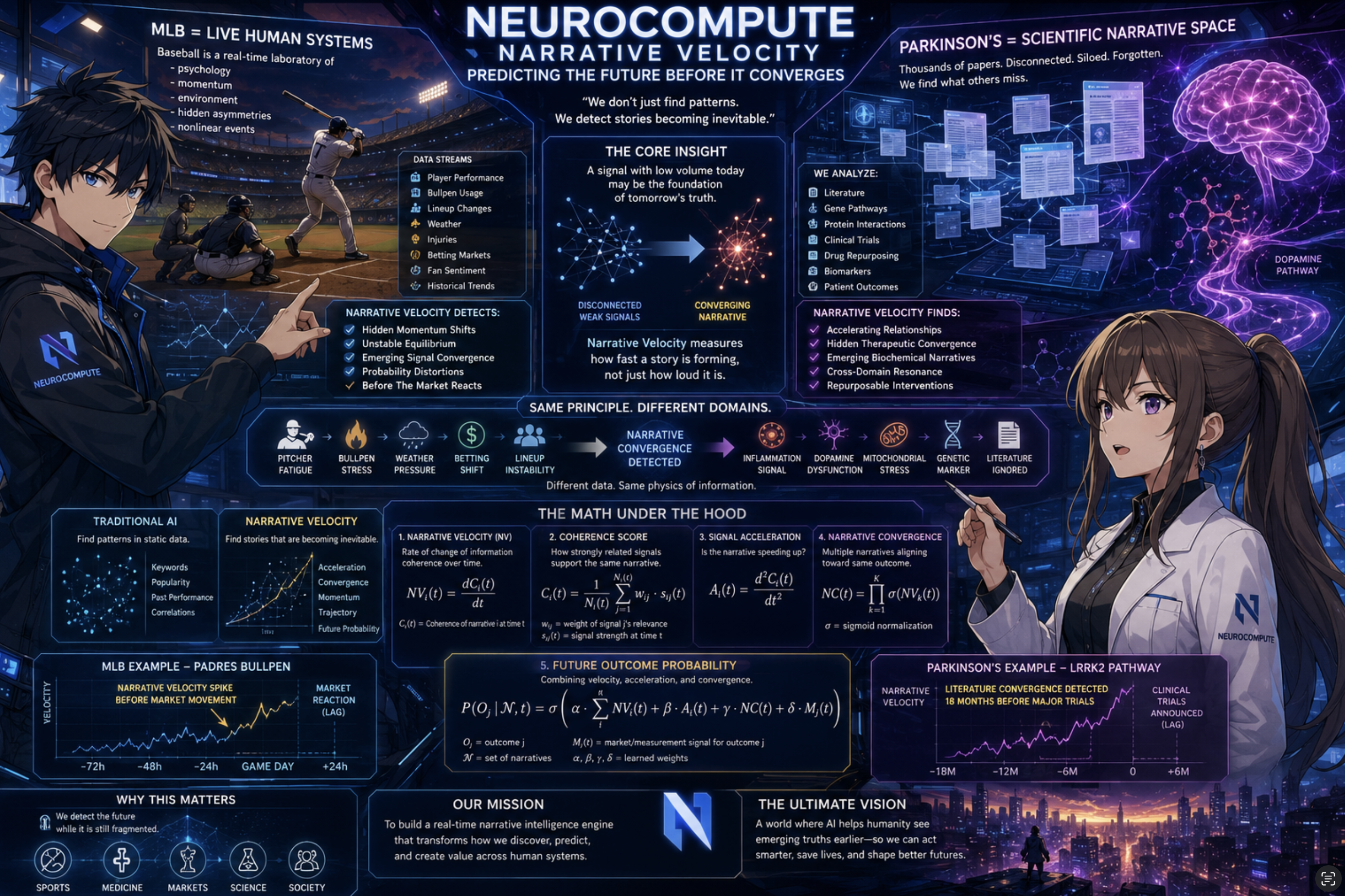
Neurocompute Parkinson’s Narrative Velocity Infographic
NEUROCOMPUTE VISUAL SYSTEM

Open the Narrative Velocity Map

Explore the full Parkinson’s research intelligence diagram.

Expand Intelligence View →
Full Neurocompute Infographic