D grade · PMID 41980956
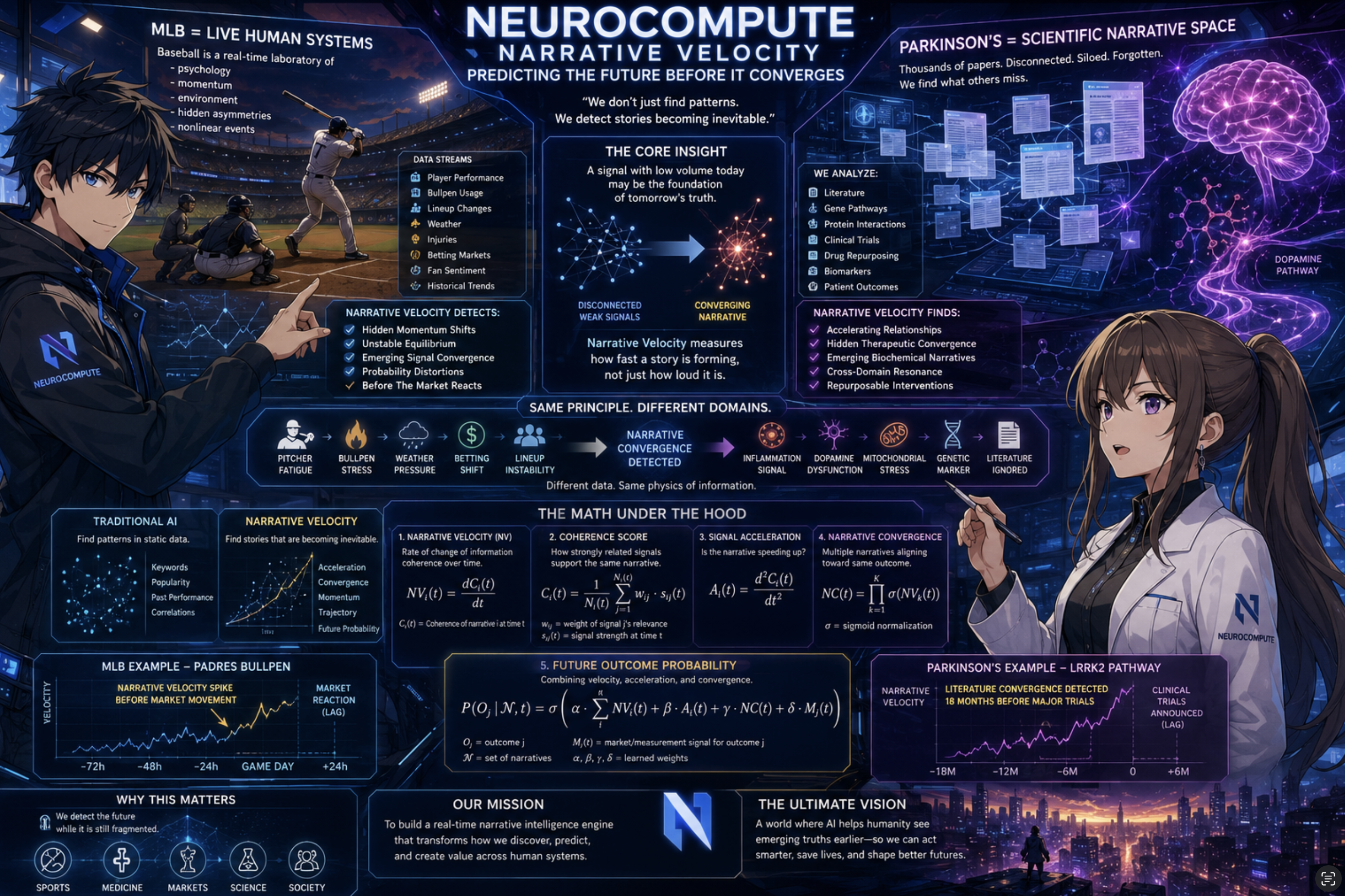
View analysis →Finding therapies hidden in 1,516 Parkinson’s papers.
Neurocompute scores biomedical literature, surfaces overlooked patterns, and turns Parkinson’s research into a living discovery terminal.
Ranked discovery teasers
D grade · PMID 41938729
View analysis →D grade · PMID 42045285
View analysis →D grade · PMID 41984551
View analysis →D grade · PMID 41937703
View analysis →D grade · PMID 41975601
View analysis →D grade · PMID 41968682
View analysis →D grade · PMID 41977439
View analysis →D grade · PMID 41968685
View analysis →D grade · PMID 41967208
View analysis →Database feed
All ranked Parkinson’s papers
About 13% of clinically diagnosed Parkinson's patients were negative on CSF α‑synuclein seed amplification assay and showed distinct clinical features suggesting a subgroup with low or absent Lewy body pathology.
This supports CSF α‑syn SAA as a stratification biomarker for trials and implies α‑synuclein–targeted therapies may not be appropriate for all PD patients, improving patient selection and trial design.
IDEA-FAST is a 24-week, multi-center observational study recruiting 2,000 participants (including 500 with Parkinson's disease) to develop and validate CE-certified digital endpoints for fatigue, sleep quality, and daytime sleepiness using active and passive wearable and digital measures.
By creating validated, sensitive digital outcome measures for fatigue and sleep, the study can improve measurement precision and remote monitoring in PD clinical trials, facilitating better-powered therapeutic evaluations and faster detection of treatment effects.
Colonic biopsies from iRBD (prodromal PD) and PD patients show increased mRNA for IL-1β and IL-8 (with TNF-α up in PD) despite no detectable changes in gut permeability, tight-junction proteins, or fecal calprotectin.
Findings implicate low-level enteric inflammation early in PD and nominate IL-1β/IL-8 pathways as potential early biomarkers or anti-inflammatory therapeutic targets, without evidence that barrier dysfunction is required for this gut immune signature.
Review synthesizing evidence that reduced renal function (eGFR, cystatin C) associates with worse PD severity and cognitive decline, proposing uremic toxins, systemic inflammation, oxidative stress, and impaired renal clearance of alpha‑synuclein as mechanistic links in a kidney–brain axis.
Points to accessible renal biomarkers for prognostic stratification and a plausible mechanistic pathway (uremic toxin/alpha‑synuclein clearance) that could be leveraged to design biomarker‑driven trials or explore renal‑targeted repurposing strategies to slow PD progression.
Comprehensive review of neural cell-derived small extracellular vesicles (sEVs) detailing their physiological roles, contribution to AD/PD pathology via intercellular spread of pathogenic proteins/nucleic acids, and advances in endogenous/exogenous engineering for brain-penetrant therapeutic…
Identifies sEVs as both likely mediators of alpha-synuclein propagation and as engineerable, biologically compatible nanocarriers for delivering therapeutics across brain barriers—providing actionable targets and delivery strategies relevant to Parkinson's drug discovery while noting translational…
This review surveys engineered stem cell approaches (gene editing, biomaterials, pretreatment) for CNS repair, emphasizing paracrine actions—neurotrophic factor secretion, immune modulation, and exosome-mediated cargo delivery—and summarizes preclinical benefits across disorders including…
Offers moderate Parkinson's therapeutic value by cataloging actionable engineering strategies and paracrine mechanisms that could enhance cell-based neuroprotection and circuit repair, but it lacks PD-specific mechanistic insights or clinical validation.
Comprehensive review summarizing molecular drivers of dopaminergic neuron loss in PD—α-synuclein aggregation, lysosomal/chaperone-mediated autophagy failure, mitochondrial dysfunction, calcium dysregulation, apoptosis and ferroptosis—and discussing therapeutic approaches such as mitochondrial…
By synthesizing multiple high-priority, druggable mechanisms (mitochondria, α-synuclein/lysosomal clearance, autophagy, ferroptosis) and mapping them to potential interventions, the review is a useful resource for prioritizing therapeutic targets and repurposing strategies even though it presents…
A broad review of targeting non-coding RNAs (miRNAs, lncRNAs, exosomal RNAs) and associated chemical, computational, delivery, and CRISPR/Cas13 editing strategies for neurodegenerative disease therapy, highlighting proof-of-concept targets and technological enablers but remaining disease-agnostic.
This work is moderately valuable for Parkinson's discovery because it outlines translatable RNA-targeting and delivery technologies that could be applied to PD-relevant mechanisms (e.g., aggregation and neuroinflammation) but lacks PD-specific targets, data, or actionable preclinical/clinical…
This review synthesizes animal and mechanistic studies indicating that chlorogenic acid (a dietary polyphenol) exerts neuroprotective effects relevant to Parkinson's disease through anti-inflammatory, antioxidant, and autophagy-modulating actions, while highlighting gaps in molecular specificity…
CGA engages multiple PD-relevant pathways (neuroinflammation, oxidative stress, protein aggregation, autophagy) and could be a low-risk repurposing candidate, but its translational value is tempered by limited mechanistic resolution and pharmacokinetic/bioavailability challenges.
Review synthesizing how UPS components (E3 ligases, deubiquitinases) control neuroinflammatory hubs (NF-κB, NLRP3) in AD and PD and highlighting actionable nodes—PINK1/Parkin, Peli1, USP9X—for modulating mitophagy and glial activation.
Points to concrete, druggable UPS mechanisms that link mitochondrial quality control and inflammasome/NF-κB signaling to pathogenic glial states in PD, providing clear molecular targets for therapeutic discovery and repurposing despite being a review.
This review integrates structural (cryo-EM), electrophysiological, and functional evidence that the microglia-enriched K2P channel THIK-1 controls membrane potential, surveillance motility, synaptic pruning, and NLRP3 inflammasome–dependent pyroptosis, and argues THIK-1 is a druggable…
THIK-1 links microglial bioelectric regulation to NLRP3-mediated neuroinflammation, is structurally characterized for small-molecule targeting, and thus represents a promising, microglia-specific therapeutic entry point to modulate inflammation-driven Parkinson's disease processes.
This comprehensive review synthesizes molecular mechanisms by which complement components C3 and C5 drive neuroinflammation, synaptic pruning, and neuronal injury across acute and chronic CNS disorders—including Parkinson's disease—and surveys therapeutic strategies and biomarkers targeting C3/C5…
Because it highlights C3/C5 as actionable, druggable inflammatory hubs with existing inhibitors and biomarker approaches, the paper is a valuable resource for guiding development and repurposing of complement-modulating strategies for Parkinson's disease while cautioning about context-dependent…
A fatal case report in a Parkinson's patient links sequential SSRI exposure while on rasagiline to severe serotonin syndrome, with a homozygous CYP2D6*10/*10 pharmacogenotype implicated in drug accumulation and extreme toxicity.
Clinically actionable finding: supports pre-emptive pharmacogenomic screening and stricter management of serotonergic polypharmacy (including MAO-B inhibitors) in PD to improve safety and personalize therapeutic choices.
Comprehensive review of blood-brain barrier structure, its role in neurological disease including Parkinson's, and a critical assessment of drug delivery strategies (passive/active targeting, receptor-mediated transcytosis, focused ultrasound, nanoplatforms, biomimetic systems) with preclinical…
By synthesizing actionable BBB-targeting strategies and highlighting translational barriers, the paper is directly useful for researchers designing delivery approaches to get neuroprotective, antibody, or gene-based Parkinson's therapies into the brain.
This review synthesizes clinical trial evidence that different exercise modalities can improve non-motor symptoms in Parkinson's disease and discusses dosing considerations and putative neurobiological mechanisms.
Although not presenting new molecular data, the paper identifies plausible mechanisms (neuroplasticity, inflammation, sleep and metabolic effects) and practical dosing insights that can guide adjunctive therapeutic strategies, trial design, and prioritization of translational targets for PD…
Systematic review and meta-analysis of 26 controlled trials (≈2,250 participants) found sustained (≥3 months) improvements in balance, gait, and UPDRS-III after various physiotherapy/exercise interventions, though study heterogeneity was high and evidence rated low-to-moderate.
Demonstrates durable, clinically meaningful functional benefits from multimodal and specific exercise programs that can inform patient care, endpoint selection, and adjunctive non-pharmacological strategies in PD, but provides little direct mechanistic or drug-discovery insight.
Systematic review of three small studies (total n=102) finds climbing is a feasible exercise for people with Parkinson's and may modestly improve motor symptoms, but evidence is limited by small samples, heterogeneous methods, and scant mechanistic or non-motor data.
Provides preliminary clinical evidence supporting climbing as a rehabilitative option for PD patients, but offers little mechanistic, biomarker, or translational insight for therapeutic drug discovery, so its immediate value for drug development is low though useful for designing larger rehab…
This paper develops a scalable Long-Term Care Needs Index for eight MENA countries by combining demographic ageing, disability prevalence, and transition probabilities from five major NCDs (including Parkinson's) to estimate and project care dependency through 2030.
While it offers little mechanistic or therapeutic insight for Parkinson's research, the study is useful for strategic planning by quantifying projected care burden from PD at a population level and highlighting the need for better PD-specific, individual-level data to inform service delivery and…
This study shows that synchronizing N3 slow oscillations with transcranial electrical stimulation (tES) lowers intracranial electrical impedance across sleep stages in healthy adults, consistent with enhanced CSF inflow and potential glymphatic clearance during deep sleep.
Sleep-driven enhancement of glymphatic-like clearance via a noninvasive, translatable intervention (tES) and a putative impedance biomarker could be leveraged to promote removal of alpha-synuclein in Parkinson's disease, though direct evidence in PD patients and correlation with pathogenic protein…
Narrative review that synthesizes preclinical and early clinical evidence that SIRT1 activators can counter brain aging by promoting mitochondrial biogenesis, autophagy, and anti-inflammatory/senomorphic actions, with region-specific effects in hippocampus and hypothalamus and potential relevance…
SIRT1 modulates mitochondria, autophagy, and neuroinflammation—pathways central to Parkinson's disease—so SIRT1 activators offer a repurposable, mechanism-backed approach worth targeted translational and PD-focused studies.