1
Higher glymphatic system activity is linked to longer prodromal stage in isolated REM sleep behavior disorder: a possible protective factor.
68.0AI
D grade · PMID 41997950
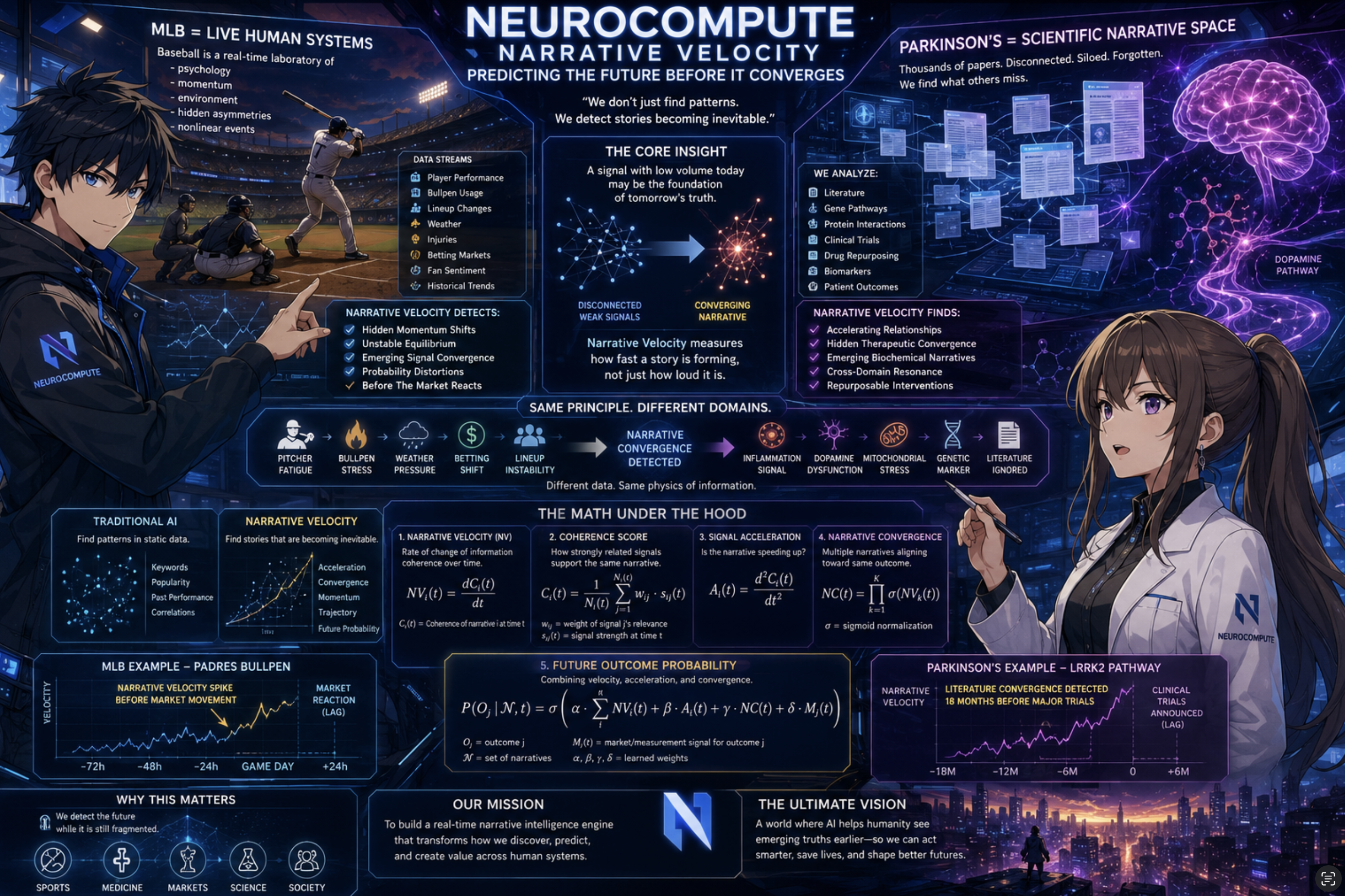
View analysis →Neurocompute scores biomedical literature, surfaces overlooked patterns, and turns Parkinson’s research into a living discovery terminal.
D grade · PMID 41997950
View analysis →D grade · PMID 41946743
View analysis →D grade · PMID 41983929
View analysis →D grade · PMID 41985723
View analysis →D grade · PMID 41995474
View analysis →D grade · PMID 41940019
View analysis →D grade · PMID 42029684
View analysis →D grade · PMID 41975595
View analysis →D grade · PMID 42014729
View analysis →D grade · PMID 41999934
View analysis →In patients with isolated REM sleep behavior disorder, higher DTI-ALPS indices—indicative of better glymphatic function—were associated with longer prodromal symptom duration and substantially delayed phenoconversion to alpha-synucleinopathy.
Points to glymphatic function as a noninvasive biomarker to stratify prodromal PD risk and a plausible, potentially modifiable target (e.g., sleep optimization, AQP4/vascular approaches) for interventions to delay conversion, while noting that causality and therapeutic efficacy remain to be proven.
Wearable inertial-sensor gait measures in idiopathic RBD patients—particularly stride length, swing time variability, and arm-swing metrics—were associated with later phenoconversion and preferentially predicted a parkinsonism-first trajectory, with converters showing steeper longitudinal decline…
Provides a noninvasive, objective digital biomarker to identify and stratify prodromal PD (especially parkinsonism-first) for earlier intervention, trial enrichment, and tracking disease progression, though it does not by itself reveal therapeutic targets.
This study reports that plasma neurofilament light chain is elevated in isolated REM sleep behavior disorder, correlates with neurogenic orthostatic hypotension, and may mark an autonomic-severe iRBD subgroup with greater risk of phenoconversion (notably to MSA).
As a noninvasive biomarker linked to autonomic dysfunction and conversion risk, plasma NfL could be used to stratify prodromal cohorts and enrich clinical trials for patients most likely to progress, aiding therapeutic development and trial design.
This PSG study found that PD patients with levodopa-induced dyskinesia lack the normal overnight increase in cortical sample entropy during N3 sleep observed in controls, and that reduced overnight SampEn change correlates with dyskinesia severity.
Entropy-based overnight EEG metrics offer a noninvasive biomarker linking disrupted sleep-related cortical dynamics to dyskinesia severity, with potential for monitoring disease complications and guiding sleep-targeted interventions in PD.
A critical review summarizing the history, current status, and misconceptions of dopamine cell replacement therapy for Parkinson’s disease, from fetal grafts to stem cell-derived vmDA neuron transplants now entering clinical trials.
Offers translationally relevant synthesis on stem-cell-derived dopamine replacement—highlighting clinical progress, safety issues, and pitfalls—which can inform trial design, risk mitigation, and therapeutic strategy in PD drug development.
Narrative review synthesizing preclinical (mostly rodent) evidence that exercise-released exerkines—including BDNF, irisin, cathepsin B, IL-6, and IGF-1—modulate neurogenesis, synaptic plasticity and neuroinflammation and could underlie exercise’s benefits in neurodegenerative and mental disorders.
Identifies actionable molecular mediators and biomarkers that point to exercise-mimetic therapeutic strategies for neuroprotection relevant to Parkinson’s disease, but its translational value is limited by reliance on rodent data and lack of direct PD-specific mechanistic or clinical evidence.
Clinical guideline addressing diagnosis and outpatient management of dysphagia in Parkinson's disease, recommending targeted history, FEES, and individualized multidisciplinary treatment (speech therapy, physiotherapy, occupational and respiratory therapy, nutritional support).
While it offers limited mechanistic or drug-discovery insight, the guideline is valuable for therapeutic development because dysphagia impacts medication delivery, morbidity/mortality (aspiration pneumonia), and provides actionable clinical endpoints and care pathways relevant to symptomatic…
This review synthesizes evidence that dysfunctional Ca2+-storing organelles (endoplasmic reticulum, mitochondria, lysosomes) and their interconnections drive neurodegeneration and highlights specific interventions—modulating mitochondrial Ca2+ handling at mitochondria-associated membranes/MCU,…
Although a review, it nominates mechanistically actionable, PD-relevant targets (mitochondrial Ca2+ flux, lysosomal Ca2+ channels, and autophagy/TFEB pathways) that align with known PD biology and could guide drug discovery or repurposing efforts.
Using genome-scale metabolic models and the TAMBOOR algorithm, the study predicts patient-specific metabolite secretion changes in Parkinson’s disease, identifies consensus and cluster-specific biomarkers (including dopamine, salsolinol, vitamin D3, retinal, melatonin, biliverdin), and stratifies…
By uncovering heterogeneous, patient-level metabolic signatures and candidate biomarkers that intersect known PD-related pathways and potentially modifiable targets, the work can inform biomarker-driven patient stratification and hypothesis-driven therapeutic or diagnostic development, although…
In LPS/TNF-α-induced mouse and SH-SY5Y cell PD models, biochanin A reduced lipid peroxidation, improved iron and antioxidant balance, and rescued behavioral and cellular deficits by inhibiting ferroptosis via the Sirt1/Nrf2/GPX4 signaling axis, with pathway involvement probed using ML385 and EX527.
Provides a mechanistically actionable lead (biochanin A) that targets ferroptosis through Sirt1–Nrf2–GPX4—an emerging PD-relevant pathway—making it a promising candidate for translational follow-up though it requires validation in classic PD models, BBB/PK and safety studies.
This review proposes that striatal parvalbumin interneurons (PVINs) — early integrators of dopaminergic, inflammatory, and network signals and a principal source of striatal GDNF — undergo a compensatory-to-degenerative shift that promotes maladaptive synaptic plasticity in Parkinson's disease and…
By centering PVINs and their GDNF/inflammatory signaling as mechanistic links between early striatal remodeling and disease progression, the paper identifies a focused, translationally relevant target space for neuroprotection and circuit-based therapies, even though the claims are largely…
Systematic review and meta-analysis of 13 randomized trials (557 patients) finding apomorphine—especially intermittent subcutaneous injection—significantly improves motor symptoms and reduces OFF time in Parkinson’s disease versus placebo, at the cost of increased mild-to-moderate adverse events.
Delivers actionable clinical evidence on optimal apomorphine delivery routes for on-demand symptom control and trial design, improving translational decision-making for symptomatic therapies though it provides little new mechanistic or disease-modifying insight.
This review compiles preclinical evidence that the isothiocyanate erucin, a compound from cruciferous vegetables, may protect neurons via antioxidant, anti-inflammatory, and neurotrophic mechanisms and summarizes limited pharmacokinetic and model data with tentative relevance to AD and PD.
Highlights a biologically plausible, naturally derived compound with translational potential for Parkinson's-related neuroprotection but is limited by being a general review with sparse PD-specific mechanistic or efficacy data, so it is a modest-priority lead for follow-up studies.
This Perspective presents the alpha-synuclein proximity ligation assay (αSYN-PLA) that reveals widespread, non-inclusion oligomeric α-synuclein pathology—including in LB-negative LRRK2 PD—and discusses antibody strategies, structural implications, temporal dynamics, and clinical applications as…
By detecting previously invisible oligomeric species in situ and framing PLA as a tool for patient stratification, target validation, and pharmacodynamic readouts, the paper offers a directly translatable approach to accelerate oligomer-focused biomarker development and therapeutic discovery for…
Mechanistic review focusing on how disruptions of the synaptic vesicle trafficking cycle—driven in PD by alpha-synuclein aggregation and LRRK2-Rab trafficking defects—contribute to presynaptic dysfunction and summarizes mechanism-oriented therapeutic strategies.
By organizing presynaptic pathology around the vesicle cycle and highlighting PD-relevant targets (α-synuclein, LRRK2/Rab) and intervention strategies, the review provides a useful, translationally-relevant framework to guide target selection and early-stage therapeutic development for Parkinson's…
This review reframes age-related neurodegeneration as driven by heterotypic co-aggregation of amyloidogenic proteins (α-synuclein, tau, Aβ, TDP-43), synthesizing biophysical, cellular, animal, and human data on cross-seeding and shared vulnerability pathways and highlighting translational…
By centering α-synuclein's interactions with other amyloid proteins and implicating proteostasis, lysosomal/autophagy dysfunction, and membrane/redox changes, the paper points to actionable biomarker strategies and multi-target therapeutic approaches directly relevant to Parkinson's drug discovery…
This review synthesizes current knowledge of mitochondria-derived vesicles (MDVs) as a distinct mitochondrial quality control pathway—covering MDV biogenesis, trafficking, clearance, roles in inter-organelle signaling and intercellular communication—and links MDV dysfunction to Parkinson's disease…
By highlighting MDVs as an actionable, mitophagy-independent mechanism for selective mitochondrial repair and clearance, the paper identifies novel targets and biomarker opportunities that could enable mitochondria-focused, disease-modifying interventions for PD.
Review of technical advances, validation, and clinical application of tau and α-synuclein PET tracers—highlighting second-generation tau tracers (e.g., [18F]PI-2620) and emerging α-synuclein tracer [18F]ACI-12589—that improve differentiation of atypical parkinsonian syndromes.
Provides high translational value by describing biomarkers that can improve differential diagnosis, patient stratification, and therapy monitoring in disease‑modifying Parkinson's trials, though it is a review rather than primary therapeutic discovery work.
The authors developed an explainable machine-learning survival model and integer risk score using baseline clinical, autonomic, cognitive and mood measures in de novo PD patients to predict long-term progression of depression (test C-index 0.744) and stratify patients into low/moderate/high risk.
Although not mechanistic, the tool enables early risk stratification and trial enrichment and highlights autonomic, sleep, cognitive and gut-related features that can guide personalized monitoring and targeted nonpharmacologic or pharmacologic interventions to prevent or mitigate depression in…
Targeted review of Parkinson's disease–related fatigue that highlights preliminary evidence for rTMS and tDCS reducing fatigue and improving cognitive processing but notes small sample sizes, heterogeneous protocols, and limited standardized outcomes.
Points to a clinically important, under-treated non-motor symptom and identifies non-invasive brain stimulation as a translational, symptomatic intervention that warrants well-designed randomized trials to optimize parameters and confirm long-term efficacy.